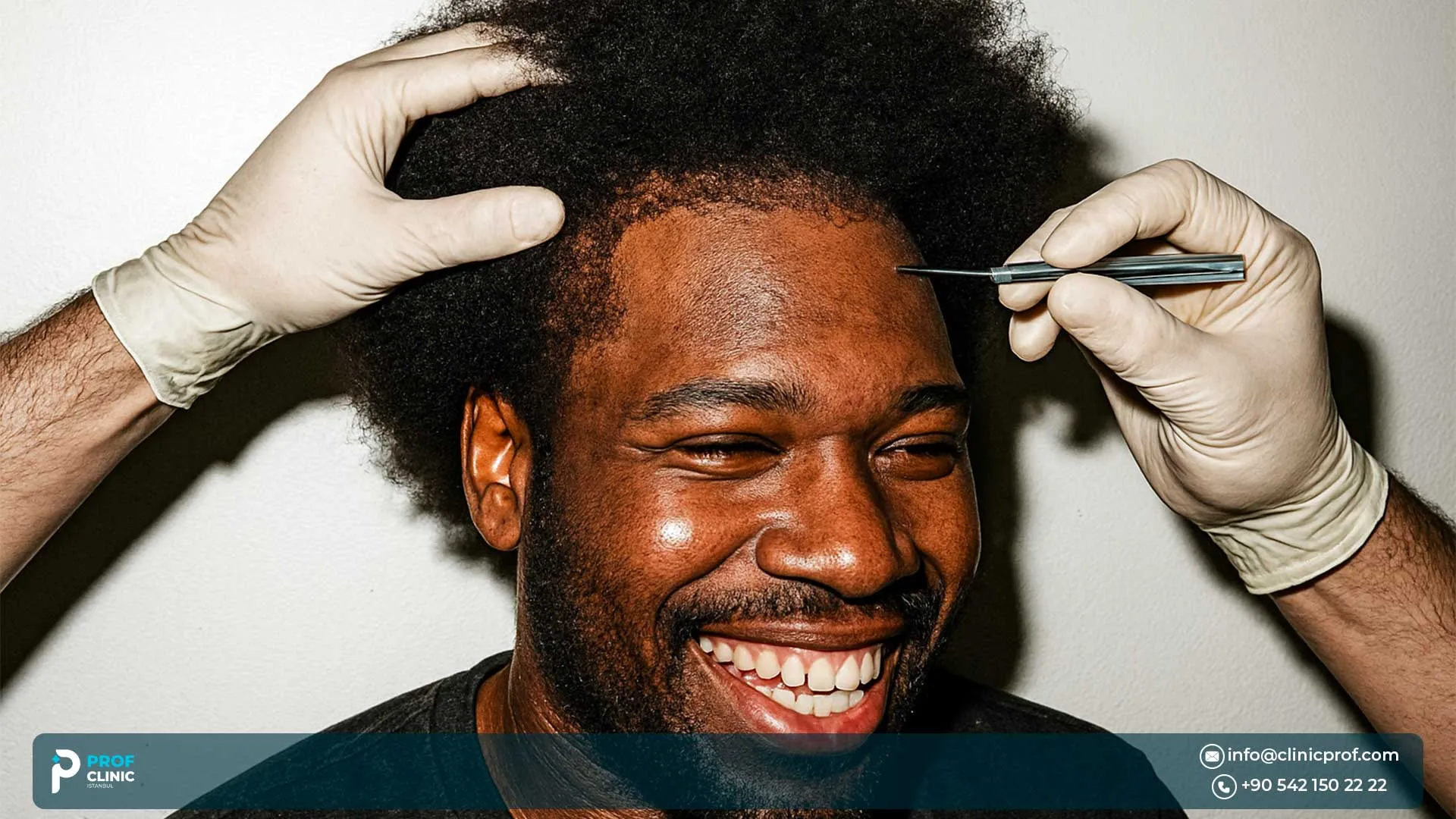
Can you get a hair transplant if you have curly hair? In most cases, yes. A curly hair transplant moves your own curly follicles from the back and sides of the scalp to thinning areas, and the curl usually grows back with them. What changes is the method: curly roots bend under the skin, so they take more care to remove without damage, and the hairline has to follow the way your curls turn.
In this guide by Prof Clinic, you’ll learn who is a good candidate, why curly and Afro-textured follicles are harder to harvest, how FUE, DHI and FUT compare for curly hair, what recovery looks like, and what it usually costs in Istanbul. By the end, you’ll know the questions to ask before you book surgery in Turkey.
Can You Get a Hair Transplant With Curly Hair?
Yes, curly hair can be transplanted, and for many people it gives a fuller-looking result than straight hair would. The procedure follows the same principle as any hair transplant in Turkey: follicles are taken from the donor area, where hair is usually resistant to pattern hair loss, and placed where hair has thinned. The difference lies in how the team harvests, handles and angles curved follicles.
Who Is a Good Candidate?
Your curl type rarely decides whether you can have surgery. These four factors usually do:
- The type of hair loss: the NHS describes hair transplants as suitable for permanent baldness, such as pattern hair loss, but not usually for other types such as alopecia areata.
- A stable scalp: itching, burning, scaling or patchy loss should be diagnosed before surgery, because some of these conditions scar the follicles.
- Enough donor hair: the density and health of the back and sides decide how many grafts can be taken safely, now and in the future.
- Realistic expectations: a transplant redistributes the hair you have; it does not create new follicles.
If two or more of these are uncertain, a medical assessment comes before any talk of graft numbers.
Curly Hair Implants vs a Hair Transplant
“Curly hair implants” usually means a transplant of your own curly follicles, and that is what this guide covers. The phrase is also used to sell synthetic hair fibres, which are a different product. The ISHRS states that the US Food and Drug Administration banned prosthetic hair fibres in 1983 because they could cause serious infections, illness and injury, and the society supports that position. They also note that the fibres neither stimulated hair growth nor concealed baldness.
The practical takeaway: if a clinic offers “curly implants”, ask whether it means your own follicles or artificial fibres before you go any further.
Is Curly Hair Better or Harder to Transplant?
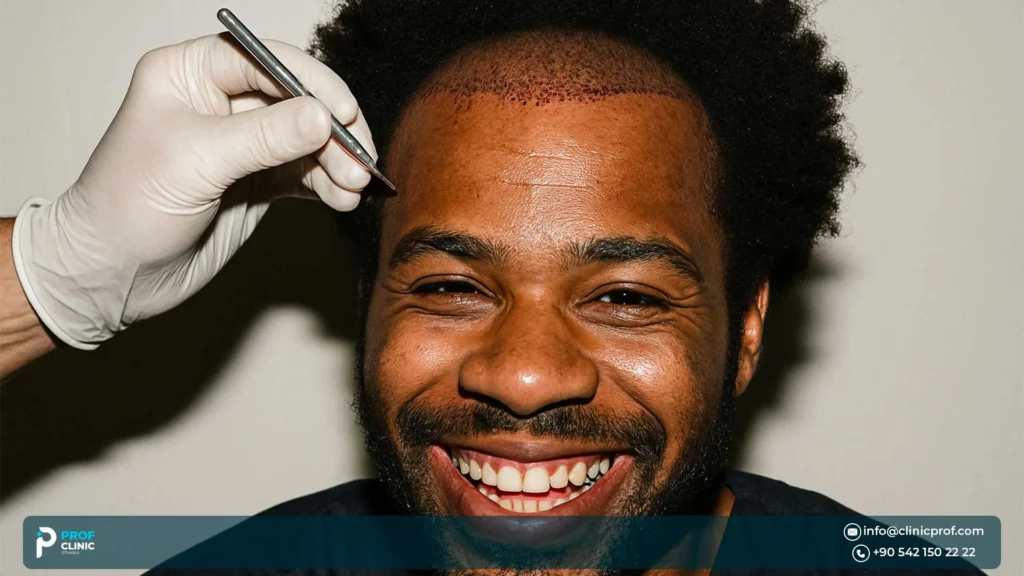
Both. Curly hair is usually better for the final look, because curls cover more scalp, but it is harder for the surgical team, because the roots curve beneath the skin. Understanding both sides explains why curly cases are often planned and priced differently.
Why Curls Give More Coverage
A curly hair bends and overlaps its neighbours, so each graft hides more scalp than a straight hair of the same thickness. The ISHRS notes that the natural curl in hair of Black ancestry usually gives an impression of good density, so fewer donor hairs are needed for a satisfying result. This can make someone a candidate even when a straight-haired patient with similar loss would not be.
There is a catch. The same ISHRS article warns that thick curls can disguise the donor area, making it look denser than it really is. A careful team checks donor density close up rather than judging it by eye.
Why Curly Follicles Are Harder to Extract
Under the skin, a curly or coily follicle often follows a C-shaped or spiral path instead of a straight line. In FUE, a small punch cuts around each graft, and a punch aimed for a straight root can slice through a curved one. Surgeons call this transection. A 2023 multicentre study in Dermatologic Surgery reports that FUE is suboptimal for many patients of African descent because hair and skin characteristics vary so widely, and that thicker, firmer skin affected the transection rate even more than the curl did.
The same study points out that graft damage can vary from one part of the scalp to another in the same person. Teams that do well with curly hair usually:
- Work more slowly: extraction takes longer, which is one reason curly cases cost more.
- Trim and read the donor hair: keeping the hair short shows the true exit angle, as described in the ISHRS article.
- Adapt the punch and depth: to the curl and skin in each zone, rather than using one setting for the whole session.
- Check grafts under magnification: so damaged follicles are noticed early.
Also read: Hair Transplant Donor Area: Healing, Thinning and Limits
Wondering how your donor area looks to a surgeon? Send photos of the back and sides of your head on WhatsApp and ask what they suggest for your curl type.
Afro and Black Curly Hair Transplant: Checks Before Surgery
For tightly coiled or Afro-textured hair, the two checks that matter most are the diagnosis and the skin’s healing pattern. A planned afro hair transplant in Turkey should start with both, because they decide whether surgery is wise at all, not just how it is done.
Rule Out Scarring and Traction Alopecia
Not every hairline loss in curly hair is pattern baldness. The ISHRS lists central centrifugal cicatricial alopecia (CCCA), traction alopecia and dissecting cellulitis among the scalp conditions to consider before surgery in Black patients. A review in the Indian Journal of Plastic Surgery adds that scarring alopecias are usually diagnosed with trichoscopy and a scalp biopsy, and that the common consensus is to wait for about 2 years of inactive disease before transplanting. Even then, graft survival in scarred skin is unpredictable, and a small test session with a 6-month wait may come first.
Traction alopecia deserves special attention. The American Academy of Dermatology (AAD) explains that tight cornrows, locs, braids, buns, ponytails, and extensions or weaves can pull hair out over time, and that the damage can become permanent if the pulling continues. Early signs include broken hairs around the forehead and a receding hairline.
Why this matters to you: if the cause of the loss is still active, new grafts can be lost the same way. Stopping the cause comes first; surgery comes later, if at all.
Keloids, Dark Marks and Healing
Your scarring history matters as much as your hair, so think back: have you ever had raised, thick scars after a cut, piercing or surgery? The ISHRS lists a history of keloid or hypertrophic scarring as a pre-operative factor in Black patients, and notes that darker skin can develop hyperpigmentation at the donor and recipient sites. The 2023 study also cautions that larger punches mean larger wounds, a concern for people already prone to abnormal scarring. Tell your doctor about any such history before the day.
Plan the Hairline for Your Curl Pattern
A natural result depends on direction as much as density. The hairline should suit your face and age, and each graft needs to sit at an angle that lets the curl fall the way your own hair does. According to the ISHRS, many Black patients also prefer a hairline with less temple recession than the typical design for straight hair.
Before you commit, ask the team:
- Can I see results in patients with a curl pattern like mine?
- How do you limit transection when the follicles are curved?
- How will you angle the front grafts so they don’t look stiff or point the wrong way?
- What hairstyles should I avoid during recovery, and for how long?
Also read: 4C Hair Transplant: Special Considerations for Type 4 Coily Hair
FUE, DHI or FUT for a Curly Hair Transplant?
Neither technique is right for every curly-haired patient. The label matters less than the team’s skill with curved follicles: protecting them during harvesting and placing them at angles that match your curl. Here is how the three options compare:
- FUE (follicular unit extraction): grafts are removed one by one with a small punch, leaving tiny dot scars.
- DHI (direct hair implantation): usually FUE harvesting, followed by placement with an implanter pen that loads and inserts each graft.
- FUT (strip method): a thin strip of scalp is removed and divided into grafts under magnification, leaving one linear scar.
| Technique | What it means for curly hair | Usually suits | Main trade-off |
|---|---|---|---|
| FUE | Curved roots raise the risk of transection unless the approach is adapted | People who wear their hair short and want to avoid a linear scar | Slower and more skill-dependent in tight curls |
| DHI | The implanter gives fine control of angle and direction at the hairline | Hairline work where curl direction matters most | Same harvesting challenge as FUE; quality varies by team |
| FUT | Grafts are separated under magnification, where the curve can be seen and followed | People who keep their hair long enough to cover a scar | Linear scar that may show with very short haircuts |
The NHS notes that the FUT scar should not be visible unless you have very short hair, which is the key point for many men with Afro-textured hair. The 2023 Dermatologic Surgery study observes that these men often have the least tolerance for a linear scar because they prefer close-cropped styles, which is why FUE is so often requested despite the extra difficulty.
Some simple decision rules:
- Lean towards FUE or DHI if you keep your hair short and the team can show curly or coily cases like yours.
- Consider FUT if protecting every graft matters most to you and your hairstyle will cover a fine linear scar.
- Avoid one-size packages: ask for a plan based on your safe donor zone, curl tightness and skin type.
For a closer look at the two most requested methods, see FUE vs DHI for coily and curly hair.
Not sure which method fits your hair? Book a consultation and ask for a written recommendation that explains the reasoning.
What Happens on the Day of a Curly Hair Transplant
A curly hair transplant usually takes a full day and follows a set sequence. The NHS says most hair transplants are done under local anaesthetic and sedation, so you stay awake but should not feel pain, and you don’t normally need to stay overnight. A typical day runs like this:
- Final review: photos, consent and confirmation of the hairline design.
- Trimming or shaving: the donor area is cut short, partly so the team can read the exit angle of each curl.
- Local anaesthetic: the donor and recipient areas are numbed.
- Harvesting: FUE extraction or removal of the FUT strip, usually at a slower pace for curly hair.
- Graft preparation: grafts are sorted and checked under magnification.
- Placement: recipient sites are opened and grafts inserted, or placed directly with an implanter pen.
- Aftercare briefing: washing, sleeping position and activity limits are explained before you leave.
If your loss covers a large area, the NHS notes that two or more sessions may be needed.

Recovery and Aftercare for Curly Hair
Recovery after a curly hair transplant follows the same early pattern as any transplant, with one extra rule: keep tension off the scalp. The NHS describes a tight, achy and swollen scalp for a few days, with temporary scabbing, and says you may need 1 to 2 weeks off work.
The general aftercare instructions from medical sources focus on protecting the grafts while they settle:
- Follow the washing instructions you are given exactly, both timing and technique.
- Don’t scratch, pick at scabs or rub the grafted area.
- Keep tight hats, helmets and hard pillows away from the grafts in the first days.
- Protect your scalp from strong sun while it heals.
- Avoid hard exercise and heavy sweating until your doctor says it is safe.
For curly and coily hair, add these:
- No pulling styles at first: skip braids, cornrows, ponytails and loc retwists until your doctor clears you. The AAD advises loosening braids around the hairline and wearing them for no longer than 6–8 weeks once you do.
- Gentle detangling: use your fingers or a wide comb and work slowly, away from new grafts.
- Pause chemical treatments: relaxers, bleach and dye should wait until your doctor says the scalp has healed.
- Watch for ingrown hairs: the ISHRS notes that ingrown hairs or folliculitis can appear 2–3 months after surgery in Black patients and are usually treated with antibiotics.
Spreading redness, pus, fever, or pain that gets worse rather than better is not normal healing. The NHS lists bleeding, infection and allergic reactions among the small risks, so contact your clinic promptly if you notice any of them.
Will Transplanted Hair Stay Curly?
Usually, yes. Transplanted follicles tend to keep the character of the area they came from, including colour, thickness and curl. In a study of 35 men in the Indian Journal of Plastic Surgery, beard and body hair moved to the scalp kept its colour, curl and calibre over follow-up of 6 months to 2 years. Curly scalp hair moved from the back of the head behaves the same way.
Two points are worth knowing:
- Early growth can look different: the first new hairs are often finer or frizzier than the hair around them and settle as they mature.
- Angles shape the result: healthy curly hairs can still look unnatural if they were placed at the wrong angle or direction.
If you have straight hair and notice curly hair after a hair transplant, it is usually the early-growth stage rather than a permanent change. Give it time, and ask your doctor to review it if it hasn’t settled once the result has matured.
When Will You See the Result?
Patience matters more than usual with curly hair, because new curls take time to gain length and spring. The NHS says new hair usually starts to appear after about 4 months, and full results should be seen after 10 to 18 months. These are typical ranges, not fixed rules.
Also read: Curly Hair Transplant Before and After: Results, Texture & Timeline
To see how curly and Afro-textured cases develop, browse our before-and-after gallery.

How Much Does a Curly Hair Transplant Cost in Turkey?
As a general guide, a curly or Afro-textured hair transplant in Istanbul costs about €2,500–€4,500 as a package. This is an approximate range as of October 2026, not a final price. It sits above a standard scalp transplant because curved follicles take longer to extract and need more careful handling.
The final figure depends on:
- How many grafts your plan needs and how much donor hair is available.
- How tight your curl is and how thick and firm your scalp skin is.
- The technique chosen for your case.
- Whether the work is done in one session or two.
Packages usually include the procedure, pre-op blood tests, medication and an aftercare kit, hotel accommodation, and VIP airport and hotel transfers. For a detailed breakdown, see Afro hair transplant cost in Turkey.
Comparing quotes? Ask for an itemised written quote that shows what is included and what isn’t.
Prof Clinic for Curly and Afro Hair Transplants in Istanbul
At Prof Clinic, a curly hair transplant in Istanbul starts with a medical assessment, not a graft count. The medical lead for hair restoration, Spc. Dr. Lütfi Öztürk, is an internal-medicine specialist who carries out the medical assessment and treatment planning and coordinates follow-up.
Here is what you can check before you travel:
- Afro and curly hair as a named service: the clinic lists Afro hair transplants among its hair services, alongside men’s, women’s, beard and eyebrow work.
- Techniques: FUE, DHI, Sapphire FUE and Micro FUE, with the method chosen after your hair and scalp are assessed.
- Pre-op tests: blood count, ECG, kidney and liver function, electrolytes, blood sugar, and hepatitis and HIV screening before surgery.
- Honest expectations: expected density is discussed individually, and no specific density is promised in advance.
- A written quote: sent after the team reviews your photos, for an all-inclusive package covering the procedure, accommodation, transfers and post-op care.
- Follow-up after you fly home: the coordination team stays in touch and gives advice over WhatsApp.
FAQs About Curly Hair Transplants
Can you get a hair transplant with curly hair?
Yes, in most cases. Eligibility depends on the type of hair loss, the strength of your donor area and the health of your scalp, not on the curl itself. Pattern hair loss is usually suitable, while active scarring alopecia or ongoing traction loss needs diagnosis and treatment first. A team experienced with curved follicles matters more than the technique name.
Is curly hair harder to transplant?
Usually, yes, especially tightly coiled hair. The roots curve under the skin, so a punch aimed for a straight follicle can cut through them. Research in patients of African descent also shows that thick, firm scalp skin makes extraction harder. Experienced teams slow down and adapt their tools to reduce graft damage.
Do curly hair implants work?
If “implants” means transplanting your own curly follicles, yes, it is an established procedure. If it means synthetic hair fibres, be cautious. The ISHRS supports the US FDA ban on prosthetic hair fibres, which dates from 1983, because they could cause serious infections and injury. Always ask which one a clinic is offering.
Will my transplanted hair stay curly?
Usually, yes. Transplanted follicles keep the characteristics of their donor area, including curl and thickness. The first new hairs can look finer or frizzier while they grow in, and the final texture is easier to judge after about a year. Correct graft angles are what make the curls fall naturally.
Do you need fewer grafts with curly hair?
Often, yes. Curls overlap and hide more scalp, so fewer donor hairs can create a satisfying look of density, as the ISHRS notes. The exact number still depends on the area to cover and your donor supply. Curls can also make the donor area look denser than it is, so it should be measured, not guessed.
Can I braid my hair after a hair transplant?
Not straight away. Braids, cornrows and other tight styles pull on the scalp and should wait until your doctor confirms the grafts are secure. When you return to them, the AAD advises keeping braids loose around the hairline and wearing them for no longer than 6–8 weeks, so traction does not damage new or existing hair.
Final Thoughts
A curly hair transplant is usually possible and often gives excellent coverage, because curls hide more scalp than straight hair. Success depends on three things: confirming the cause of your hair loss, a team that can harvest curved follicles without damaging them, and a hairline designed around your curl pattern. Recovery asks for patience and no tight styles in the early months.
The safest first step is an assessment, not a booking. Contact Prof Clinic with photos of your hair and scalp, and ask for a written plan explaining what is realistic for your curls.
Sources
- ISHRS — Hair Restoration in African-Americans
- ISHRS — Prosthetic Hair Fibers (Position Statement)
- NHS — Hair transplant
- American Academy of Dermatology — Hairstyles that pull can lead to hair loss
- Dermatologic Surgery — Follicular Unit Excision in Patients of African Descent: A Skin-Responsive Technique (Umar et al., 2023)
- Indian Journal of Plastic Surgery — Role of Hair Transplantation in Scarring Alopecia: To Do or Not to Do (Singh & Muthuvel, 2021)
- Indian Journal of Plastic Surgery — Use of Body and Beard Donor Hair in Surgical Treatment of Androgenic Alopecia (Poswal, 2013)