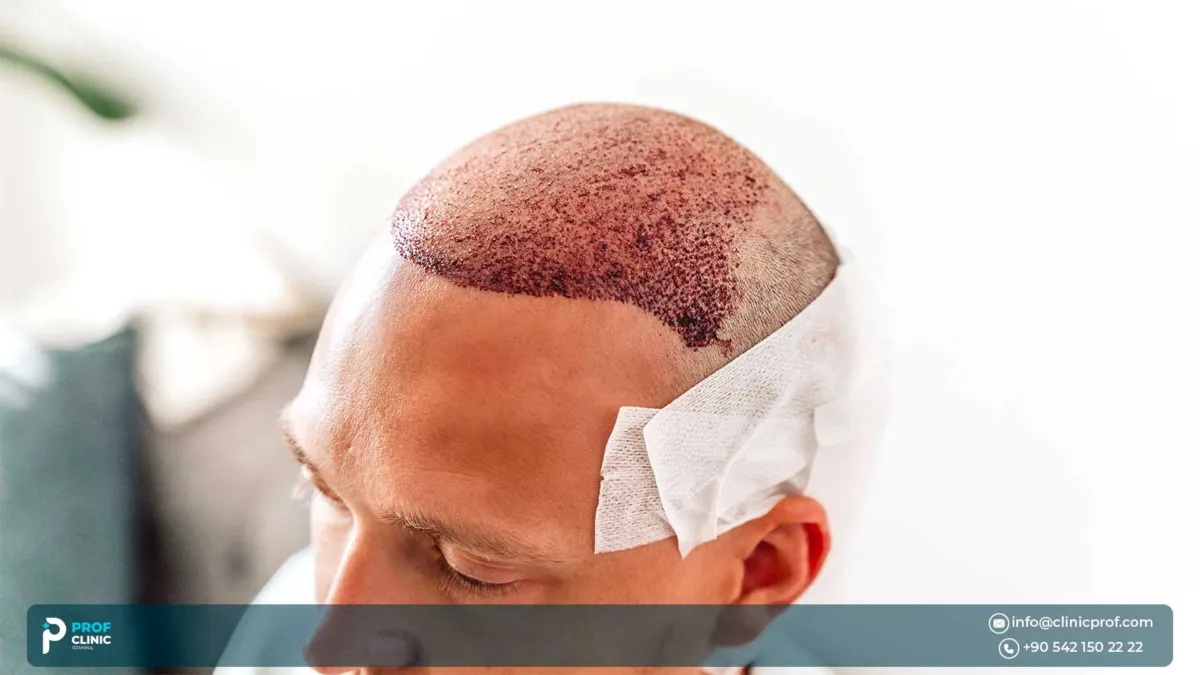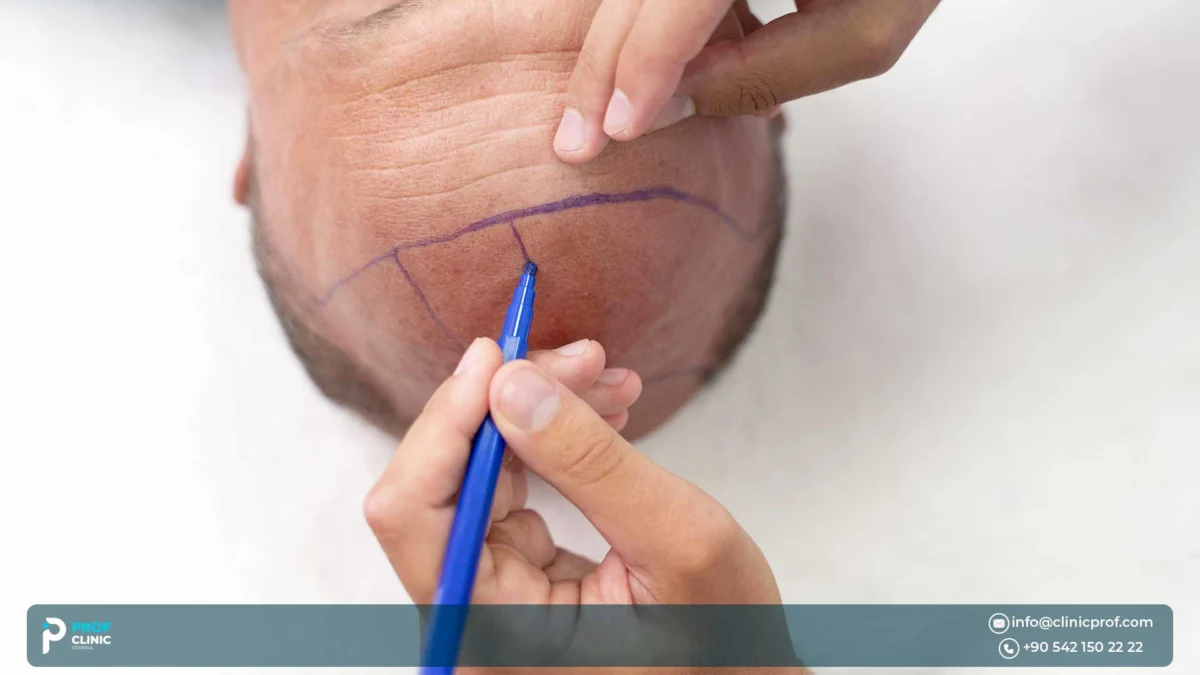
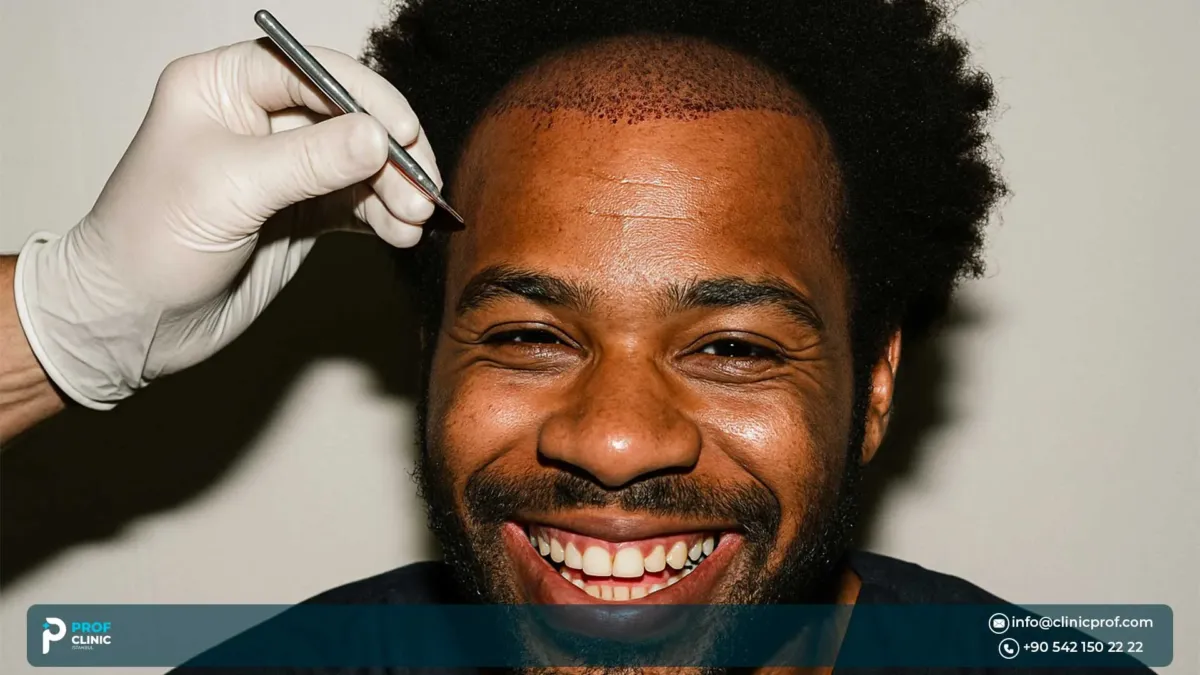
When you compare a curly hair transplant before and after, will the result look natural, and will the new hair actually grow back curly? In most cases, yes. Transplanted hair keeps the texture of the donor hair it came from, so curls return as curls, and their spiral shape often makes the result look fuller than the same number of straight hairs would. The catch is timing: a curl needs length before it shows, so early regrowth can look quite different from the final result.
In this guide by Prof Clinic, you’ll learn why texture stays the same after surgery, what curly hair looks like month by month after a transplant, how your curl type shapes the result, and how to style or straighten safely once you’ve healed. By the end, you’ll know what a fair before-and-after comparison for curly hair should show.
Curly Hair Transplant Before and After: What Really Changes
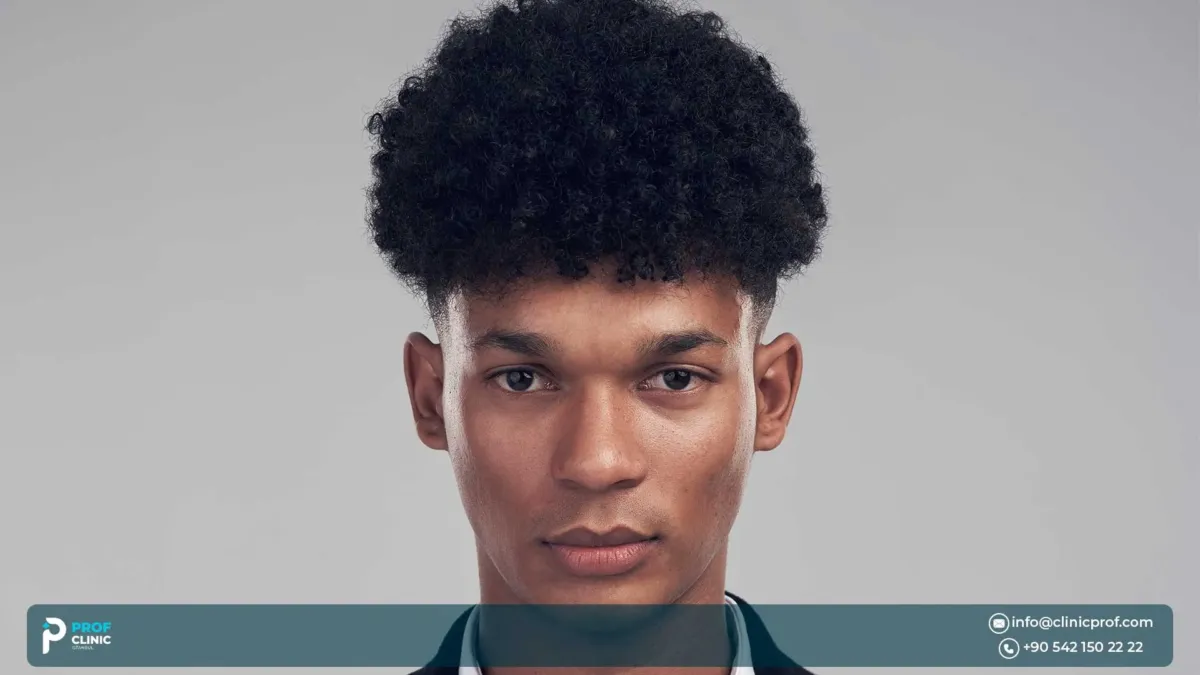
The main change you see in a curly hair transplant is coverage: thinning or bald areas fill with hair that grows in the same curl pattern as the rest of your head. What doesn’t change is the hair itself. Its colour, thickness and curl come from the donor area, usually the back and sides of the scalp, so the aim is to match your own hair, not to create a new texture.
Here’s what a typical comparison shows once the result has matured:
- Hairline and temples: a filled, softly defined hairline where skin showed before, with curls framing the face rather than a hard edge.
- Coverage: less scalp visible from the front and top, because each curl spreads across more surface than a straight hair.
- Texture match: new hairs that blend with your native curls once they reach a similar length.
- Donor area: shorter, slightly sparser-looking hair at the back for a while as the extraction sites heal and the hair grows out.
- What stays the same: your curl pattern, your hair colour and any ongoing thinning in areas that weren’t treated.
What it means in real life: the most convincing curly before-and-after photos don’t look like a different person. They look like the same hair, with less scalp showing.

Will Transplanted Hair Stay Curly?
Yes. In most cases, curly hair after transplant keeps the curl, colour and thickness it had in the donor area, because those traits are set by the follicle, not by the skin it’s moved into. Hair restoration surgeons call this donor dominance, and it is the reason a transplant can match your hair at all.
The research supports it. In a 2002 study in Dermatologic Surgery, Hwang and colleagues examined 12 patients about a year after hair was moved from the back of the scalp to the front, and found no significant difference in growth rate or shaft thickness compared with the donor hairs. A 2013 study of 35 men in the Indian Journal of Plastic Surgery reached the same conclusion for beard and body hair moved to the scalp: it kept its colour, curl and calibre at follow-ups of six months to two years.
The new location isn’t completely irrelevant. In another part of the same 2002 study, scalp hairs moved to the lower leg grew more slowly, which suggests the recipient site can affect growth rate and survival. For scalp-to-scalp transplants, though, the texture you start with is the texture you keep.
Can a Hair Transplant Change Hair Texture?
No. A hair transplant can’t turn curly hair straight or straight hair curly, because it relocates follicles rather than reprogramming them. If your hair is wavy at the back of the head, it will grow wavy at the hairline. The texture of a transplanted area can only differ when the donor hair itself is different, for example when beard or body hair is used to add grafts. That hair keeps its own coarser, curlier character, so it usually suits areas where it blends in, such as the crown, better than the front hairline. Our guide to body hair transplant (BHT) explains when beard or chest hair can help and where it falls short.
Why Early Regrowth Can Look Different
The first hairs to appear often look finer, straighter or frizzier than the rest of your curls, and this is the stage that worries curly-haired patients most. New hairs are short and thin when they first come through, and a curl needs some length and thickness before its pattern becomes visible. As the hairs grow and mature over the following months, they usually settle into the same pattern as your native hair.
A useful rule here is the length test: judge texture by length, not by date. A very short hair can’t show the full pattern of a loose curl, so compare transplanted hairs with native hairs of the same length. If the texture still looks clearly different once the hairs are long and the result has matured, raise it at your follow-up.
Curly Hair After Hair Transplant: Month by Month
Curly hair after a hair transplant follows the same growth cycle as any transplanted hair: shedding within weeks, a quiet resting phase, then gradual regrowth that turns visibly curly as it gains length. The NHS says new hair usually starts to appear after about four months and that the full result should be seen after 10 to 18 months. The American Academy of Dermatology (AAD) adds that transplanted hair usually falls out two to eight weeks after surgery and that most patients see results between six and nine months.
This table follows what happens to the curl itself:
| Timepoint | What you may see | What the curl is doing |
|---|---|---|
| Weeks 1–2 | Small crusts, redness and short stubble at the graft sites | Nothing visible yet; the hair shafts are very short |
| Weeks 2–8 | Most transplanted hairs shed while the follicles stay in the skin | Resting; the area may look much as it did before surgery |
| Months 2–3 | Fine first hairs, sometimes with small bumps or ingrown hairs | New hairs too short to show a curl |
| Months 4–6 | More hairs come through, often finer than your native hair | A wave or loose bend may appear as the hairs lengthen |
| Months 6–9 | A clear change in coverage for many patients | The pattern becomes recognisable and starts to clump with native curls |
| Months 10–18 | The mature result, with thickness still improving in some areas | Curls usually blend with native hair of a similar length |
Treat these as usual ranges rather than fixed rules. Tight coils can show their pattern sooner than loose waves, and the crown usually matures last. For the general process in more detail, our guide to the hair transplant timeline month by month covers each stage, from shedding to the mature result. If the shedding in weeks 2 to 8 worries you, our guide to shock loss after a hair transplant explains what is normal and when the hair returns.
Months two and three have a curly-hair quirk. ISHRS member William D. Yates notes that folliculitis and ingrown hairs can appear two to three months after surgery, as curly hair starts to grow back through the skin. Some small spots around the new curls are normal at this point, but if they hurt, spread or fill with pus, show them to your clinic.

Also read: Afro Hair Transplant Before and After: Real Results and Timeline
Wondering whether your regrowth is on track? Send your photos to the Prof Clinic team on WhatsApp with the date of your procedure, and ask where your curl pattern should be by now.
Why Curly Hair Transplant Results Often Look Denser
Curly hair transplant results often look denser than straight-hair results with a similar number of grafts, because each curl lifts away from the scalp and covers more surface. Yates writes that the characteristic curl of hair in people of Black ancestry usually gives an impression of good density, so fewer donor hairs are needed to create a satisfactory look. The same effect applies, to a lesser degree, to looser curls and waves.
There is a trade-off. Yates also warns that thick curl can disguise donor density, making the donor area appear denser than it really is. Curls may give more coverage per graft, but your donor supply is still limited, which is why a careful plan for an afro hair transplant counts the grafts available, not just how full the hair looks.
Wavy, Curly or Coily: How Curl Type Shapes the Result
Curl type changes what a before-and-after looks like, and what you can reasonably expect from it:
- Wavy hair: a modest coverage gain over straight hair. Hairline design and graft direction stay quite visible, because loose waves lie closer to the scalp.
- Curly hair (ringlets and spirals): strong coverage once the curls reach a few centimetres. Results often look fullest when the hair is worn at medium length.
- Coily and Afro-textured hair: the most coverage per graft, but the follicles curve under the skin, which makes extraction more demanding. Bumps and ingrown hairs in early regrowth are also more likely.
However curly your hair is, the hairline still needs a soft, slightly irregular edge, because curls make a hard, straight line more noticeable, not less. If your hair is type 4 or very tightly coiled, our guide to 4C hair transplants for type 4 coily hair covers the extra planning points.
How to Read Curly Hair Before-and-After Photos
Curly hair before-and-after photos are only fair when the curls are shown in the same state each time. Shrinkage, styling products and hair length can make the same result look thin in one picture and full in the next.
Check these points before you trust a comparison:
- Same curl state: both photos dry, or both wet. Stretched or blow-dried curls look longer and cover more.
- Similar length: a 12-month photo with longer curls will look fuller than a 4-month photo, even with the same grafts.
- Defined or natural: gel, mousse or a fresh twist-out adds definition the hair may not have on an ordinary day.
- Hairline close-ups: you should see the direction of the first rows of curls, not just a well-framed face.
- The donor area: the back of the head should look healed and evenly covered.
The same patience applies to any hair type; our overview of hair transplant results and the right time to assess them gives the broader picture.
Want to see how curly cases develop over time? Browse the Prof Clinic before-and-after gallery and use this checklist as you look.

Styling Curly Hair After a Hair Transplant
You can usually return to your normal curly routine once the grafts are secure and your doctor has cleared you, but the first weeks call for a very gentle approach. The NHS says you need to be very careful with transplanted hair for the first two weeks after the operation. The points below are general guidance from medical sources; always follow the written aftercare instructions from your own doctor.
- The first two weeks: wash only as instructed, don’t rub or pick the crusts, and keep combs, picks and tight headwear away from the grafts.
- Products: hold off on gels, oils and leave-in creams on the grafted area until your doctor approves them.
- Heat: once you’re cleared, the AAD recommends a ceramic comb or iron no more than once a week, at the lowest temperature that gives you the style you want.
- Tension: the AAD advises making sure braids, cornrows and weaves are not too tight, and asking the stylist to stop and redo them if it hurts.
- Moisture: the AAD suggests using conditioner every time you wash, paying attention to the ends.
Can You Straighten Curly Hair After a Transplant?
You can, once you’re fully healed and your doctor agrees, but straightening never changes the hair that grows in. A 2022 review in Anais Brasileiros de Dermatologia explains that permanent chemical straighteners are permanent only in the area treated, so new growth keeps its natural curl. That’s why relaxed hair needs touch-ups, which the AAD says should be done only every two to three months, only on newly grown hair and by a professional stylist.
The same review links chemical straighteners to scalp inflammation, damage to the hair shaft and hair loss in some studies, so ask your doctor how long to wait before using one near transplanted follicles. Heat straightening lasts only until your next wash; if you use it, follow the once-a-week, low-temperature advice above.
When a Curly Hair Transplant Result Disappoints
Most disappointing curly results come down to timing, direction or donor supply rather than the hair changing texture. Knowing the usual causes helps you ask the right questions at your follow-up:
- Judging too early: the NHS gives 10 to 18 months for the full result, and a curl pattern can take much of that time to show.
- Wrong angle or direction: curls exaggerate misdirected grafts, so poor placement shows more on curly hair than on straight hair. If the hairline itself looks wrong, see how an unnatural hairline is corrected.
- Mismatched donor hair: beard or body hair keeps its own curl and calibre, so it can stand out if it is placed at the hairline.
- Limited donor supply: curls hide small gaps, but they can’t make up for grafts that weren’t available.
- Ongoing hair loss: the AAD notes that hair loss and thinning can continue after a transplant, so native hair around the grafts may change over time.
- Bumps and ingrown hairs: common during curly regrowth, but persistent or painful bumps need treatment.
Curly Hair Implants vs a Curly Hair Transplant: What Is the Difference?
People who search for curly hair implants usually mean one of two things. If you mean a hair transplant, the answer is the one above: your own follicles are moved and keep their curl. If you mean a quick fix with synthetic curls, that is a different and riskier procedure. The ISHRS aligns with the US Food and Drug Administration (FDA), which banned prosthetic hair fibres in 1983 and warns that they could cause serious infections, illness and injuries. A hair transplant uses your own follicles, which is why it keeps growing and matches your curl.
Still deciding whether your curls make you a candidate? Our guide to whether curly hair can be transplanted covers suitability before you get to results.
Worried your curls aren’t growing in as expected? Contact the Prof Clinic team with dated photos taken in the same light, and ask for a review of your timeline.
Prof Clinic for Curly Hair Transplants in Istanbul: Planning Around Your Curl
At Prof Clinic in Istanbul, a curly and Afro hair transplant in Turkey starts with an assessment of your curl pattern, donor area and hair-loss stage. Your curl-specific plan is drawn up by Spc. Dr. Lütfi Öztürk, the internal-medicine specialist who leads hair restoration at the clinic: he handles the medical assessment and treatment planning, then coordinates follow-up while the curls grow in.
Before booking, these are the points you can verify:
- Techniques: curly hair is part of the clinic’s wider hair transplant in Turkey service, using FUE, DHI or Sapphire FUE depending on your hair texture and scalp.
- Pre-op tests: before any grafts are taken, you have a blood count, an ECG, kidney and liver function tests, electrolytes and blood sugar, plus hepatitis and HIV screening.
- Honest expectations: coils cover more scalp than straight hair, but the density you can expect is still discussed for your own case, and no figure is promised beforehand.
- A written quote: the team looks at photos of your curls and donor area first, then sends the price in writing; the package covers the procedure, accommodation, airport and hotel transfers, and post-op care.
- Follow-up from home: while your curls grow back over the following months, the coordination team keeps in contact and answers your questions on WhatsApp.
As a general guide, a curly or Afro hair transplant in Istanbul costs about €2,500–€4,500, because extracting curved follicles is slower and takes more time. Looser waves may fall closer to the standard scalp range of about €1,800–€3,500. Both are approximate 2026 ranges, not final prices; your price depends on your case after assessment and is confirmed in the written quote.
Ready to find out what your curls could cover? Book a free online consultation and share photos of your hair dry and at its usual length.
FAQs About Curly Hair Transplant Before and After
Does transplanted hair stay curly?
Yes, in most cases. Transplanted follicles keep the curl, colour and thickness of the donor area, a principle known as donor dominance. The first regrowth can look finer or straighter because the hairs are short and immature, but they usually settle into your natural pattern as they lengthen over the following months.
Can a hair transplant change hair texture from curly to straight?
No. A hair transplant moves follicles; it doesn’t change what they produce. Curly donor hair grows back curly, and straight donor hair grows back straight. The only real difference comes from using another donor source, such as beard hair, which keeps its own coarser texture wherever it is placed.
How long before transplanted hair comes in curly?
Usually somewhere between months four and nine. New hair often starts to appear around month four, but it is short and fine at first, so the curl shows only as the hairs lengthen. By months six to nine many patients can see their pattern, and the NHS says the full result can take 10 to 18 months.
Why does my transplanted hair look frizzy or wiry?
Early regrowth is often finer and less defined than mature hair, so it can look frizzy, wiry or oddly straight for a while. This usually improves as the hairs thicken and lengthen. If the texture still looks clearly different after a year, or the area has painful bumps, ask your clinic to review it.
Do curly hair transplant results look denser than straight hair?
Often, yes. Curls lift away from the scalp and cover more surface, so the same number of grafts can give a fuller look than straight hair. In an ISHRS article, Yates notes that this curl effect means fewer donor hairs may be needed for a satisfactory impression of density, though donor supply is still limited.
Can I straighten or relax my hair after a hair transplant?
Only once you’re fully healed and your doctor agrees. Chemical straightening affects only the hair it touches, so your new growth will still come in curly. Relaxers have been linked to scalp irritation and hair loss, so ask how long to wait, and follow the AAD’s advice to touch up only new growth, every two to three months.
Final Thoughts
A fair curly hair transplant before and after shows the same hair with less scalp, not a new texture. Your follicles keep their curl, so the real questions are how much donor hair you have, how carefully each graft is angled and how patiently you wait, since a curl can take much of the 10–18-month growth period to show. Judge the result by curl state, length and light, not by a single photo.
The safest first step is an honest look at your curl pattern and donor area. Talk to Prof Clinic and ask for a written plan before you book.
Sources
- NHS — Hair transplant
- American Academy of Dermatology — A hair transplant can give you permanent, natural-looking results
- ISHRS — Hair Restoration in African-Americans (Yates)
- Dermatologic Surgery — Does the Recipient Site Influence the Hair Growth Characteristics in Hair Transplantation? (Hwang et al., 2002)
- Indian Journal of Plastic Surgery — Use of Body and Beard Donor Hair in Surgical Treatment of Androgenic Alopecia (Poswal, 2013)
- American Academy of Dermatology — Black hair: Tips for everyday care
- Anais Brasileiros de Dermatologia — Effects of Chemical Straighteners on the Hair Shaft and Scalp (Hatsbach de Paula et al., 2022)
- ISHRS — ISHRS Aligns with U.S. FDA: Exploring the Role of Prosthetic Hair Fibers