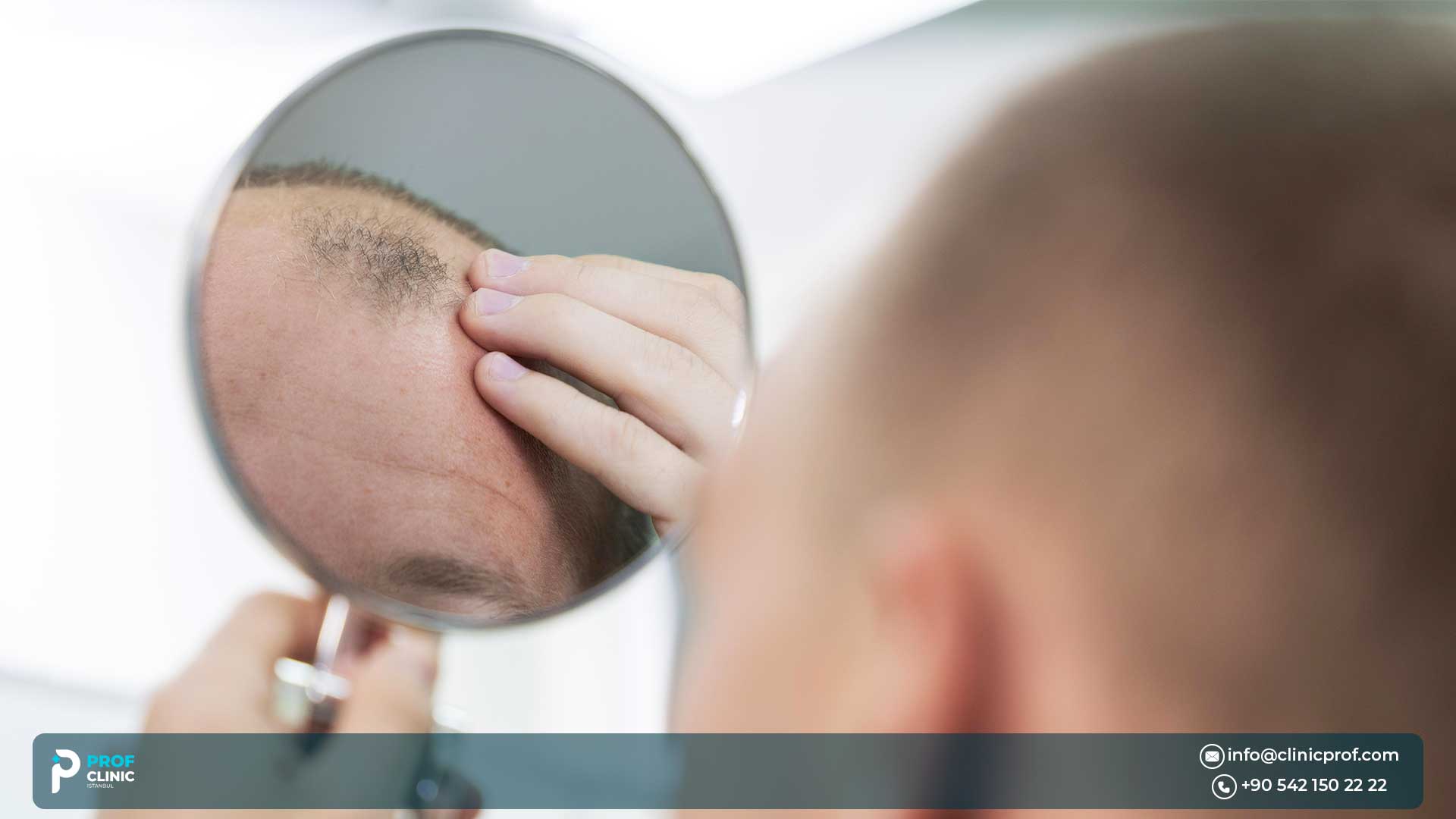
What happens to the hair transplant donor area after surgery, and will the back of your head ever look the same? For most people, the donor area heals within about two weeks and, once the shaved hair grows back, looks much as it did before, with a slight drop in density that is hard to spot. The real limit is supply: every graft moved to the front is gone from the back for good, so how many are taken, and from where, matters more than the name of the technique.
In this guide by Prof Clinic, you’ll learn how much your donor can usually give, what donor area recovery looks like week by week, how to tell normal thinning from an overharvested donor, what FUE and FUT scars look like, and what the options are when the donor is weak. By the end, you’ll know what to ask before anyone plans your graft count.

What Is the Hair Transplant Donor Area, and Why Is It Limited?
The donor area is the band of hair at the back and sides of the scalp that supplies the grafts for a transplant. A 2026 review in Frontiers in Medicine describes the occipital and parietal regions as the “safe donor area” because their hair tends to stay more stable in male and female pattern hair loss. The same review stresses that the boundaries are not fixed: they vary from person to person, especially in younger patients and in people whose hair is also thinning from the bottom up.
The American Academy of Dermatology puts the first condition for a transplant simply: you need enough healthy hair on your scalp to move to the area that needs it. A hair transplant in Turkey or anywhere else does not create new hair. It redistributes follicles you already have.
The Donor Budget: Why Every Graft Counts
It helps to think of the donor area as a budget with no top-ups. Each follicle removed is a permanent withdrawal, and hair loss elsewhere may keep progressing. The NHS notes that your hair may keep thinning around the transplant, which is why a plan that spends the whole budget at 28 can leave nothing for the crown at 40.
Why this matters to you: the most important number in your plan is not how many grafts you can have today, but how many you will still have in reserve if you need a second session later.
How Many Grafts Can Your Donor Area Safely Give?
There is no universal number. How much a donor can give depends on its density, the size of the safe zone, the thickness and curl of the hair, and how far your hair loss is likely to progress. Published guidance varies, which is itself telling. The Frontiers review notes that many authors recommend taking about 10–20% of the donor’s baseline follicular unit density per session, and that the risk of overharvesting rises in sessions above 3,000–4,000 grafts and when donor density is low. A 2018 study in the World Journal of Plastic Surgery suggested staying below 35% of density in a first session and 10–20% in a second, and warned that harvesting beyond the safe donor area turns it into a “danger zone”.
These figures are guides for surgeons, not targets for patients. Two people with the same Norwood stage can have very different budgets, and a responsible plan is built around your scalp, not a package size.

What Decides Your Donor Capacity
The table sums up the main factors and which way each one pushes.
| Donor factor | Works in your favour | Limits what can be taken |
|---|---|---|
| Density | Many follicular units per square centimetre | Low density, where gaps show sooner |
| Hair thickness | Coarse hair covers more scalp per graft | Fine hair, which needs more grafts for the same look |
| Curl and colour | Wavy or curly hair; low contrast between hair and skin | Straight dark hair on pale skin, which shows thinning easily |
| Safe zone size | A wide, stable band at the back and sides | A narrow band, or thinning in the donor itself |
| Future hair loss | Stable loss in an older patient | Young age or a strong family history of extensive loss |
If you’re a man with advancing loss, the planning approach on our male hair transplant in Turkey page explains how the pattern and the donor are assessed together.
Also read: How Many Grafts Do I Need? Graft Count by Norwood Stage
14 Things to Check Before Anyone Plans Your Donor Harvest
Before you agree to a graft number, make sure these points have been covered:
- Donor photos: clear pictures of the back and sides, not just the front.
- Density check: whether your donor density has been estimated, and how.
- Miniaturisation: whether hairs in the donor itself show signs of thinning.
- Safe zone: where the extraction area will start and stop.
- Graft number: the planned count, and the reason for it.
- Reserve: what would be left for a possible second session.
- Future loss: how your likely progression has been factored in.
- Technique: FUE, DHI or FUT, and why it suits your donor.
- Spacing: how extraction will be spread so no patch is emptied.
- Punch size: the tool size, which affects how visible the dots are.
- Haircut plans: whether you want to wear your hair very short later.
- Scar history: any keloid or poor scarring in you or your family.
- Medication: whether treatment to slow ongoing loss has been discussed.
- Follow-up: who checks the donor after you fly home, and how.
A clinic that answers these questions clearly is planning for your hair at 50, not just your photos at 12 months.
Hair Transplant Donor Area Recovery: Days 1–14 and Months 1–3
Donor area recovery usually happens in two stages: the skin closes within about two weeks, while the hair around it takes a few months to look fully normal again. With FUE, the Frontiers review notes that crusts usually appear 2–10 days after surgery and clear by about day 7–10 with proper care. The NHS describes a tight, achy and swollen scalp for a few days, with temporary scabbing.

The First Two Weeks
Here’s what most people notice, by timing:
- Days 1–3: the donor feels tight and tender, with pinpoint red marks or, after FUT, a stitched line.
- Days 2–7: small crusts form over each extraction site. Itching or a mild burning feeling can come and go as the skin heals.
- Days 7–10: most FUE crusts have come away with gentle washing, leaving pink dots that fade over the following weeks.
- Days 10–14: after FUT, the NHS says non-dissolvable stitches are usually removed at this point. Most people need 1–2 weeks off work.
These are typical ranges, not fixed rules. Session size, technique and your skin can all shift them.
Months 1–3: Regrowth, Donor Shock Loss and Numbness
The shaved donor hair grows back at its normal pace and usually covers the extraction dots within weeks. A few people notice a patch that looks thinner than expected after 2–4 weeks. This is donor effluvium, a temporary shedding of hairs near the extraction sites; the Frontiers review says it usually resolves by 3–6 months.
Numbness or tingling in the donor is also common early on, because small skin nerves are cut by the punches. It usually fades; in persistent cases, full recovery typically comes within 4–8 months, and long-term numbness was reported in about 2% of patients in one large FUE series.
Washing, sleeping and the first month of care are covered step by step in our aftercare guide, so we keep it short here: keep the donor clean, don’t pick the crusts, and follow your surgeon’s washing plan.
Also read: Hair Transplant Aftercare: Day-by-Day Guide to the First 30 Days
Not sure if your donor is healing as it should? Send a photo of the back of your head to our team on WhatsApp rather than guessing.
Donor Area Thinning After Hair Transplant: Normal or Overharvested?
Some donor area thinning after a hair transplant is normal: a slight, even drop in density across the harvested zone, plus temporary shedding in the first weeks. An overharvested donor area looks different. The Frontiers review describes visible thinning, a “moth-eaten” look, a see-through window effect or permanent donor depletion, usually becoming obvious weeks to months after surgery.
The simplest test is pattern and direction. Normal changes are even and improve over the first few months; overharvesting is patchy, sharply bordered and does not improve once the shaved hair has grown back.
| What you notice | Usually normal | Worth a check |
|---|---|---|
| Thinning | Slight, even and only visible up close | Patchy, see-through or still present after 6 months |
| Redness | Pink dots fading over a few weeks | Spreading redness, warmth or pus |
| Burning or itching | Mild, in the first weeks while the skin heals | Intense, with a rash or swelling |
| Numbness | Patchy numbness that slowly returns to normal | No improvement at all after several months |
| Bumps | Occasional small spots that settle quickly | Clusters of painful pimples or a lump that grows |
Bumps deserve a note. Folliculitis, an inflammation around the hair follicles, affected 12.1% of patients in one multicentre study cited by the Frontiers review, and the donor site was involved in nearly half of those cases. Report it early rather than waiting, so it can be assessed and treated.
Signs of an Overharvested Donor Area
These are the patterns surgeons look for:
- Moth-eaten look: scattered empty patches instead of an even, lighter density.
- Window effect: scalp visible through the hair at a normal haircut length.
- Sharp borders: a clear line where the harvested zone meets untouched hair.
- Harvest outside the safe zone: extraction too low on the neck or too high on the crown, where hair may later thin.
What Lowers the Risk of Overharvesting
Overharvesting is easier to prevent than to fix, because follicles that have been removed do not come back. The Frontiers review points to even spacing, tapering extraction at the edges, limiting the share of density taken per session, and small punches of about 0.8–0.9 mm. Session size matters too: very large single sessions on an average donor carry more risk than a staged plan.
Worried about thinning at the back after a transplant elsewhere? Contact our team with recent photos of your donor and the date of your procedure.
Donor Area Scars: FUE Dots vs FUT Line
Every harvesting method leaves scars; the difference is their shape. FUE leaves many tiny round scars, often seen as small white dots, and the Frontiers review calls the idea of a scarless FUE a misconception. FUT leaves one linear scar across the back of the head, which the NHS says should not be visible unless you have very short hair.
| Point | FUE | FUT (strip) |
|---|---|---|
| Scar type | Many small dot scars spread over the donor | One fine line, usually hidden by the hair above it |
| Shaving | The donor is usually shaved | Only the strip area is trimmed |
| Stitches | None | Removed after about 10–14 days if non-dissolvable |
| Visibility rises with | Large punches, dense extraction, dark hair, darker skin, very short cuts | Very short cuts, tension on the wound, poor healing |
| Usually suits | People who want the option of shorter haircuts | People with a loose scalp who wear their hair longer |
Abnormal scarring, such as raised or keloid scars, is rare but more likely in people with a personal or family history of it, so mention any history at your assessment. FUE and FUT are each covered in depth in our technique guides: FUE Hair Transplant in Turkey: Procedure, Pros and Cons, and Cost and FUT Hair Transplant: Strip Method, Scar, Recovery and Cost.
How Short Can You Cut Your Hair Afterwards?
There is no single safe clipper grade. After FUT, the line usually stays hidden as long as the hair above it covers it, while a very close crop may show it. After FUE, the dots are rarely noticeable at a normal short cut, but a skin fade or a shaved head can reveal them, especially with dark hair on lighter skin. If you like very short styles, say so before surgery, because it changes how the donor should be harvested.
To see what healed results look like, browse consented cases in our before-and-after gallery.
Weak Donor Area Hair Transplant: Body Hair and Other Options
A weak donor area does not always rule out a transplant, but it changes the goal. With a weak donor area, the hair transplant plan usually focuses on the zones that frame the face, such as the hairline and front, rather than trying to cover the whole scalp. The AAD adds that hair loss can continue after surgery, so a dermatologist may recommend medicine to help keep the result. Your doctor can tell you whether that applies to you.
Body Hair Transplant: When Beard or Chest Hair Helps
A body hair transplant uses FUE to take follicles from areas such as the beard, chest or limbs. A 2017 review in the Indian Dermatology Online Journal describes it as a useful extra donor source in advanced baldness (Norwood 5 and above) and in scarring alopecia when scalp donor hair is scarce, used alone or alongside scalp grafts. The same review is clear about the trade-offs: body hair may not match scalp hair in thickness, length or growth cycle, and harvesting it takes more time and skill.
Body hair is therefore usually a supplement, not a replacement. Using beard hair for the scalp is a topic of its own, which we cover separately in our beard articles. The Frontiers review also advises against body or beard FUE in people at high risk of poor scarring unless a small test extraction heals well first.
Donor Area Planning at Prof Clinic in Istanbul
At Prof Clinic, the donor area is part of the medical assessment from the first contact. Medical assessment and treatment planning for hair restoration are led by Spc. Dr. Lütfi Öztürk, an internal-medicine specialist. His assessment considers the pattern and stability of your hair loss, donor-area quality, scalp condition, medical history, medication use and your expectations.

Here is what you can check for yourself:
- Photo-based planning: you’re asked for clear photos of the front, sides, crown and donor area, plus a short medical and hair-loss history.
- Written offer: the clinic sends a written price offer after evaluating your photos.
- Honest density talk: the extent of treatment and the expected density are discussed individually and are not promised in advance.
- Pre-op tests: blood count, ECG, kidney and liver function, electrolytes, blood sugar, and hepatitis and HIV screening before surgery.
- Techniques named on the site: FUE, DHI, Sapphire FUE and Micro FUE for hair transplant in Istanbul.
- Follow-up: the coordination team follows up after the procedure and gives advice over WhatsApp.
Want to know what your donor can realistically give? Book a free online consultation and include a photo of the back of your head.
Medical note: this article is for general information. Whether a transplant suits you, and how many grafts your donor can give, can only be decided after a medical assessment.
Hair Transplant Donor Area FAQs
Does hair grow back in the donor area?
The shaved hair around the extraction sites grows back normally, but a follicle that has been removed does not regrow in that spot. That is why the donor looks slightly less dense after a transplant. Temporary shedding near the extraction sites can happen in the first weeks and usually recovers within 3–6 months.
How long does the donor area take to heal?
The skin usually heals within about 7–14 days. FUE crusts tend to clear by day 7–10, while FUT stitches, if non-dissolvable, come out after 10–14 days. Pinkness, numbness or uneven regrowth can take a few more weeks, and occasionally months, to settle completely.
Why does my donor area look thin after the transplant?
In the first months, it is usually short regrowing hair or temporary donor shock loss. Some permanent drop in density is expected because follicles were moved. Thinning that is patchy, see-through or unchanged after about six months may point to overharvesting and is worth a medical review.
Will the donor area leave a scar?
Yes, every method leaves some scarring. FUE leaves small dot scars that are rarely noticed at normal hair lengths, while FUT leaves a fine line that is usually hidden unless the hair is cut very short. Large punches, dense extraction and a tendency to poor scarring all make scars more visible.
Can someone else donate hair for my transplant?
Not in routine practice. A hair transplant uses your own hair, because your immune system treats another person’s follicles as foreign tissue. Transplants between individuals have so far been studied in research, such as a 2017 primate study in the Journal of Investigative Dermatology, where grafts survived only with immune-suppressing drugs.
Can I have a second transplant from the same donor area?
Often, yes, if enough donor hair was left after the first session. Published guidance suggests taking a smaller share of density in a second session than in the first. Your doctor will check what remains in the safe zone and whether body hair would need to supplement it.
Your Donor Area, in Short
The hair transplant donor area heals faster than most people expect, but it never refills. A good result is one that looks natural at the front and leaves the back looking untouched, with some hair still in reserve. Before you agree to a graft number, ask how it was worked out and what it leaves behind. Contact Prof Clinic to have your donor assessed before you decide.
Sources
- Frontiers in Medicine — Complications in follicular unit excision hair transplantation: current evidence and practical approaches (Romera de Blas et al., 2026)
- World Journal of Plastic Surgery — Effect of Follicular Unit Extraction on the Donor Area (Mohmand & Ahmad, 2018)
- Indian Dermatology Online Journal — Body to Scalp: Evolving Trends in Body Hair Transplantation (Saxena & Savant, 2017)
- Journal of Investigative Dermatology — Allogeneic Hair Transplantation with Enhanced Survival by Anti-ICAM-1 Antibody with Short-Term Rapamycin Treatment in Nonhuman Primates (Kim et al., 2017)
- NHS — Hair transplant
- American Academy of Dermatology — A hair transplant can give you permanent, natural-looking results