Many people who search “dental implants for the elderly” are not looking for a textbook definition. They are asking a more personal question: ِِAm I too old for implants, or is there still a realistic path to restore chewing comfort, stability, and confidence? At Prof Clinic in Istanbul, we do not start with age alone. We look at bone support, gum condition, general health, healing potential, current dentures or missing teeth, and what type of restoration would actually fit your daily life.
In this guide, we explain why there is no universal upper age limit for dental implants, who may still qualify, which implants for seniors can work best, how implants compare with dentures, what we assess before recommending treatment in Turkey, and when it makes sense to request a case review before you book travel.
Why is age alone not a barrier?
A patient in their 60s, 70s, or even 80s is not automatically ruled out by chronology. What matters more is whether treatment can be planned safely and maintained well. At Prof Clinic, we focus on clinical suitability: jawbone support, oral tissues, medical stability, smoking status, healing expectations, and how much hygiene effort the final restoration will require.
That is why we prefer evaluation over assumptions. Some older adults are excellent candidates for a single implant or a limited bridge. Others do better with implant-supported dentures or a full-arch concept. The right answer is not hidden in age alone; it is found in the examination, imaging, and a realistic treatment design.
Is there an age limit for dental implants?
There is no fixed upper age limit for dental implants. In practical terms, the better question is whether the mouth and body can support treatment predictably. If a patient has enough bone or can be treated safely with a suitable alternative plan, healthy or manageable oral tissues, and a realistic commitment to healing and follow-up, implants may still be possible.
When patients ask us about the phrase “age limit dental implants,” we explain the same principle: there is no simple age cut-off that makes the decision for you. At Prof Clinic in Istanbul, we review the full picture before we tell you whether a single implant, implant bridge, implant-supported denture, or full-arch option looks more realistic.

Who is a good candidate for implants in older age?
A good senior candidate is not “someone below a certain age.” A better candidate is someone whose case can be planned safely and maintained well over time. We usually want to see enough bone support or a workable alternative strategy, mouth tissues that can be kept stable, medical conditions that are controlled or appropriately reviewed, and a patient who can keep up with cleaning and follow-up.
Some older adults need more planning rather than automatic rejection. Long-term denture wear, bone loss after tooth loss, a history of gum disease, diabetes that needs control, smoking, or medications that affect healing can all change the plan. They do not always close the door, but they may change which option is safest and most practical.
What we usually want you to prepare before a senior implant consultation:
- A short list of your current medical conditions and medications.
- Any recent panoramic X-ray or CBCT/CT scan you already have.
- Clear smile photos and, if relevant, photos of the dentures you currently wear.
- A note about your main problem: loose dentures, missing back teeth, reduced chewing, speech confidence, or multiple failing teeth.
If you already have recent imaging, send it via WhatsApp so we can review the basics before you commit to travel. If you want to understand the wider implant route first, start with our dental implants in Turkey overview.
How do we evaluate senior implant cases at Prof Clinic in Istanbul?
At Prof Clinic, we assess more than the missing teeth themselves. We review the amount and shape of available bone, the condition of the gums and supporting tissues, the bite, any existing dentures or restorations, your medical history, and the practical question of what kind of daily cleaning you can realistically manage.
This is especially important for older adults because the technically possible option is not always the best lifestyle option. A fixed full-arch bridge can sound attractive, but if hygiene underneath the bridge will be difficult, a removable implant-supported solution may actually be the wiser design. Our role is to match the treatment to your anatomy, health profile, and long-term maintainability.
Before making a decision, many patients also review our Medical Team and Before & After pages to understand who will plan the case and what type of restorative outcomes we aim for.
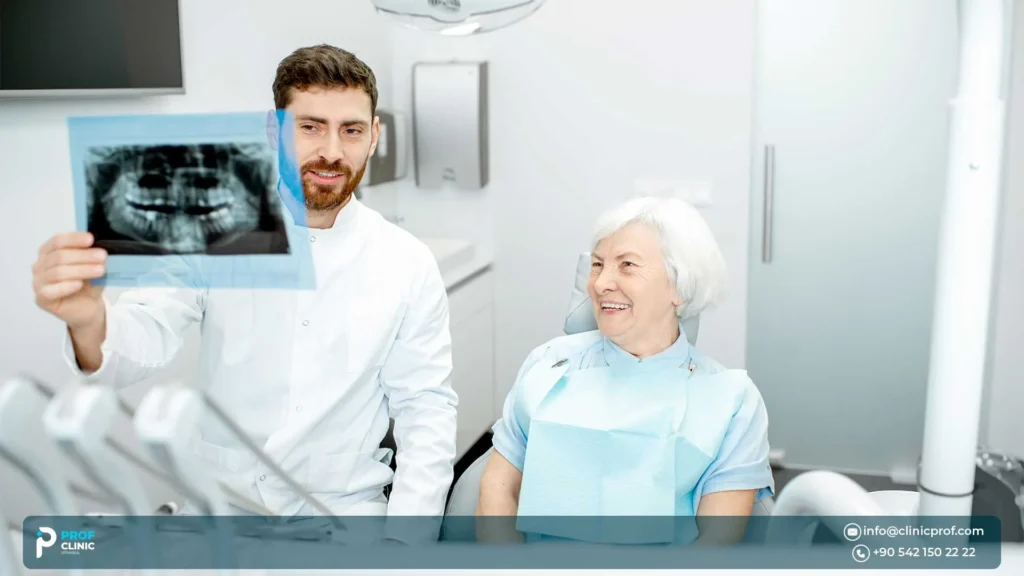
Which implants for the seniors can work best?
The best option depends less on age and more on how many teeth are missing, how much support is available, whether you want something fixed or removable, and how comfortable you are with daily cleaning. At Prof Clinic, we explain the choices clearly rather than treating one design as automatically “best” for every older patient.
| Option | Usually suits | Senior planning note | Design |
| Single implant | One missing tooth | Useful when the problem is local, but imaging still decides whether support and bite forces are suitable. | Fixed |
| Implant bridge | Several neighbouring missing teeth | May reduce the number of implants needed, but the span and bite must be planned carefully. | Fixed |
| Implant-supported denture | Loose dentures or multiple missing teeth | Often attractive for seniors who want more retention with easier removable cleaning. | Removable or fixed |
| Full-arch option such as All-on-4 | Many missing or failing teeth in one jaw | Good only in selected cases after CBCT-based planning and realistic discussion of hygiene and follow-up. | Usually fixed |
If you are already wearing dentures, the real comparison is often not simply “implants or no implants,” but which implant-supported design matches your cleaning ability and comfort goals.
For that comparison, read our implant-supported dentures vs traditional dentures, our full arch dental implants guide, and our all-on-4 in Turkey page together rather than choosing by age alone.
Dental implants vs dentures for seniors
Traditional dentures remain a valid solution for some older adults, especially when surgery is not suitable or when a simpler route fits the patient better. But implants become more attractive when movement, chewing insecurity, speech concerns, sore spots, or long-term instability are the main problems.
At Prof Clinic, we usually frame the question like this: Which solution gives you the best mix of stability, maintainability, and realism for your mouth? For one patient, that may be a straightforward removable denture. For another, it may be a snap-on or fixed implant-supported design that restores confidence far better than suction alone.
What can the treatment journey look like in Turkey?
Older patients often want to know not just whether implants are possible, but how treatment would be organized if they travel to Istanbul. At Prof Clinic, we prefer an evaluation-first path: First we assess your records and imaging, then we outline whether your case looks more like a single-tooth, partial, denture-stability, or full-arch problem. Only after that should the timeline and visit plan be discussed seriously.
That matters because some patients may qualify for immediate concepts, while others are safer with a staged plan that protects healing and long-term stability. The right timeline is the one that matches the biology of the case, not the fastest promise on the page.
If you are still comparing destinations or clinic standards, review dental implants Istanbul: Why choose the city? Turkey vs other countries for dental implants, and is it safe to have dental implants in Turkey? before you decide.
Recovery, hygiene, and long-term maintenance in older age
A strong senior implant plan is not only about surgery. It is also about what happens afterward. The early healing stage may include swelling, tenderness, bruising, or short-term soreness, but the bigger long-term issue is whether the restoration can be cleaned and reviewed properly over the years.
This is why we talk openly about maintenance. Some fixed restorations need more technique and special cleaning tools underneath. Some removable implant-supported dentures are easier for older adults to clean at home. At Prof Clinic, we would rather recommend the option you can live with successfully than the one that only sounds impressive in theory.
Before treatment, we recommend reading our dental implant aftercare in Turkey guide. It helps you judge whether the clinic’s follow-up standards and instructions match the level of clarity you would want after surgery.
When to book a senior implant assessment?
The best time to request an assessment is when you stop asking, “Am I too old?” and start asking, “Which route actually suits my case?” That shift matters because this topic is not really about age anxiety; it is about candidacy, safety, comfort, and realistic planning.
If dentures move when you eat or speak, if several teeth are missing or failing, if chewing has become limited, or if you have been told you may have bone loss, that is usually the right moment to seek a professional review. At Prof Clinic in Istanbul, we can often give the first level of guidance more efficiently when you send recent imaging and a short medical summary first.
If you want a more informed consultation, send your smile photos, panoramic X-ray, or CBCT through our contact page. If you want to prepare the right questions before that first review, use our questions to ask implant Dentistguide.
FAQs about dental implants the elderly
Is there an upper age limit for dental implants?
No fixed upper age limit is used in routine planning. The more important factors are bone support, oral tissue condition, medical stability, healing expectations, and whether the patient can maintain the restoration well.
Can someone in their 70s or 80s still get implants?
Yes, some older adults in their 70s or 80s may still be good candidates after proper evaluation. The decision should be based on imaging, oral condition, medical review, and the best prosthetic design for that patient.
What are the best implants for seniors?
There is no universal “best” option. For some patients, a single implant or implant bridge is enough. Others do better with implant-supported dentures or a full-arch concept, especially if denture stability is the main problem.
What if I already wear dentures?
That often makes the conversation more practical, not less. We would compare your current stability problems with the realistic benefits and maintenance demands of implant-supported removable or fixed options.
Does bone loss always rule out implants?
No. Bone loss can change the plan, but it does not always rule implants out. It may affect the number of implants, the design, whether additional procedures are considered, or whether a different restorative route is safer.
What should I send before an online review?
Ideally, send recent smile photos, a panoramic X-ray or CBCT if you have one, a brief medical summary, and a note explaining your main problem—such as loose dentures, multiple missing teeth, or difficulty chewing.