For many, the daily routine of pencils or the fading lines of microblading never quite feel like the real thing. If you are tired of temporary fixes, an eyebrow hair transplant in Turkey offers a permanent, biological solution.
At Prof Clinic, we know that the biggest fear isn’t the procedure itself; it’s the risk of an unnatural result. That is why our approach to eyebrow hair restoration is built on surgical precision, ensuring every graft follows the subtle fan pattern and specific angles of your natural features.
In this comprehensive guide, we will break down:
- Candidacy: Are you a fit for a hair transplant in the eyebrow?
- The Istanbul Advantage: Why choosing an eyebrow hair transplant clinic in Istanbul requires a focus on medical standards over marketing hype.
- The Journey: From Micro FUE and DHI techniques to the 12-month recovery timeline.
What is an eyebrow hair transplant?
If you’ve spent years relying on pencils or microblading to fill in the gaps, you know those solutions are only temporary.
An eyebrow hair transplant, often referred to as eyebrow restoration, offers a permanent, biological shift.
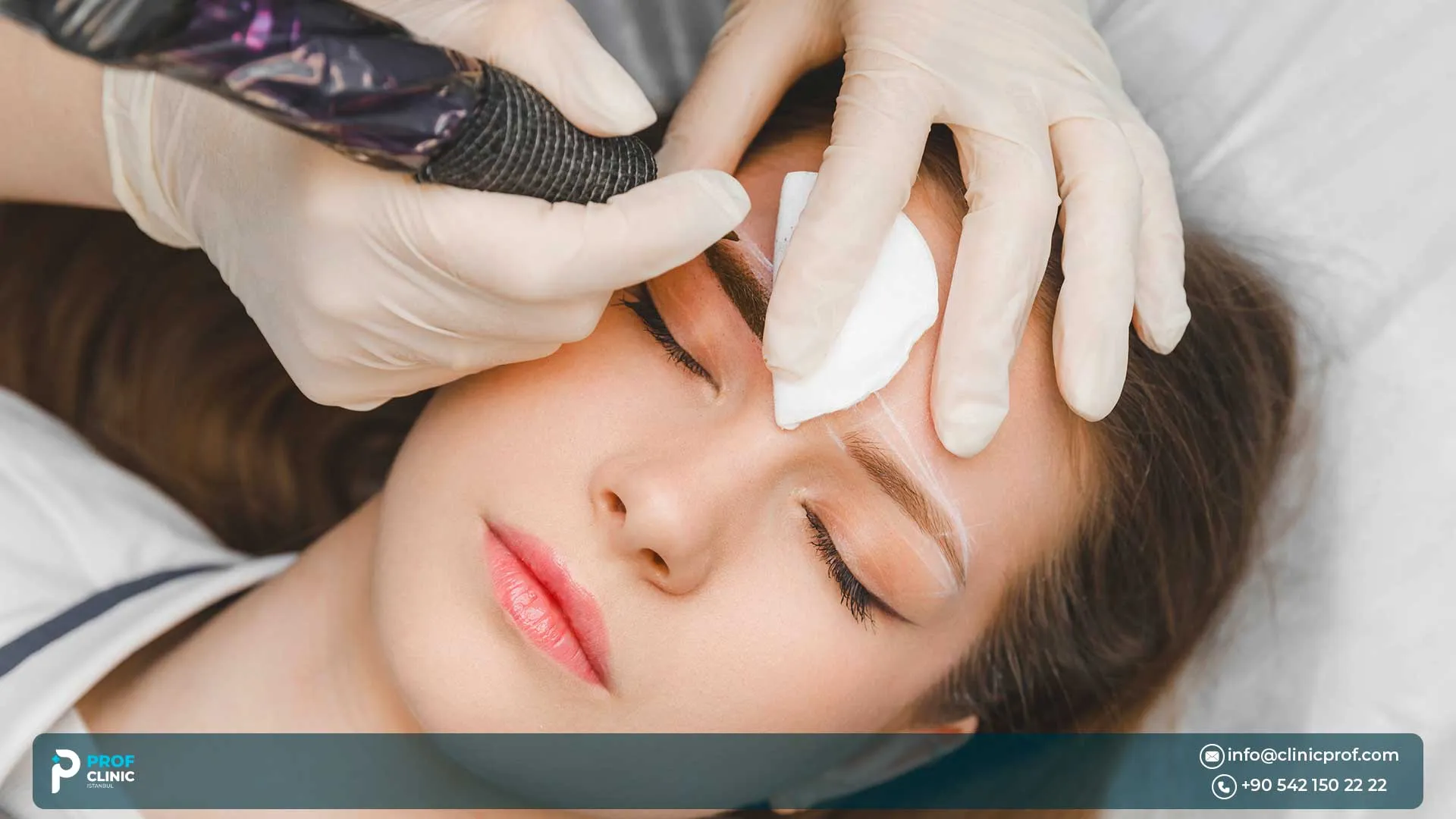
Essentially, this procedure involves relocating your own healthy hair follicles, typically harvested from the back of the scalp, directly into the brow region.
However, unlike a standard hair transplant, eyebrow hair restoration is an art of extreme precision. Because eyebrows define the symmetry of your face, the follicles must be placed as single-hair grafts, carefully angled to mimic the natural, subtle “fan” pattern of your original brows.
ِAlaso read: Eyebrow Hair Transplant Procedure: How it Works & Donor Hair Options
Why Consider Eyebrow Restoration?
Most patients visiting eyebrow hair transplant clinics in Istanbul are looking to correct specific concerns, such as:
- The Aftermath of Trends: Reversing thinning caused by years of over-plucking.
- Genetic Realities: Filling in naturally sparse or “transparent” brows.
- Scar Camouflage: Restoring hair over stable scars from past trauma or surgeries.
- Medical or Traction Loss: Addressing patches caused by physical stress or harsh grooming habits.
What an eyebrow transplant is not?
It is crucial to understand that a hair transplant in the eyebrow area is not a cosmetic tint or a tattoo. It is living tissue.
Unlike microblading, which fades over time, these hairs will grow and behave like natural hair, meaning they will require occasional trimming and gentle grooming to maintain your desired aesthetic.
Also read: Reasons for PRP (Platelet-Rich Plasma) Treatment
Why choose Turkey and Istanbul for eyebrow hair restoration?
When searching for an eyebrow hair transplant in Turkey, you’ll quickly notice that Istanbul is one of the most established hubs for this procedure.
But why do so many international patients consider Istanbul for this procedure? It’s not just about the location; it’s about a highly developed ecosystem designed for hair restoration.
Patients seeking an eyebrow hair transplant in Istanbul usually look for three key advantages:
- Specialized Expertise: Many teams in Istanbul focus heavily on hair restoration and have dedicated protocols for eyebrow work. Ask who performs the key steps (design, recipient sites, implantation) and review cases similar to yours.
- Seamless Logistics: From the moment you land, the coordination for international visitors—including scheduling and linguistic support—is built into the experience.
- Technological Variety: Access to the latest tools and techniques tailored specifically for delicate eyebrow restoration rather than a “one-size-fits-all” approach.
It’s easy to be overwhelmed by the sheer number of options in Istanbul. However, remember that you aren’t just choosing a city for your eyebrow hair transplant procedure; you are choosing a medical team. High clinical standards and proven expertise are what turn medical travel into a safer, more predictable patient experience and outcome.
Also read: Hair Transplant in Turkey: The Number One Location for Dense, Natural Hair
How to Avoid Unnatural Eyebrow Outcomes?
Before booking your flight for a Turkey eyebrow hair transplant, you must look beyond the brochure.
A reputable clinic should be transparent about:
- The Lead Specialist: Who is designing the brow shape and creating the recipient sites?
- Precision Control: How exactly do they ensure the transplanted hairs follow your natural growth direction to avoid wild or upward-growing brows?
- Long-Distance Support: What does the remote follow-up plan look like once you return home?
Also read: Eyebrow Hair Transplant Side Effects: What Could Go Wrong?
Can you get an eyebrow hair transplant?
One of the most frequent questions we receive is: “Can anyone undergo an eyebrow hair transplant?” While the procedure is a high-impact option for many, it is not a one-size-fits-all treatment.
Determining your suitability is a critical step that combines your medical health with aesthetic goals.
Who is an ideal candidate for an eyebrow hair transplant?
Typically, you are considered a strong candidate for eyebrow hair restoration if you meet the following criteria:
- Stable Thinning: Your brow loss has stabilized and isn’t caused by an ongoing, fluctuating medical condition.
- Realistic Expectations: You understand that while a transplant adds density and shape, it aims for a natural look rather than perfect makeup symmetry.
- Healthy Donor Hair: You have adequate hair at the back of the scalp that can be selected to better match the texture of brow hair..
- Commitment to Care: You are willing to follow a precise aftercare routine and groom the new hairs as they grow.
When is caution necessary?
Conversely, we may advise against or delay the procedure in certain scenarios:
- Active Inflammation: Any active skin infection or inflammation around the brow area must be fully resolved first.
- Healing Constraints: Certain uncontrolled medical conditions can compromise the delicate healing process important for graft survival.
- Complex Scarring: While eyebrow restoration can camouflage scars, very dense or complex scar tissue may limit the blood supply needed to support hair growth.
Is there an Age Limit for an eyebrow transplant?
There is no magic number when it comes to age. Instead, suitability is determined by your overall health, the quality of your donor area, and whether your aesthetic goals have remained stable over time.
Whether you are in your 20s or 60s, the focus remains on long-term, natural results.
Ready to find out if you’re a candidate? Every face is unique. The best way to know if a hair transplant in the eyebrow area is right for you is through a personalized assessment. Request a personalized assessment and share photos, noting whether you prefer a soft, straight, or arched look.
Our team at Prof Clinic will provide a clinical evaluation of whether a transplant or an alternative approach serves you best.
Also read: Is Eyebrow Hair Transplant Permanent? Longevity, Success Rate & Maintenance
Techniques used for Eyebrow Hair Transplants in Turkey
When researching an eyebrow hair transplant in Turkey, you will encounter several technical terms like Micro FUE, Sapphire FUE, and DHI.
While these labels refer to the tools or implantation method used, it’s important to remember that eyebrows are an aesthetic precision zone.
Unlike the scalp, the success of eyebrow restoration depends largely on three variables: the angle of exit, the direction of growth, and the use of single-hair grafts.
Why do Brows Require a Different Mastery than the Scalp?
Restoring a brow is far more delicate than filling in a receding hairline. Here is why:
- The Pluggy Trap: Brows must consist almost exclusively of single-hair grafts. Using multi-hair grafts (common in scalp work) results in an unnatural, “clumped” appearance.
- Directional Shifting: The direction of hair changes significantly as you move from the head (near the nose) to the body and finally the tail of the brow.
- Texture Matching: The donor hair (usually from the nape or behind the ear) must be selected to match the natural curl and fineness of a brow.
Also read: Eyebrow Hair Transplant Procedure: How it Works & Donor Hair Options
Micro FUE vs. Sapphire FUE vs. DHI
| Technique | How It Works (Simplified) | Potential Advantages | Practical Considerations |
| Micro FUE | Individual follicles are extracted and implanted with fine-tuned control. | Excellent for harvesting the delicate single-hair grafts needed for brows. | Success depends largely on the team’s skill in graft handling. |
| Sapphire FUE | Channels are created using ultra-sharp blades made from sapphire. | Allows for incredibly clean, micro-channels that may heal quickly. | A great tool, but it doesn’t guarantee a natural look without a skilled designer. |
| DHI (Direct Hair Implantation) | Uses a pen-like tool (Choi Implanter) to place grafts directly into the skin. | Offers high control over the depth and angle of each hair in experienced hands. | Not a ‘magic wand’; it requires meticulous planning and graft selection to work effectively. |
What is the secret to a natural-looking eyebrow transplant?
At Prof Clinic, we believe that while tools like Sapphire blades or DHI pens are helpful, they are secondary to the artistic execution.
A truly natural eyebrow is the result of:
- Bespoke Design: Creating a shape and thickness that complements your unique bone structure.
- Angle & Flow: Placing each hair at a specific degree to mimic how natural brows lay flat against the skin.
- Donor Selection: Choosing only the finest hairs that suit brow styling.
- Graft Integrity: Protecting the follicles during the transition to support healthy growth in the new area.
Also read: Sapphire FUE Hair Transplant: Everything you want to know
What happens before, during, and after the eyebrow restoration procedure?
When planning an eyebrow hair transplant, understanding the timeline, from the first consultation to the final result, is essential.
Here is a breakdown of what to expect when you partner with a specialized eyebrow hair transplant clinic.
1. The Planning Phase
Your journey begins long before you board a flight to Istanbul. High-quality care starts with:
- Virtual Consultation: A thorough review of your medical history and a candid discussion about your goals.
- Aesthetic Design: We analyze your facial balance to suggest a brow shape (soft, straight, or arched) that complements your features.
- Donor Evaluation: Our team assesses the hair at the back of your scalp to ensure it has the right caliber and texture for a natural-looking brow.
- Pre-Op Preparation: You’ll receive specific guidance on lifestyle adjustments (such as smoking, alcohol, or certain medications) to ensure your body is ready for optimal healing.
2. The Procedure Day
The procedure itself is minimally invasive and designed for comfort:
- Local Anesthesia: We ensure the donor and recipient areas are numb so you remain comfortable throughout.
- Precision Extraction: Using FUE-based methods, we carefully harvest individual follicles.
- The Art of Implantation: This is the most critical stage. Whether using Sapphire or DHI, we place each graft with a strict focus on the natural exit angle and flow, ensuring the hair lies flat and grows in the correct direction.
3. The Recovery Phase
Healing is a process, and we stay with you every step of the way:
- The First Few Days: It is normal to experience mild redness, slight swelling, and small scabs. This can be a sign that the skin is beginning to secure the new grafts..
- Tailored Instructions: You will receive a bespoke aftercare kit and instructions on how to wash and protect your new brows.
- Remote Follow-Up: Since many of our patients travel back home, we maintain a digital bridge to monitor your progress and answer any questions.
While complications are rare, your health is our priority. If you experience increasing pain, fever, or worsening swelling after returning home, you should seek medical advice promptly.
Growth timeline, and how to get natural-looking eyebrows
One of the most common sources of frustration in eyebrow restoration is the expectation of instant perfection. It is vital to remember that a hair transplant in the eyebrow area follows a biological rhythm.
You aren’t just getting new hair; you are embarking on an up to 12-month maturation journey.
The Recovery Timeline
While every individual heals differently, most patients at our eyebrow hair transplant clinic experience the following stages:
- Days 1–14 (Healing Phase): You will notice some redness and small scabs. This is an important window where the grafts are ‘taking root.’
- Weeks 2–8 (The Shedding Phase): Don’t panic! It is perfectly normal for the transplanted hairs to fall out. The follicle remains beneath the skin; it’s simply resetting for a new growth cycle.
- Months 3–6 (Early Regrowth): You’ll start to see fine, new hairs sprouting. At this stage, they may be thin, but they often thicken over time.
- Months 9–12 (The Final Result): By the one-year mark, the brows typically reach their final density and texture, blending seamlessly with your natural features.
How to Maintain Your Natural Results
The procedure is only one part of the process; your aftercare routine plays a major role in healing and how the brows settle over time. To ensure your eyebrow hair transplant Istanbul journey ends with the best possible look, follow these professional tips:
- Trim and Groom: Because the donor hair usually comes from your scalp, it will grow faster than original brow hair. You will need to occasionally trim them and use a gentle brow gel to help guide them to lay in your desired direction.
- Style with Care: Follow our specific guidance on when it’s safe to resume using cosmetics or washing the area with standard cleansers.
- Hands-Off Policy: During the first 14 days, avoid rubbing the area or picking at scabs. Strong friction is a major risk of a newly placed graft.
Every face has a different starting point. To see what is achievable, we invite you to browse our Before & After Gallery. Comparing cases similar to your own is the best way to set realistic goals for your eyebrow restoration.
Want to know what’s realistic for your face shape and skin type? Request a free assessment and ask for cases similar to mine in the gallery.
Risks, side effects, and realistic expectations of eyebrow hair transplant
No surgical procedure is risk-free. Your surgeon should explain the potential complications in your specific case and provide clear instructions on when to seek medical help, especially after you return home.
While the majority of side effects are short-term and easily manageable, achieving a safe and successful result requires a partnership between a skilled medical team and a compliant patient.
Understanding the Risks & How We Mitigate Them
Most patients experience temporary redness, swelling, and scabbing. These are normal signs of the skin’s healing process.
However, we take specific steps to minimize more significant concerns:
| Possible Issue | Clinical Mitigation | Your Role in Success |
| Swelling & Redness | We use gentle, minimally invasive techniques to reduce tissue trauma. | Follow the cleansing and ointment protocol strictly; avoid all friction. |
| Infection Risk | Procedures are performed in a sterile environment with strict wound-care guidance. | Report any worsening pain, fever, or unusual discharge to us immediately. |
| Unnatural Growth Angle | We prioritize single-hair grafts and maintain precise control over the exit angle. | Review our previous cases and confirm the expertise of the surgical team. |
| Density Mismatch | We perform meticulous donor selection and graft protection during the transfer. | Maintain realistic expectations and attend all scheduled follow-ups. |
| Scarring Concerns | We use precise extraction methods to ensure even spacing and minimal impact. | Disclose your full medical and scarring history during your consultation. |
The golden rule of eyebrow restoration expectations
The most honest advice we can offer is this: Your outcome depends largely on the experience and artistic understanding of the team you choose.
An eyebrow is not just a patch of hair; it is a complex growth pattern that requires a specialist’s touch. In general clinical practice, a successful transplant is a combination of medical science and aesthetic design.
Transparency builds the best results. We encourage you to read our Success Stories & Patient Testimonials. Seeing how others managed their recovery and achieved their goals can provide the clarity you need before starting your own journey.
How to choose an eyebrow hair transplant clinic in Turkey
When you search for an eyebrow hair transplant clinic, you will be met with countless promises and flashy advertisements.
However, because eyebrow restoration is a permanent surgical procedure, your decision should be based on objective standards, not marketing hype.
Use this checklist to evaluate any clinic you are considering:
1. The Medical & Design Standards
- Who is responsible for the critical steps, such as designing the brow shape and creating the recipient sites?
- Does the clinic routinely use single-hair grafts for brows to avoid an unnatural, clumpy look?
- Can the team explain how they adjust the angle of hair growth from the head (near the nose) to the body, then the tail?
2. Safety & International Support
- What are the clinic’s hygiene standards and emergency preparedness?
- Do they provide a clear, written aftercare plan and a dedicated follow-up schedule for when you return home?
- Are they honest about the growth timeline, or are they promising “instant” results?
Why consider Prof Clinic for your journey?
At Prof Clinic, we believe that a successful transplant starts with education, not pressure. Our approach is guide-first, meaning we prioritize:
- Realistic Screening: If you aren’t a good candidate, we will tell you.
- Bespoke Design: We don’t use “stencils.” Every brow is designed to complement your unique facial structure.
- Coordinated Support: From your first photo assessment to your 12-month follow-up, our international patient team ensures you are never navigating the process alone.
The result? A confident decision based on medical logic, aesthetic art, and long-term safety.
Ready for a Realistic Plan? Your new look starts with a conversation. Book a free consultation with Prof Clinic today. Share your photos, tell us about your ideal style, and receive a personalized plan covering technique options, your specific timeline, and aftercare.
FAQs about eyebrow hair transplant in Turkey
How long does an eyebrow hair transplant last?
Since the procedure uses your own living follicles, the results are intended to be long-lasting. However, the long-term density and health of the grafts depend on your individual healing process, the surgical technique used, and your commitment to the aftercare protocol.
Can you transplant hair to an eyebrow?
Yes. An eyebrow hair transplant involves harvesting healthy follicles from a donor area (usually the back of the head) and meticulously implanting them into the brow. The key to success is the surgeon’s ability to mimic the natural direction and sharp angles of native brow hair.
Can I get a natural-looking eyebrow transplant?
In most cases, yes. A natural-looking result is achieved through three pillars: a bespoke brow design that fits your face, the use of single-hair grafts (using single-hair grafts to avoid clumping), and precise placement to match your natural hair flow. Always ask your clinic to show before/after cases that mirror your starting point to verify their artistic skill.
Which country is best for eyebrow transplant?
There is no single “best” country. While eyebrow hair transplant Turkey is a popular search due to the high volume of experts in Istanbul, the clinic’s individual standards matter more than the map. You should prioritize clinician experience, safety protocols, and transparent aftercare over a country’s general reputation.
Is there an age limit for eyebrow transplant?
There is no strict age cutoff. Candidacy is determined by your overall health, the stability of your hair loss, and the quality of your donor hair. Whether you are addressing thinning from age or long-term over-plucking, a professional consultation is the only way to confirm if the procedure is right for you.
What is the most natural-looking hair transplant?
The “most natural” method is the one performed by a team that understands the unique anatomy of the face. For eyebrows, this usually involves Micro FUE or DHI, where each graft’s angle and direction are controlled to ensure the hair lays flat and flows naturally across the brow bone.