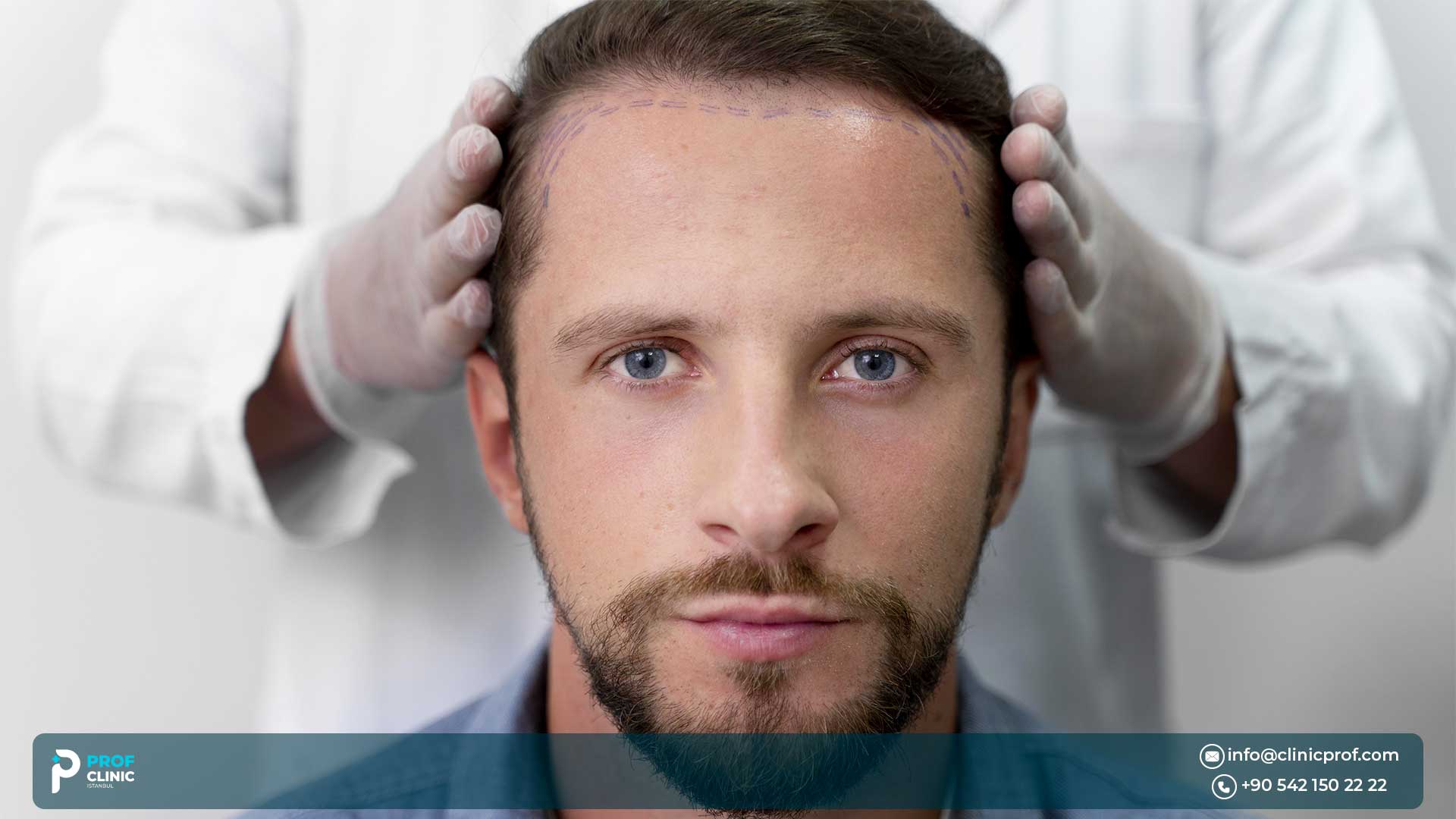
Can you have an unshaven hair transplant, and is it as good as a shaved one? In many cases, yes: grafts can be taken and placed without shaving your head, so your usual hairstyle hides most signs of surgery. The trade-off is that the procedure is slower and more demanding, so it suits smaller sessions, hairline work and many women better than large areas of baldness.
In this guide by Prof Clinic, you’ll learn the three main no-shave methods, who each one suits, how unshaven FUE and DHI differ, how many grafts are realistic, how discreet the first 10 days really are, and why the price is usually higher. By the end, you’ll know which questions to ask before you book a procedure in Istanbul.

What Is an Unshaven Hair Transplant?
An unshaven hair transplant is any FUE-based procedure in which the donor area, and usually the recipient area, is not shaved short. In a standard FUE operation, the NHS notes, the back of the head is shaved. No-shave methods keep the surrounding hair long and work between it, which is why they take more time and more skill.
“Unshaven” is used loosely by clinics, so it helps to know that it covers three different approaches:
| Method | What is cut | Usually suits | Main trade-off |
|---|---|---|---|
| Partial shave (hidden window) | A box-shaped patch of the donor area, covered by longer hair above it | Medium sessions in people with hair long enough to cover the patch | Grafts come from one small zone, so that zone can look thinner |
| Fully unshaven FUE | Only the individual hairs being removed, trimmed one by one or cut by the punch | Small to medium sessions, hairlines, people who cannot show any shaving | Longer surgery; the newly placed hairs are short for a while |
| Long hair FUE | Nothing; grafts are moved with their hair at full length | Hairlines, temples and cases where the result must be invisible from day one | The slowest option, with the lowest number of grafts per day |
Partial-Shave (Hidden Window) Technique
In a partial shave, a rectangle of the donor area is shaved and the hair above it falls down to cover it. Two papers by a Korean surgical team, in Plastic and Reconstructive Surgery Global Open (2017) and the Annals of Plastic Surgery (2019), describe it as a useful compromise, but only when your hair is long enough to hide the patch and the number of grafts is modest. Because every graft comes from one area, it can’t spread the harvest across the whole donor zone.
Fully Unshaven FUE
In fully unshaven FUE, nothing is shaved. The surgeon either trims each target hair to about 1–2 mm before extraction (the pretrimmed method) or lets the rotating punch cut the hair as it removes the follicle (the direct method). In the 2017 comparison, pretrimming took 3.4 minutes per 50 grafts against 2.6 minutes for the direct method, while damage rates were similar. Either way, the harvest can be spread evenly across the donor area.
Long Hair FUE (Preview Technique)
Long hair FUE goes one step further: the grafts are harvested and implanted with their hair still about 30–40 mm long. A 2021 paper in the International Journal of Dermatology reports that this gives an immediate preview of roughly what the result may look like at one year, and makes the surgery hard to spot. It needs a special open-window punch, more staff and a long learning curve.

Who Does a No-Shave Hair Transplant Suit?
A no-shave hair transplant suits people who need a limited number of grafts and who have a strong reason to keep their hair long through recovery. It is less about the technique itself and more about matching the method to the size of the area and the quality of your donor hair.
Small Areas, Hairlines and Touch-Ups
The clearest candidates are people treating a hairline, the temples, a small gap or a scar, or adding density after an earlier procedure. In the 2019 series of 658 nonshaven FUE patients, female hairline corrections averaged about 1,000 grafts and scalp-scar repairs far fewer, while male pattern baldness cases averaged about 1,400. At those sizes, the extra time an unshaven session takes is manageable.
Unshaven Hair Transplant for Women
In published no-shave series, women make up a large share of patients, because they usually wear their hair longer and their thinning tends to be spread along the part line and crown rather than forming a bald patch. The ISHRS guide to hair transplant for women notes that FUE is often done with donor shaving, which makes it harder for women to return to normal activities, and that no-shave options are available to help conceal recovery.

Surgery is only one part of the picture, though. The ISHRS stresses that the best candidates have a predictable pattern of thinning and healthy donor hair, not widespread, rapidly progressing loss. A doctor should confirm the cause first, and a female hair transplant in Turkey is planned around that diagnosis, not around the shaving method.
Also read: Hair Transplant for Women in Turkey: Candidates, Methods & Cost
People Who Can’t Take Time Off Work
If you work with the public, appear on camera or simply don’t want colleagues to know, an unshaven plan can shorten the period in which the surgery is obvious. The NHS suggests that you may need 1 to 2 weeks off work after a hair transplant. Without a freshly shaved head, many people feel comfortable going back sooner, but tenderness, swelling and small scabs still need the first few days.
When a Shaved Procedure Is Usually the Better Choice
Shaving is often the better route when you need a large session, when donor density is low or when the bald area is wide. The 2019 authors point out that partial shaving does not work when the hair is already cut short or many grafts are needed, and that longer operations raise the time grafts spend outside the body, which can lower survival. A shaved session of several thousand grafts may give a better result in one sitting than an unshaven plan split into two.
Not sure which group you fall into? Send photos of your hairline and the back of your head on WhatsApp and ask whether a no-shave plan is realistic for your case.
Unshaven FUE vs Unshaven DHI: How the Techniques Differ
Unshaven FUE and unshaven DHI use the same extraction step and differ in how the grafts are placed. “Unshaven” refers to the haircut, FUE to how follicles are removed, and DHI to placing them with an implanter pen, so a clinic can combine them in different ways.
Unshaven FUE: Extraction Without Shaving the Donor Area
With unshaven FUE, follicles are removed one by one between long hairs, then placed into tiny incisions (slits) made in the recipient area. The surgeon has to move existing hair aside for every graft, and assistants hold it back with clips or sticks, as the 2019 paper describes. If you want the background on standard FUE, our guide to FUE Hair Transplant in Turkey: Procedure, Pros and Cons, and Cost covers the basics.
Unshaven DHI With the Choi Implanter Pen
In unshaven DHI, the extracted grafts are loaded into an implanter (often called a Choi pen) that makes the incision and places the graft in a single movement. A 2023 practical guide in Clinical, Cosmetic and Investigational Dermatology notes that this lets the surgeon adjust the angle to the hair’s curl, but that the method can be harder in people who bleed easily and is labour-intensive. The large nonshaven series cited above also placed grafts with sharp implanters.
What it means in real life: neither technique is automatically better for an unshaven case. What matters is the team’s experience with no-shave work and how many grafts your plan needs.
Also read: DHI Hair Transplant in Turkey: Choi Pen Method, Cost & Results
The Limits: Graft Numbers, Surgery Time and Trade-Offs
The main limit of an unshaven hair transplant is time. In the 2019 series, one cycle of about 1.5 hours of extraction and 1.5 hours of placement was repeated through the day: about 1,600–1,800 grafts took roughly 6 hours, 2,400–2,700 grafts took 9 hours, and the most placed in one day was about 3,000. The authors note that very long operations tire both patient and surgeon.
How Many Grafts Can Be Done Without Shaving?
For most people, an unshaven session is realistic up to a few thousand grafts, and long-hair FUE allows fewer. The 2021 long-hair study reported about 5 hours for a 1,500-graft case and a maximum of about 2,500 grafts per day. Partial-shave patches are smaller still: the 2019 authors estimate about 900 grafts from a three-finger-wide patch in a woman with good density. If you need more, ask whether two sessions or a shaved plan makes more sense.
14 Things to Check Before Booking an Unshaven Hair Transplant
Before you choose a plan, check these points with the clinic:
- Which method: partial shave, fully unshaven or long hair FUE.
- Recipient area: whether the hair in the treated area will be trimmed.
- Graft estimate: how many grafts you need and whether one session can cover them.
- Session length: how many hours of surgery to expect, and whether it spans two days.
- Donor density: whether your donor area can supply the grafts without visible thinning.
- Cause of hair loss: whether it has been diagnosed, especially for women with diffuse thinning.
- Who does what: who makes the incisions, who extracts and who places the grafts.
- Team experience: how often the team does no-shave cases.
- Placement tool: slits with forceps or an implanter pen, and why.
- Hair length: how long your hair should be on the day so it covers the donor area.
- Hair type: whether very fine, very curly or very light hair changes the plan.
- Medication: what to pause before surgery and what to keep taking for ongoing hair loss.
- Price: how much the unshaven option adds compared with a shaved session.
- Follow-up: how photos and questions are handled after you fly home.
A clinic that answers these clearly, in writing, is giving you the information you need to compare offers fairly.
Results and Recovery: How Discreet Is It in the First 10 Days?
An unshaven hair transplant is usually discreet to casual observers, but it isn’t invisible to you. The NHS lists a tight, achy and swollen scalp for a few days and temporary scabbing where hair was transplanted as common after any hair transplant. The difference is that longer hair can fall over the donor area and, in many cases, over the recipient area too.
Here’s what most people notice, grouped by timing:
- Days 1–3: tenderness and some swelling, which can drift towards the forehead. The donor area is usually hidden; the recipient area may show redness if your hair is short at the front.
- Days 4–7: small crusts form around each graft. With longer hair styled over them, most people can run errands or work without obvious signs.
- Days 7–10: crusts usually loosen and fall away with gentle washing, as your clinic advises. Redness fades at different speeds in different skin types.
- Weeks 2–8: the transplanted hairs shed, which the AAD describes as normal. With long-hair FUE, some hairs that do not shed help the area look natural in the meantime.
- Months 3–12: new hair grows in. The AAD says most patients see results at 6–9 months, and some at 12.
These are typical ranges, not fixed rules. For a detailed month-by-month view, see Hair Transplant Timeline Month by Month: Growth and Shock Loss.

Unshaven Hair Transplant Before and After: What Photos Should Show
Good unshaven hair transplant before-and-after photos should show the same angle, lighting and hair length, plus an image taken immediately after surgery. Long-hair cases can look full straight away, so a “day one” photo alone tells you little: the useful comparison is before surgery against 10–12 months later, once the transplanted hairs have shed and regrown. The NHS notes that full results can take 10 to 18 months.
Want to see how results develop over time? Browse the Prof Clinic before-and-after gallery and look for cases with a similar starting point and hair type to yours.
Unshaven Hair Transplant Cost: Why It Usually Costs More
An unshaven hair transplant usually costs more than a shaved session of the same size because it takes longer and needs more people. The 2021 long-hair paper lists a prolonged operation time, more surgical staff and a higher level of expertise among the method’s main drawbacks, and those costs are usually reflected in the quote.
As a general guide, a scalp hair transplant package in Istanbul is about €1,800–€3,500, and a female hair transplant about €2,000–€3,800. Unshaven and long-hair plans tend to sit towards the upper end of these ranges, or carry a surcharge. These are approximate averages as of October 2026, not final prices, and they depend on your case after assessment. For how packages are built, see Hair Transplant Cost in Turkey 2026: Prices, Packages & Grafts.
The factors that usually move the unshaven hair transplant cost are:
| Factor | Why it affects the price |
|---|---|
| Method | Long hair FUE is slower than fully unshaven FUE, which is slower than a partial shave |
| Number of grafts | More grafts mean more hours, and possibly a second day of surgery |
| Placement tool | Implanter-pen work needs extra assistants to load the pens |
| Area treated | Hairlines and temples need precise angles; scars need careful planning |
| Package contents | Hotel nights, transfers, tests and aftercare products change the total |
Comparing quotes? Ask our team for an itemised quote that states the method, the graft estimate and what the package includes.
Planning an Unshaven Hair Transplant With Prof Clinic in Istanbul
At Prof Clinic, no-shave options are offered especially for women: on the female hair transplant service, only a small section of the donor area is trimmed and covered by the surrounding hair, so daily routines can continue. For any other case, whether a no-shave plan is possible is a question for the assessment, where the technique is also chosen from the methods the clinic uses: FUE, DHI, Sapphire FUE and Micro FUE.
The medical assessment and treatment planning for hair transplant in Istanbul are led by Spc. Dr. Lütfi Öztürk, an internal medicine specialist who also coordinates follow-up. Before surgery, the clinic runs pre-op tests, including blood count, ECG, kidney and liver function, electrolytes, blood sugar, and hepatitis and HIV screening.
Here is what you can expect from the process:
- Photo review first: the team assesses your photos and sends a written price offer before you travel.
- All-inclusive package: the procedure, accommodation, airport and hotel transfers and post-op care are included, with a transparent written quote.
- Honest expectations: the density you can expect is discussed individually and is not promised in advance.
- Follow-up from home: the coordination team stays in touch after the procedure and answers questions over WhatsApp.
Stays in Istanbul are typically 2–4 days, depending on your plan and travel. If you want to explore every option for hair transplant in Turkey, shaved and unshaven, the assessment is the place to compare them.
This guide is for general information only. Whether you are a candidate, and for which method, can only be decided after a medical assessment.
FAQs About Unshaven Hair Transplants
Do I have to shave my head for a hair transplant?
Not always. A standard FUE procedure usually shaves the donor area at the back of the head, and often the area being treated too. Partial-shave and fully unshaven methods avoid most or all of that, but they suit smaller sessions best. Whether your case can be done without shaving is decided after the doctor has looked at your donor area and the size of the thinning zone.
How many grafts can be done without shaving?
It depends on the method and the team. In one published series of 658 nonshaven FUE patients, about 1,600–1,800 grafts took around 6 hours and the daily maximum was about 3,000. With long-hair FUE the same group reported a maximum of about 2,500 grafts a day. In published series, typical unshaven cases averaged roughly 1,000–1,500 grafts.
Is an unshaven hair transplant more expensive?
Usually, yes. Working between long hairs is slower, needs more staff and limits how many grafts can be placed in a day, so clinics often price it above a shaved session of the same size. As a rough October 2026 guide, scalp packages in Istanbul run about €1,800–€3,500, and unshaven work tends to sit towards the upper end. Your written quote is final.
Is unshaven hair transplant suitable for women?
Often, yes. Women tend to wear their hair longer and usually need fewer grafts, spread along the part line or hairline, which fits a no-shave or partial-shave plan well. The ISHRS notes that no-shave options exist with FUE to help conceal recovery. Diffuse, unstable thinning is a different matter and should be diagnosed before any surgery is planned.
Will people notice I had a hair transplant if I do not shave?
In most small and medium cases, casual observers rarely notice once the first few days have passed. The treated area is usually red or crusted for the first week or so, but longer surrounding hair usually covers it. Close family or a hairdresser may still spot small scabs, and the grafted hairs typically shed between weeks 2 and 8, which is normal.
Is DHI the same as an unshaven hair transplant?
No. DHI describes how grafts are placed, using an implanter pen, while unshaven describes how much hair is cut. DHI can be done shaved or unshaven, and unshaven work can also use FUE with slit incisions. Ask the clinic which extraction method, which placement tool and which shaving plan it proposes for you, as these are three separate choices.
Making the Decision
An unshaven hair transplant makes most sense when the area is small to medium, the donor hair is healthy and keeping your hairstyle matters more to you than finishing in the fewest sessions. For larger areas, a shaved procedure is often the more efficient choice. Ask which method, how many grafts and how many hours the plan involves, and get the answers in writing.
The safest next step is an assessment, not a booking. Book a free online consultation and send photos of your hairline, crown and donor area to find out whether a no-shave plan is realistic for you.
Sources
- NHS — Hair transplant
- American Academy of Dermatology (AAD) — A hair transplant can give you permanent, natural-looking results
- ISHRS — A Guide to Hair Transplant for Women
- Plastic and Reconstructive Surgery Global Open — Pretrimmed versus Direct Nonshaven Follicular Unit Extraction (Park & You, 2017)
- Annals of Plastic Surgery — Nonshaven Follicular Unit Extraction: Personal Experience (Park et al., 2019)
- International Journal of Dermatology — Long Hair Follicular Unit Excision: Personal Experience (Park et al., 2021)
- Clinical, Cosmetic and Investigational Dermatology — A Practical Guide to Hair Graft Placement Using the Sharp Implanter Method (Park et al., 2023)