If you have lost most of your teeth, or your denture no longer stays put, you have probably come across All-on-4 dental implants in Turkey as an option. In short, All-on-4 fixes a full arch of new teeth onto four implants in one jaw, so the teeth do not come out like a denture.
It suits many people with missing or failing teeth, though not everyone. Bone volume, general health, smoking and gum health decide whether four implants are enough, and only a 3D scan can show that clearly.
This guide explains what All-on-4 is, how the tilted back implants work, who is a good candidate, how treatment runs step by step, and its real benefits and limits. Cost, recovery and long-term results each have their own detailed guide, linked along the way.
What Is All-on-4 and How Is It Different from a Denture?
All-on-4 is a full-arch treatment in which a fixed bridge of teeth is screwed onto four titanium implants placed in one jaw. You do not take it out at night; only your dentist removes it for maintenance.
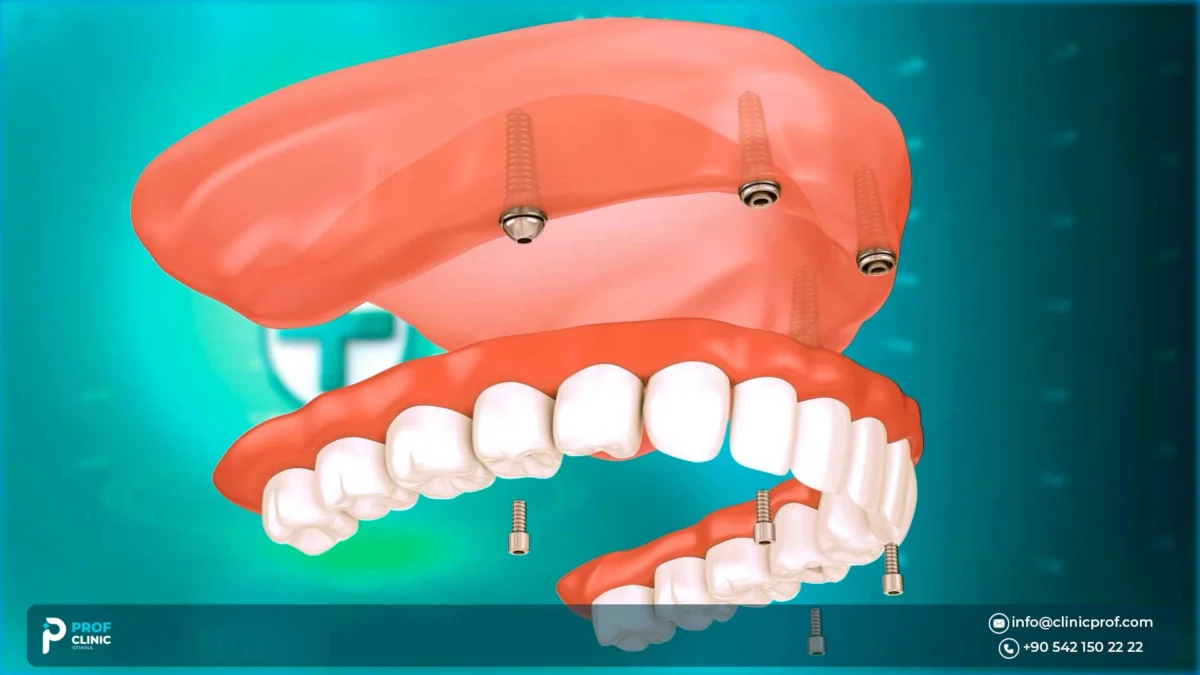
A conventional denture rests on the gums and is held by suction or adhesive, so it can move when you eat or talk. The All-on-4 bridge is anchored in bone instead. First described in the early 2000s for the lower jaw, the concept is now used in both jaws. It is one of several full-arch options within dental treatment in Istanbul.
Each arch is treated separately. Some people need All-on-4 in the upper jaw only, others in the lower jaw or in both, depending on which teeth can still be kept.
How Do Four Implants Support a Whole Arch of Teeth?
Four implants can carry a full arch because of where they go and how they are angled. Two implants sit upright at the front of the jaw, where bone is usually denser, and the two back implants are tilted towards the rear.
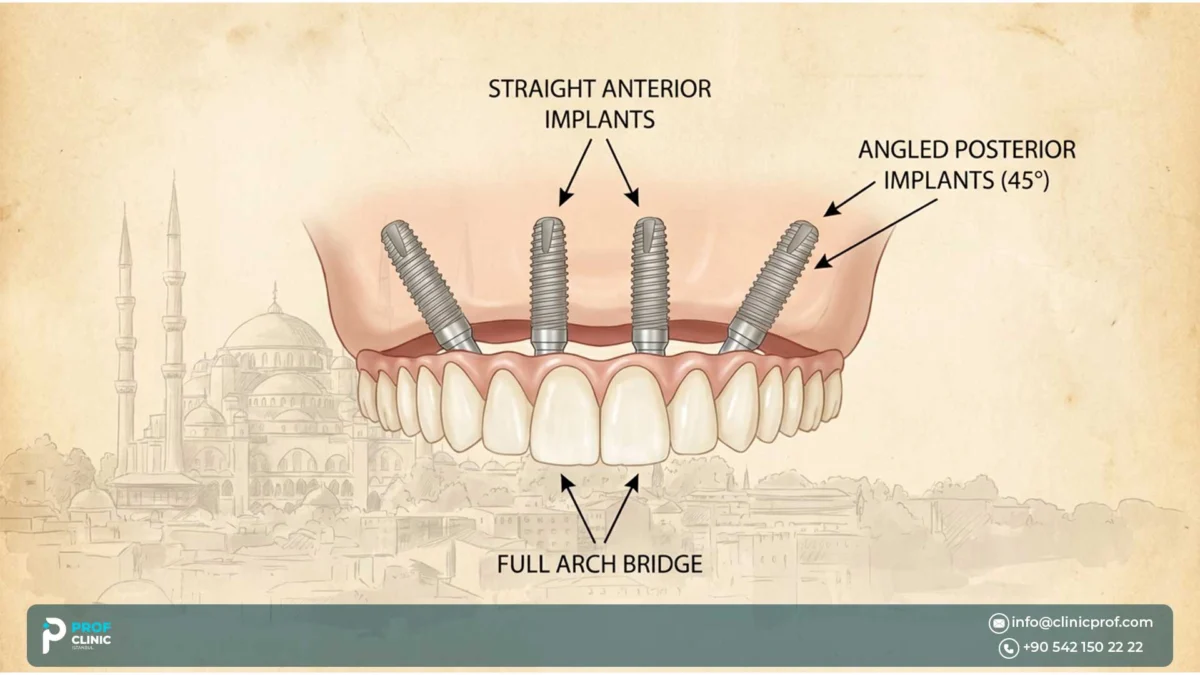
According to a prosthodontic review in the Journal of Clinical and Diagnostic Research, the back implants are usually tilted by about 30 to 45 degrees. This angle allows longer implants in the existing bone while steering clear of the sinuses above and the main nerve below. That is why All-on-4 can often reduce the need for bone grafting.
Because one rigid bridge joins the four implants, they share the biting load. When the implants are stable enough at surgery, a temporary fixed bridge can often be attached within a few days. This is called immediate loading, and it is not possible in every case.
Who Is a Good Candidate for All-on-4 Implants?
Good candidates for All-on-4 implants are adults missing most or all teeth in one jaw, with teeth that cannot be saved, or struggling with a loose denture. Beyond that, these factors matter:
- Enough bone at the front of the jaw: a CBCT scan shows the height and width of the bone and the position of nerves and sinuses.
- Healthy gums: active gum disease is treated before surgery, because inflammation around implants threatens their stability.
- Controlled general health: conditions such as diabetes should be well managed, and your medication is reviewed in advance.
- No smoking, or a willingness to stop: a large review in the Journal of Dentistry linked smoking to more implant failures, more infections and greater bone loss.
- Realistic expectations: healing takes months, and a fixed bridge needs careful daily cleaning.
- Time for follow-up: check-ups matter both during healing and after the final bridge is fitted.
If the bone is very thin, the dentist may suggest grafting first, more implants or a different design. In severe upper-jaw bone loss, zygomatic implants are sometimes considered, though that is a separate treatment.
If you are unsure where you stand, you can contact our dental team with recent photos and any X-rays. They will explain what a full assessment would need to check.
All-on-4 vs Dentures and Single Implants: How They Compare
All-on-4 sits between a removable denture and replacing each tooth with its own implant, and many people call it a fixed denture on implants. The table summarises the practical differences for someone missing a full arch.
| Feature | Removable denture | All-on-4 fixed bridge | One implant per tooth |
|---|---|---|---|
| What holds the teeth | Gums, suction or adhesive | Four implants in the jaw | An implant for each tooth or short bridge |
| Can you take it out? | Yes, every day | No, only the dentist can | No |
| Implants per jaw | None | Four | Varies, usually many more |
| Bone grafting | Not needed | Often reduced by the tilted back implants | More often needed where bone is thin |
| Chewing | Can slip with harder foods | Firm and stable | Firm and stable |
| Daily cleaning | Remove and clean the denture | Brush the bridge and clean under it with special floss or a water flosser | Brush and floss like natural teeth |
| Effect on the jawbone | Bone keeps shrinking slowly | Implants help limit bone loss | Implants help limit bone loss |
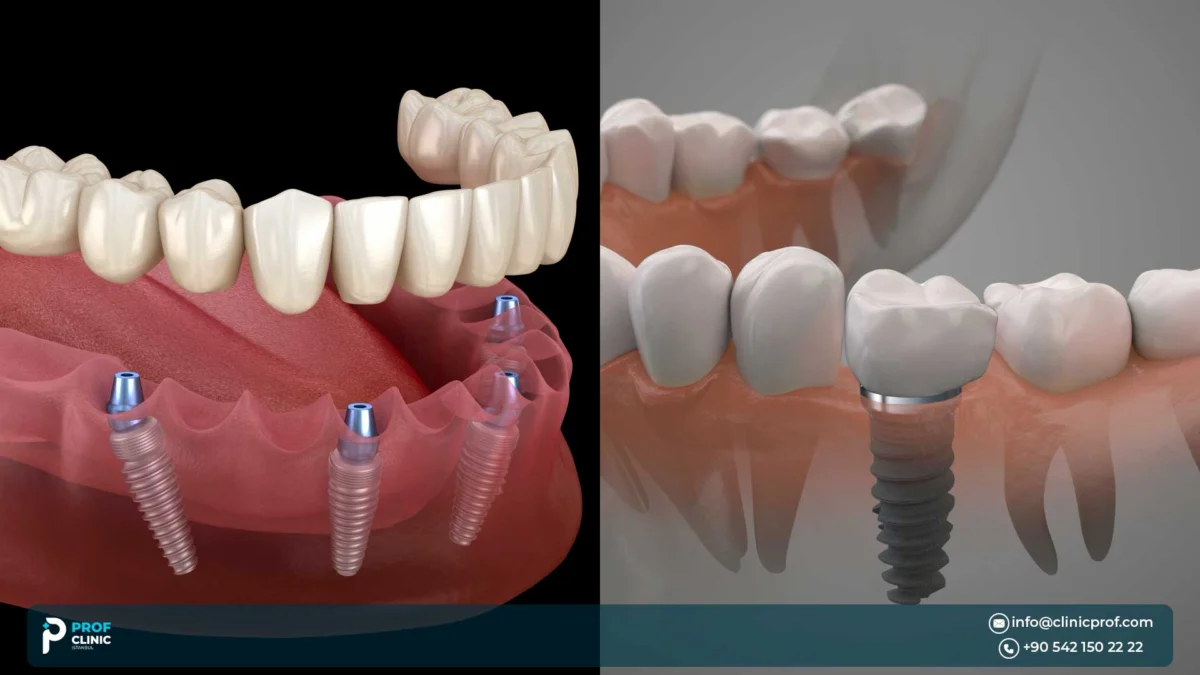
For one or two missing teeth, single dental implants are usually more suitable than a full-arch bridge. The closest alternative to All-on-4 is All-on-6, which spreads the load over six implants but needs more bone.
Also read: All-on-4 vs All-on-6: Which Full-Arch Option Suits You?
All-on-4 Dental Implants in Turkey: The Treatment Step by Step
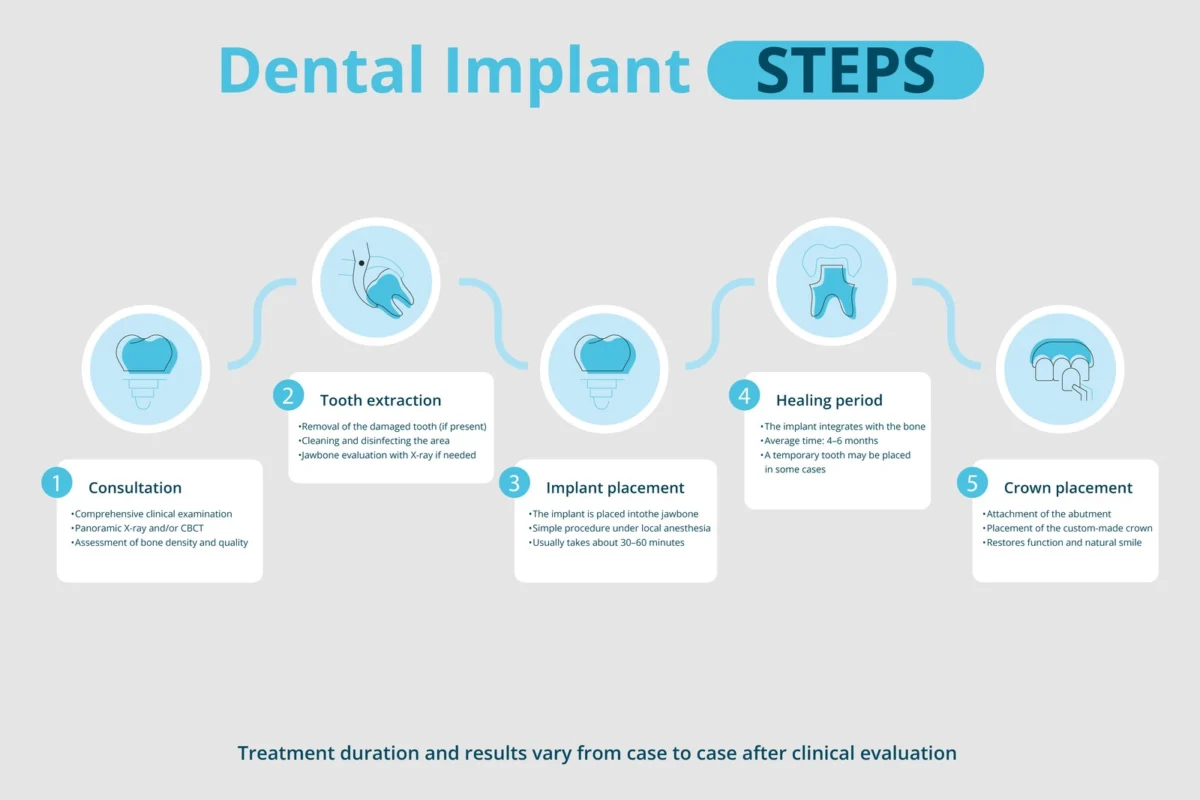
All-on-4 treatment usually runs in six stages over two main visits, with a healing period of several months in between. This is how the process typically unfolds:
- Consultation and CBCT scan: your dentist examines your mouth, reviews your medical history and takes a 3D scan of the jaw.
- Digital treatment plan: the scan is used to choose between four and six implants and to plan the position and angle of each one.
- Extractions and implant placement: under local anaesthesia, with sedation if needed, teeth that cannot be saved are removed and the implants are placed.
- Temporary fixed bridge: if the implants are stable enough, a temporary bridge is attached within a few days; if not, another temporary solution is used while they heal.
- Healing (osseointegration): the implants usually need about 3 to 6 months to fuse with the bone, and you follow a soft diet meanwhile.
- Final bridge and follow-up: new scans are taken, the final bridge is made and screwed in place, and regular check-ups follow.
For patients travelling to Istanbul, the first visit covers the scan, surgery and temporary bridge, and the second covers the final bridge. Our guide to planning the two visits for All-on-4 in Turkey explains how to organise both trips.
Most people feel close to normal within about a week, as swelling and tenderness settle. What to eat and how to handle the first weeks are covered in our day-by-day All-on-4 recovery guide.
Benefits and Limitations of All-on-4
All-on-4 has clear benefits for the right patient, along with limits you should weigh before deciding.
Benefits of All-on-4 Implants
The main benefits of All-on-4 in Turkey, as anywhere, come from having a fixed full arch on a small number of implants:
- Fixed teeth that do not slip when you eat, speak or laugh.
- Firmer chewing than with a removable denture, which allows a more varied diet.
- Fewer implants and, often, less need for bone grafting thanks to the tilted back implants.
- Support for the lips and cheeks, which helps limit the sunken look of long-term tooth loss.
- A temporary fixed bridge within days in many cases, so you are rarely left without teeth.
Limitations and Possible Risks
The limitations are just as real, and a careful plan addresses each one:
- Teeth remaining in the treated jaw are usually removed, even if some are partly healthy.
- Not everyone qualifies: very thin bone, uncontrolled health conditions or heavy smoking can rule it out.
- Surgical risks such as infection, nerve injury or sinus problems, which Cleveland Clinic describes as usually minimal.
- Mechanical wear: over the years a bridge can chip or its screws can loosen, so repairs or replacement may be needed.
- Cleaning under a fixed bridge takes daily effort, and plaque can cause inflammation around the implants (peri-implantitis).
Long-term studies are encouraging. In one study that followed lower-jaw All-on-4 patients for 10 to 18 years, 98.8% of bridges and 93% of implants were still in function. Some patients did have mechanical or biological complications. Our article on All-on-4 success rates explains what these figures mean for you.
All-on-4 Before and After: What Changes for Patients
After All-on-4, the most noticeable changes are a fixed set of teeth, firmer chewing and fuller support for the lips and cheeks.
Speech and biting may feel unfamiliar for the first weeks while your tongue and muscles adapt to the new bridge. The final bridge is designed around your bite and facial proportions, so its shape can differ from the temporary one.
To see how full-arch cases look in practice, browse our before and after gallery. Results vary from person to person.
Planning All-on-4 with Prof Clinic in Istanbul
At Prof Clinic, planning starts with your records, not with a ready-made package. Your photos, X-rays and a 3D CBCT scan are assessed first. The choice between four and six implants is then made on that scan, as our page on All-on-4 dental implants in Turkey explains.
Surgery is carried out under local anaesthesia, with sedation if needed. You receive a clear written plan, a temporary fixed bridge when your implants are stable enough, new scans for the final bridge, and regular check-ups and cleaning afterwards. Full-arch cases can be planned with Dt. Orçun Özaydın, whose clinical work includes prosthetic planning for All-on-4 and All-on-6 cases. At Prof Clinic, All-on-4 is priced at about €4,400–7,500 per jaw (roughly £3,650–6,300 or $4,850–8,300); your final price depends on your case and is confirmed in a written quote after assessment and X-rays.
About these prices: These prices are approximate and meant for planning only. They are Prof Clinic’s indicative prices in euros; amounts in other currencies are converted at the exchange rate of 13 November 2026 and will change as exchange rates move. Your final price is set after your medical assessment and X-rays and confirmed in a written quote that lists what is included. Contact us to get the actual price for your case.
Treatment recommendations are made only after a clinical assessment and a review of your records. When you are ready, you can book a free consultation to talk through your options.
Frequently Asked Questions About All-on-4
Can I replace my dentures with All-on-4 implants?
Yes, many denture wearers switch to All-on-4 when a CBCT scan shows enough bone for four implants. The fixed bridge replaces the denture and no longer relies on adhesive or suction. If the bone has shrunk a lot after years of denture wear, grafting or a different implant plan may be needed first.
Do you get teeth on the same day with All-on-4?
Often within a few days, though not always on the day of surgery. A temporary fixed bridge is attached only when the implants are stable enough after placement. If stability is lower, the implants heal first under another temporary solution, and the final bridge follows once they have fused with the bone.
Is All-on-4 surgery painful?
The surgery is done under local anaesthesia, with sedation if needed, so the area is numb throughout the procedure. Afterwards, soreness and swelling are common for a few days. They are usually managed with the pain relief your dentist prescribes, cold compresses and a soft diet.
How long do All-on-4 implants last?
With good cleaning and regular check-ups, the implants can last many years, although this varies from person to person. The bridge is the part that wears, so it may need repairs or replacement over time. Regular check-ups help catch loose screws, chips or gum inflammation early.
How do you clean All-on-4 implants?
Brush the bridge twice a day with a soft brush and non-abrasive toothpaste, then clean underneath it with special floss, interdental brushes or a water flosser. Plaque left around implants can cause inflammation that threatens them, so professional cleaning and check-ups matter as much as home care.
How much does All-on-4 cost in Turkey?
The indicative price is given in the planning section above. The final cost depends on whether one or both jaws are treated, the number of implants, any extractions or grafting, and the material of the final bridge. At Prof Clinic, you receive a written plan and quote after your photos, X-rays and scans have been assessed.
The Bottom Line
All-on-4 dental implants in Turkey can give you a fixed full arch on four implants, often with less grafting than other implant options. Whether it suits you depends on your bone, gums, general health and smoking, which only a scan and an examination can confirm.
If you would like a first opinion, send your photos or X-rays on WhatsApp, or read more about full-arch treatment in Istanbul.
Sources
- PMC (J Clin Diagn Res) — Prosthodontic Perspective to All-On-4 Concept for Dental Implants
- PMC (J Clin Exp Dent) — The all-on-four treatment concept: Systematic review
- PubMed (Clin Implant Dent Relat Res) — All-on-4 in the edentulous mandible: 10 to 18 years of follow-up
- PubMed (Journal of Dentistry) — Smoking and dental implants: A systematic review and meta-analysis
- Cleveland Clinic — Implant-Supported Dentures
- Oral Health Foundation — Understanding Dental Implants