Is a crown hair transplant worth it when the thin spot at the back of your head keeps getting bigger? It can be, but the crown (also called the vertex) is usually the hardest area to restore: it absorbs a lot of grafts for the coverage you see, it looks finished later than the front, and the hair loss around it often hasn’t stopped. Whether it suits you depends mainly on your age, how stable your hair loss is and how much donor hair you have.
In this guide by Prof Clinic, you’ll learn why the crown behaves differently, who suits the procedure, how many grafts it needs, how growth and results unfold, and where cost and medication fit in, so you know what to ask before anyone plans grafts for your vertex.
Medical note: this article is general information. Whether a transplant suits your crown, and how many grafts you need, can only be decided after a medical assessment.
Why the Crown Is the Hardest Area for a Hair Transplant
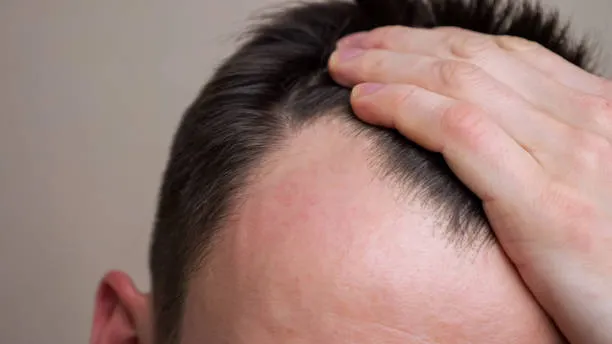
The crown is difficult for three reasons that add up: the hair grows in a spiral, the bald area is roughly round and widens in every direction, and it’s often where hair loss is still most active. None of this rules out a vertex hair transplant, but each point affects the graft count and how natural the result looks.
The Whorl: Hair That Grows in a Spiral
At the crown, hair fans out from a central point called the whorl. A review of recipient-area planning in the Journal of Cutaneous and Aesthetic Surgery explains that grafts in the vertex are placed in a whorl pattern, with directions crossing slightly (cross-hatching) to give an illusion of higher density. If the angles are wrong, the crown can look spiky or see-through even with plenty of grafts.
Some people have two whorls, often called a double crown. A double crown hair transplant follows the same principle, but the surgeon has to map both spirals and the line where they meet. Clear photos of your crown with short hair make that easier.
A Bald Spot That Keeps Widening
Male pattern hair loss is usually progressive. In the two-year finasteride trials published in the Journal of the American Academy of Dermatology, men on placebo kept losing hair at the balding vertex, the very area the trials measured. The NHS also warns that your hair might continue to thin around a transplant, so the design has to keep looking natural as time passes.
What it means in real life: if the crown is transplanted while the hair around it is still thinning, you can end up with an island of transplanted hair surrounded by new baldness a few years later. That’s why crown planning looks at where your hair loss is heading, not only at where it is today.
Not sure whether your crown is still changing? Send photos of your crown to our team on WhatsApp and ask for an opinion before you plan anything.
Are You a Candidate for a Crown Hair Transplant?
You may be a good candidate if your hair loss has slowed, your donor area at the back and sides is strong, and your goal for the crown is coverage rather than the density you had at 18. The American Academy of Dermatology (AAD) says a hair transplant needs two things: enough healthy hair that can be moved, and the ability to grow hair in the thinning area. The NHS adds that it suits permanent, inherited baldness, not other types such as alopecia areata.
Age and How Stable Your Hair Loss Is
Age matters because it hints at how much more hair you may lose. The AAD notes that men in their 20s may be asked to wait and start a hair loss medicine first. A man in his late 30s or 40s whose crown has barely changed for several years is usually a more predictable case than a 24-year-old whose crown has opened up within a year.
Donor Supply: The Real Limit
Your donor area is a fixed budget, and every graft spent on the crown can’t be used anywhere else. In a 2015 review in Clinical, Cosmetic and Investigational Dermatology, Paul Rose writes that in cases of marked hair loss, the crown is often the area that can’t be treated, simply because the patient lacks donor hair.
The Hairline-First Rule
When donor hair is limited, the front usually gets priority, because it frames the face and is what people notice first. In a study of 820 men with advanced baldness treated by FUE, published in the Journal of Cutaneous and Aesthetic Surgery, patients with average donor supply were offered the front and mid-scalp, while vertex-only treatment was reserved for men with limited donor supply who specifically wanted it. A sensible plan keeps some reserve for the crown later rather than spending everything on it now.
How Many Grafts Does the Crown Need?
A crown can need anywhere from several hundred to a few thousand grafts, and because it’s round, the number climbs fast as the bald spot widens. Surgeons estimate grafts by measuring the area in square centimetres and multiplying it by the density they plan for each zone, as the recipient-area review describes. For the vertex, the 820-case FUE study reported planned densities of about 20–25 grafts per cm², lower than the 30–40 grafts per cm² used at the front.
This is where geometry works against you. Call it the circle rule: when the diameter of a bald crown doubles, its area roughly quadruples. The table below shows the arithmetic at 20–25 grafts per cm², a simple way to answer how many grafts for the crown you might need.
| Approximate width of the bald crown | Area | Estimated grafts at 20–25 per cm² |
|---|---|---|
| About 6 cm | About 28 cm² | About 550–700 |
| About 8 cm | About 50 cm² | About 1,000–1,250 |
| About 10 cm | About 79 cm² | About 1,550–1,950 |
| About 12 cm | About 113 cm² | About 2,250–2,850 |
These are illustrative calculations, not a quote. Existing hair in the crown, hair thickness and curl, and how many grafts your donor area can spare all change the real number. In the same FUE study, men who had only the vertex covered received about 2,770 grafts on average, although that group had advanced baldness.

Also read: How Many Grafts Do I Need? Graft Count by Norwood Stage
Want a realistic number for your own crown? Ask our team for a graft estimate based on photos of your crown and donor area.
Technique Choices for the Crown: FUE, DHI and Density Planning
Both FUE and DHI can be used for the crown; what usually matters more is how the grafts are angled and how density is spread across the whorl. Both take follicular units from the donor area one by one and differ mainly in how they are placed.
FUE or DHI for the Vertex?
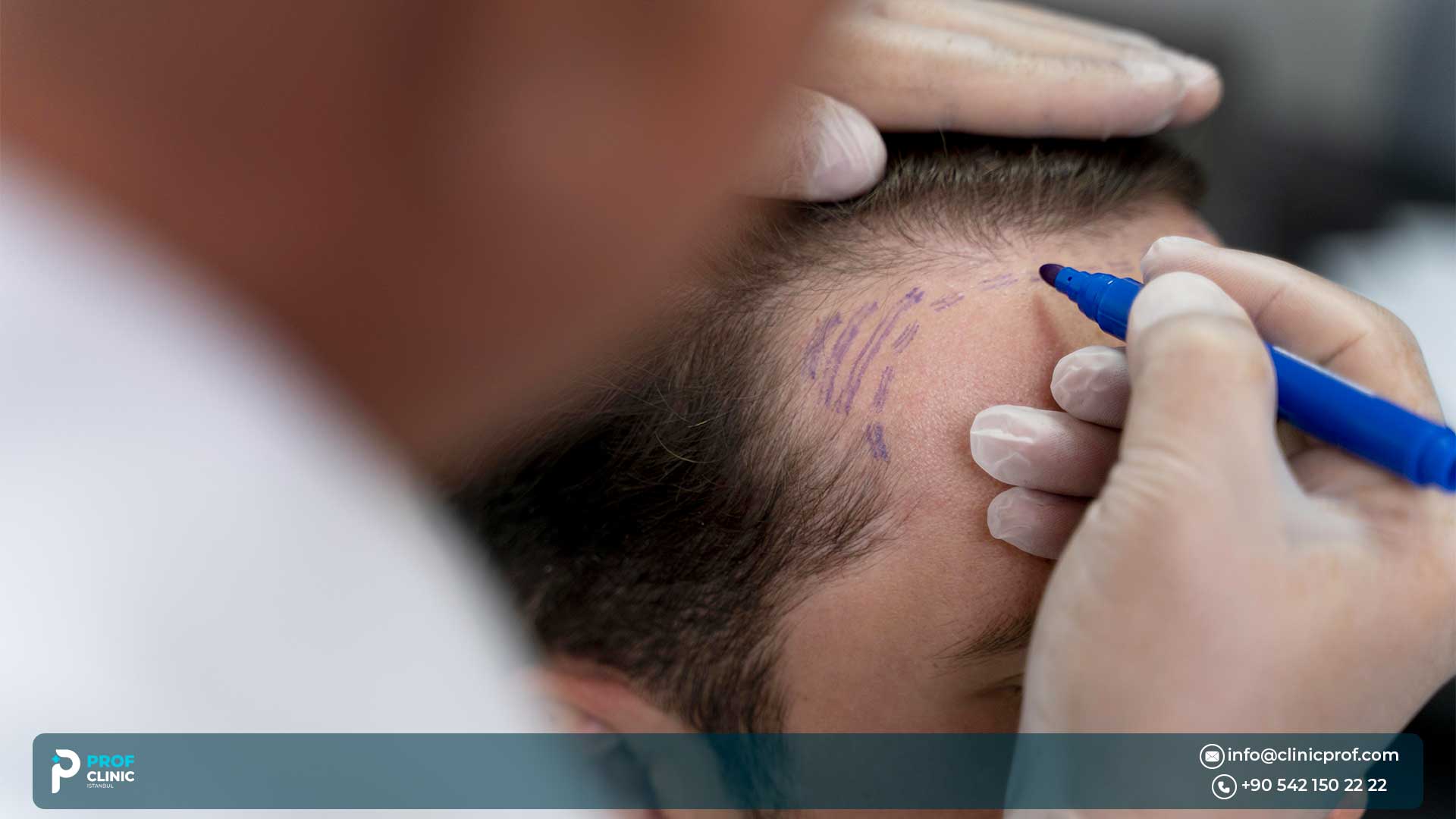
With FUE, the surgeon first opens small recipient sites, with a fine blade or a sapphire tip, and the grafts are then placed into them. With DHI, an implanter pen opens the site and places the graft in a single step, which some surgeons prefer for controlling angle and direction. Neither is universally better for the crown. The choice often depends on how many grafts you need, whether existing hair in the crown has to be protected, and your surgeon’s experience with each method.
For a deeper comparison, see FUE Hair Transplant in Turkey: Procedure, Pros and Cons, and Cost and DHI Hair Transplant in Turkey: Choi Pen Method, Cost & Results.
Density, Direction and the Illusion of Coverage
Crown density is usually planned lower than at the front, so the aim is coverage that looks full in normal light. Packing grafts too tightly can backfire: the recipient-area review warns that very high densities of more than 60 grafts per cm² can compromise the blood supply of the skin and reduce graft survival. A soft, feathered edge also helps the crown blend in if the surrounding hair thins later, which is why good crown work looks less like a patch and more like a gradual change.
12 Things to Check Before a Crown Hair Transplant
Before you agree to a plan for your vertex, go through these points with your doctor:
- Your diagnosis: Confirm the thinning is pattern hair loss, not alopecia areata or a scalp condition.
- Stability: Compare photos from the past one to two years, and ask how the plan allows for future hair loss.
- Donor total: Ask how many grafts your donor area can safely give over your lifetime, not just in this session.
- Hairline needs: Find out how many grafts the front may need now or later.
- Crown size: Ask for the measured area and planned density, not just a round number.
- Whorl mapping: Check that the design follows your natural spiral, or both spirals if you have a double crown.
- Existing hair: Ask how native hairs in the crown will be protected while sites are made.
- Technique: Ask why FUE or DHI is suggested for your case.
- Medication: Discuss whether a hair loss medicine is advisable to protect the untreated hair.
- Timeline: Plan to judge the crown at 12–18 months, not at six.
- Second session: Ask whether a second pass may be needed for density, and roughly what it would involve.
- Follow-up: Confirm who reviews your progress photos after you fly home, and how they should be taken.
The answers tell you more about a plan than the graft number alone.
Crown Hair Transplant Growth Timeline: Why It Takes 12–18 Months
The crown follows the same growth cycle as the rest of the scalp, but it’s usually the last area to look finished, so it’s wise to judge it at around 12–18 months. The NHS says the transplanted hair often falls out after a few weeks, new hair usually starts to appear after about 4 months, and the full results should be seen after 10 to 18 months. The AAD notes that most patients see results at six to nine months, while for some it takes 12 months.
Why does the crown seem slower? Partly it’s how the area is seen: hair fans out from the whorl, so early fine hairs reveal more scalp than at the front, and the lower planned density means coverage builds gradually. Here’s a typical crown hair transplant growth timeline:
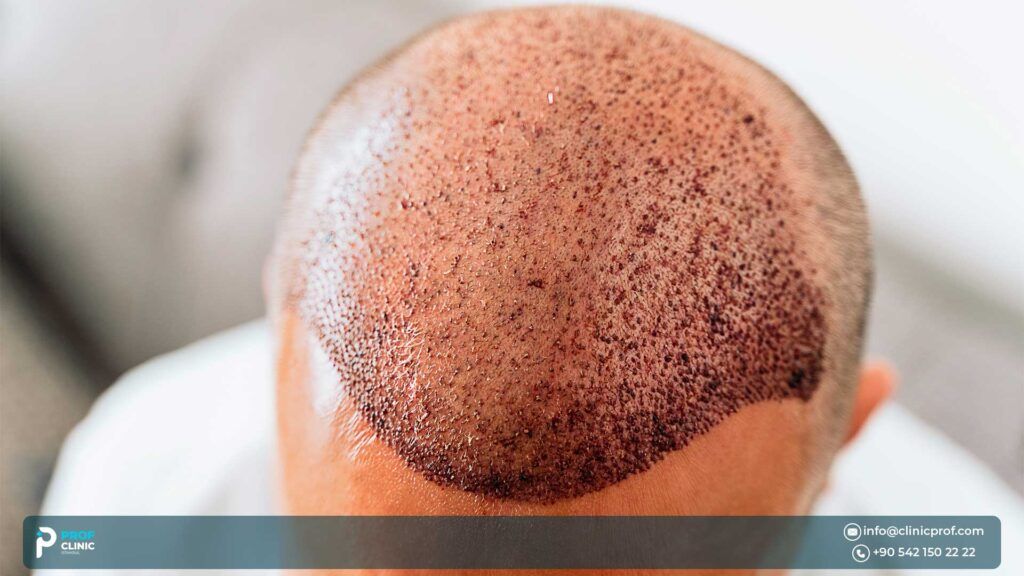
- Weeks 1–2: Small scabs form around each graft, and the grafts are still fragile; the NHS advises being very careful with them for the first 2 weeks.
- Weeks 2–8: Most transplanted hairs fall out. The AAD describes this as normal, and it isn’t graft loss.
- Months 3–4: The first fine hairs appear, although the crown may look thinner than before surgery for a while.
- Months 6–9: Visible change, with hairs still thickening; the scalp may show under bright overhead light.
- Months 12–18: The crown’s final result, as the later hairs catch up and mature.
These are typical ranges, not fixed rules.
Also read: Hair Transplant Timeline Month by Month: Growth and Shock Loss
Crown Hair Transplant Before and After: What to Expect
Realistic crown hair transplant before and after photos usually show much less visible scalp, not a return to teenage density. The AAD puts it plainly: a full head of hair may be unrealistic, but a fuller head of hair can be the goal. In the 820-case FUE study, men who had only the vertex treated gave the lowest average satisfaction score, 2.8 on a five-point scale against 4.3 for front and mid-scalp coverage, which shows how much expectations for the crown need to be agreed before surgery.
So, is a crown hair transplant successful? For a well-chosen candidate, it usually improves coverage clearly, as long as the grafts grow well and the surrounding hair stays reasonably stable. When you look at results, check these points:
- Same light and angle: overhead light makes any crown look thinner, so compare like with like.
- Dry, unstyled hair: wet hair or hair fibres can make the crown look better or worse than it is.
- Time since surgery: crown photos taken before about 12 months don’t show the final result.
- Hair and skin contrast: as our men’s service page notes, fine hair gives less coverage than thick or curly hair, and light hair can look less dense on light skin.
Want to see how results look over time? Browse consented cases in our before-and-after gallery, and focus on cases with hair and skin similar to yours.
Crown Hair Transplant Cost and the Role of Medication
Grafts drive the price of a crown transplant, while medication can decide how long the result keeps looking good, so both belong in your plan.
What a Crown Transplant Usually Costs
The crown hair transplant cost depends on the number of grafts and on whether the front is treated too. As a general guide, a scalp hair transplant in Turkey is usually offered as a package costing about €1,800–€3,500 in Istanbul. This is an approximate average range, dated October 2026, not a final price: your price depends on your case after assessment. A small crown tends to sit towards the lower part of that range, while crown plus hairline in one plan tends towards the upper part.
Packages usually include the procedure, pre-op blood tests, medication and an aftercare kit, a hotel stay and VIP airport and hotel transfers, and the final price comes in a written quote after your photos are assessed. If PRP is suggested, ask whether it’s included or billed per session; as a rough guide, a session usually costs about €100–€250. For the wider picture, read Hair Transplant Cost in Turkey 2026: Prices, Packages & Grafts.
Why Medication Matters More for the Crown
Medication can protect the hair you haven’t transplanted, and the crown is where much of the trial evidence was gathered. In the 1998 finasteride 1 mg trials, hair counts were measured in a circle of balding vertex scalp, and men on finasteride gained hair compared with placebo over two years, while those on placebo kept losing it. The AAD adds that hair loss and thinning can continue after a transplant, and that medicine can prevent or slow new loss.
Medication isn’t right for everyone and can have side effects, so it’s a decision to make with a doctor, not something to start on your own. Either way, a transplant moves hair; it doesn’t stop the loss around it.
Ready to compare a plan for your crown? Book a free online consultation and ask for a written quote that lists the graft count and what’s included.
Planning a Crown Hair Transplant with Prof Clinic in Istanbul
At Prof Clinic, crown planning starts with your photos, not with a fixed package. You send clear pictures of the front, sides, crown and donor area, with a short medical and hair-loss history. The medical assessment and treatment planning are led by Spc. Dr. Lütfi Öztürk, an internal-medicine specialist and the clinic’s medical lead for hair restoration, who reviews the pattern and stability of your hair loss, donor quality, scalp condition, medications and expectations. Expected density is discussed with you individually rather than promised in advance.
Here’s what you can check before you travel:
- Techniques: FUE, DHI, Sapphire FUE and Micro FUE are offered, and the team explains which suits your crown and why.
- Pre-op tests: blood count, ECG, kidney and liver function, electrolytes, blood sugar, and hepatitis and HIV screening.
- A written offer: the price comes in writing after the team has evaluated your photos.
- All-inclusive packages: a male hair transplant in Turkey package covers the procedure, accommodation, airport and hotel transfers and post-op care; a stay is typically 2–4 days.
- Follow-up at home: the coordination team stays in touch through the growth months and gives advice over WhatsApp.
FAQs About Crown Hair Transplants
Does a crown hair transplant work?
Yes, for suitable candidates it usually improves coverage of the crown, although it’s rarely as dense as the original hair. It works best when hair loss has stabilised, the donor area is strong and expectations are realistic. Because hair around the crown can keep thinning, doctors often discuss medication to protect the untreated hair.
How many grafts does the crown need?
It depends on the size of the bald area. Surgeons multiply the area by the planned density, often about 20–25 grafts per cm² at the vertex, so a small crown may need several hundred grafts and a large one 2,000 or more. Your own number comes only after photos or an examination.
Why does the crown grow more slowly after a transplant?
It follows the same growth cycle as the front but usually takes longer to look finished. Hair fans out from the whorl, so early fine hairs show more scalp, and crown density is planned lower, so coverage builds gradually. It’s best to judge the crown at about 12–18 months, the later part of the NHS 10–18-month window.
Should I do the hairline or the crown first?
In most cases, the hairline comes first, because it frames the face and donor hair is limited. The crown can be treated in the same session if your donor supply allows, or later, once it’s clearer how your hair loss is progressing. Younger men are often advised to stabilise their hair loss before any crown work.
Can the crown and hairline be done in one session?
Sometimes, if your donor area can safely supply enough grafts for both. Very large sessions may be split over two days. If donor hair is limited, covering both at once can leave nothing in reserve for future hair loss, so many plans treat the front first and the crown later.
Is a Crown Hair Transplant Right for You?
A crown hair transplant works best when three things line up: your hair loss has settled, your donor area can spare grafts without leaving the hairline short, and you’re happy with good coverage rather than original density. Get those answers before you think about technique or price, and give the crown 12–18 months before you judge it. To find out whether your vertex suits a male hair transplant in Istanbul, contact Prof Clinic with photos of your crown and donor area.
Sources
- NHS — Hair transplant
- American Academy of Dermatology — A hair transplant can give you permanent, natural-looking results
- Journal of Cutaneous and Aesthetic Surgery — Recipient Area (Marwah & Mysore, 2018)
- Journal of Cutaneous and Aesthetic Surgery — Approach to Hair Transplantation in Advanced Grade Baldness by Follicular Unit Extraction: A Retrospective Analysis of 820 Cases (Chouhan et al., 2019)
- Clinical, Cosmetic and Investigational Dermatology — Hair Restoration Surgery: Challenges and Solutions (Rose, 2015)
- Journal of the American Academy of Dermatology — Finasteride in the Treatment of Men with Androgenetic Alopecia (Kaufman et al., 1998)