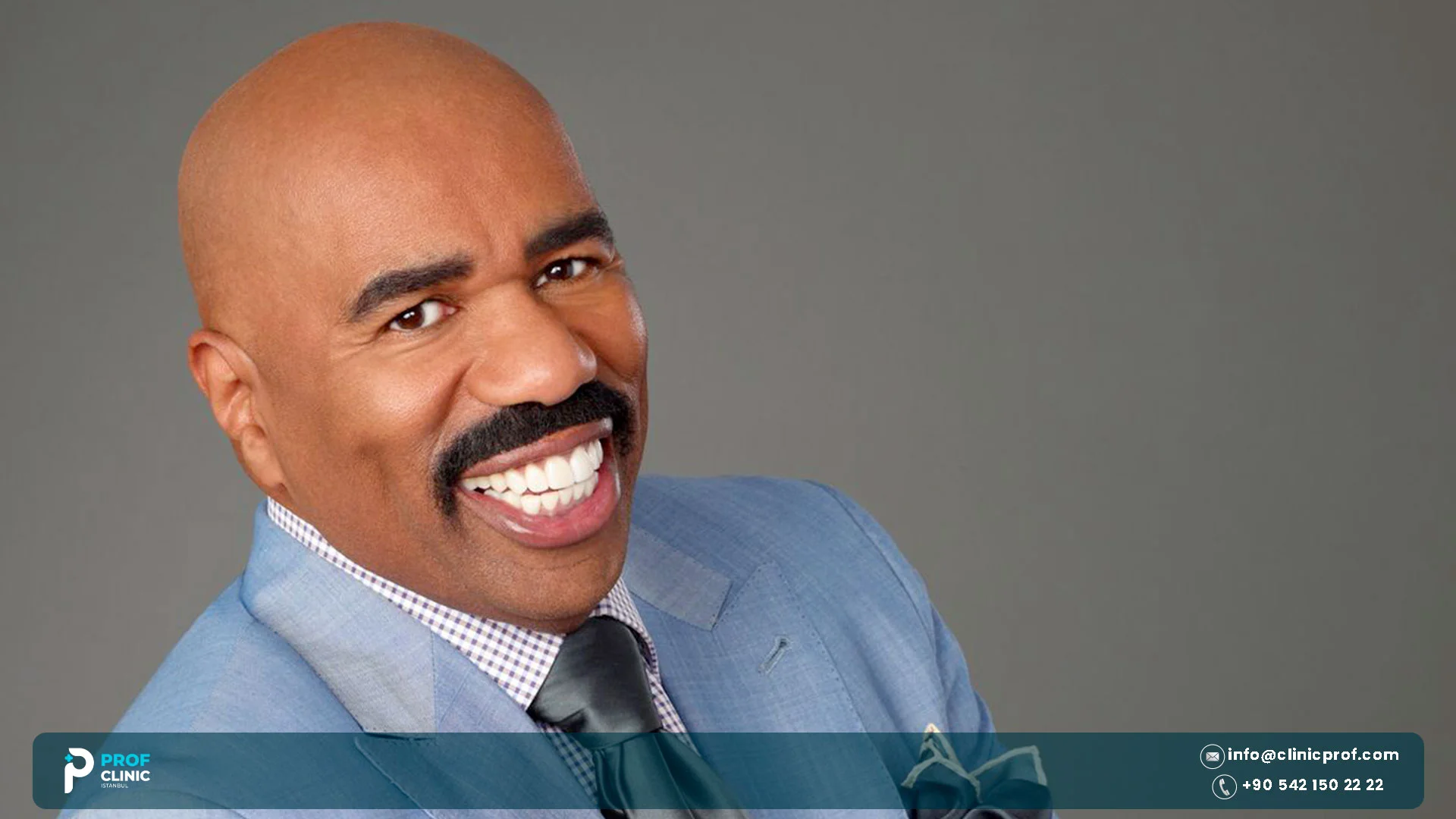
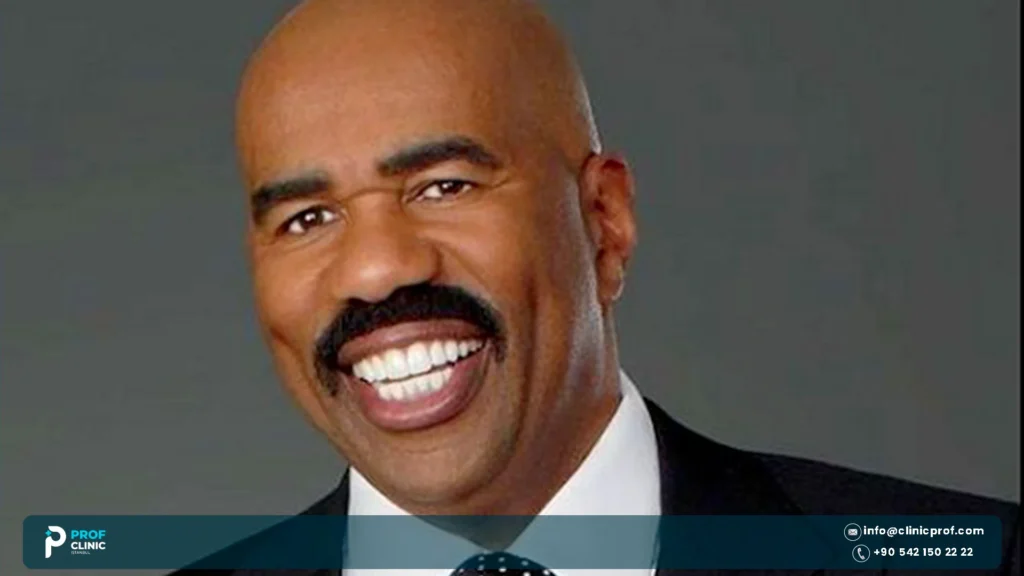
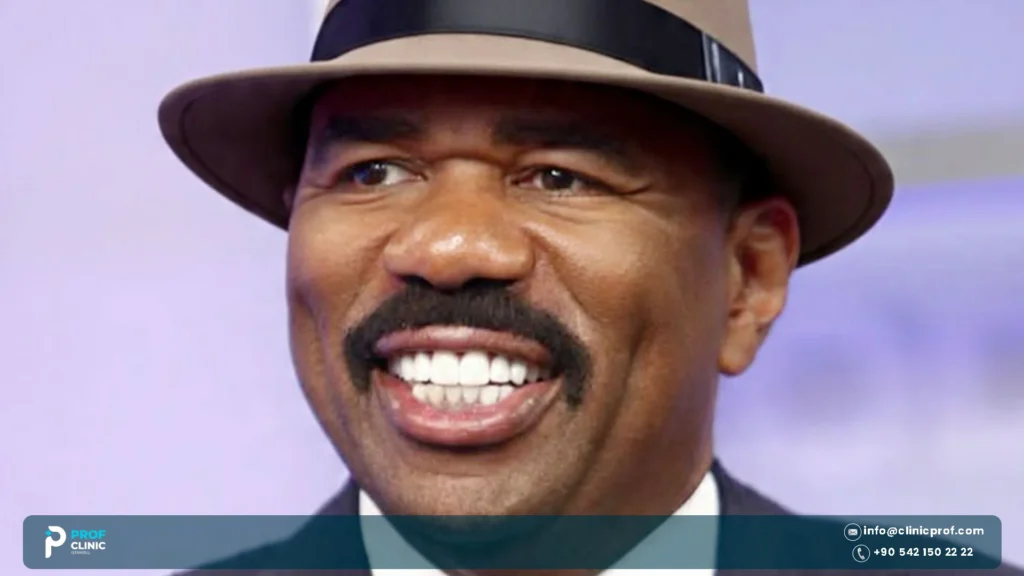
Steve Harvey teeth look brighter and more uniform today than in some of his early stand-up footage, but Harvey has never publicly confirmed veneers or dentures. There is also no reliable evidence that his familiar television smile is a removable denture.
So, are Steve Harvey’s teeth real? The public record does not tell us exactly which teeth, if any, have been cosmetically restored. What we can see is a polished modern smile; what photographs cannot establish is whether that appearance comes from veneers, crowns, whitening, bonding or a combination of treatments.
Medical note
This article is educational and does not diagnose Steve Harvey or any reader. Veneers, crowns and dentures solve different dental problems, and the appropriate treatment depends on the condition of the natural teeth, gums, bite and any missing teeth.
Steve Harvey has no known connection to Prof Clinic. His public smile is discussed only as a useful way to explain the differences between cosmetic and prosthetic dental treatment.
The Smile Built for Daytime Television
The Steve Harvey smile has spent decades under unusually close scrutiny.
Harvey moved from stand-up comedy into television, eventually becoming the long-running host of Family Feud and Celebrity Family Feud. His official Family Feud profile traces a television career that also includes The Steve Harvey Show, Little Big Shots and other camera-heavy formats where facial expressions are central to his performance.
Family Feud makes that visibility even stronger. Harvey laughs, reacts, raises his eyebrows and leans into contestants while cameras repeatedly cut to tight facial shots. A bright smile that might attract little attention across a theatre stage becomes much easier to examine on an HD television.
Steve Harvey Before Veneers: The Early Comedy Years
There is no confirmed date when Harvey received veneers because he has never publicly said that he did.
Still, his own old-school stand-up archive gives us a useful visual baseline. In early footage, Harvey already had a broad, expressive smile, but the visible teeth generally appear warmer in shade and somewhat less uniform than the very bright smile seen in many later television appearances.
That makes Steve Harvey teeth before comparisons more subtle than celebrity transformations involving obvious gaps, major crowding or missing teeth. The earlier smile does not show a completely different dental arrangement; the most noticeable differences are brightness and overall visual consistency.
The same is true when looking at early Steve Harvey teeth footage. Camera quality, film stock and lighting changed enormously between his comedy-club years and modern television, so shade differences should not automatically be interpreted as restorative dentistry.
Why Television Lighting Exposes Everything
Studio television is difficult territory for cosmetic dental work.
High-definition cameras can reveal small differences in colour, surface texture, edge shape and translucency. Strong frontal lighting also reduces shadows, making tooth contours easier to see while often making enamel appear brighter.
That combination helps explain why Harvey’s smile receives so much attention. A slightly uneven colour match that might disappear in everyday conversation can become visible in a close-up, while highly consistent teeth may appear even more uniform under studio lighting.
Photography can also work in the opposite direction. White balance, exposure and image processing can make natural teeth look much brighter than they do in person.
Are Steve Harvey’s Teeth Real?
The most accurate answer is that Harvey has never publicly provided a detailed dental history establishing whether his current smile consists entirely of untreated natural teeth, veneers, crowns or another type of restoration.
There is also an important difference between a restored natural tooth and a false replacement tooth. A veneer still uses the underlying natural tooth. A crown also covers a tooth that remains in the mouth. Dentures replace missing teeth.
So Steve Harvey’s teeth could include cosmetic restorations without being dentures or removable false teeth.
Does Steve Harvey Have Veneers?
Does Steve Harvey have veneers? It is possible, but it has not been confirmed by Harvey.
The Steve Harvey veneers theory is understandable because his modern smile frequently appears very bright, symmetrical and consistent in colour. Those visual characteristics can occur in well-designed veneer cases, but they are not diagnostic signs.
Professional whitening can create a dramatic shade change without covering the teeth. Composite bonding can modify edges and proportions. Crowns can produce similar uniformity when structurally damaged teeth require fuller coverage.
Even naturally aligned teeth can appear exceptionally uniform under professional lighting.
The American Dental Association’s veneer guidance explains that veneers are thin coverings placed over the front surfaces of teeth and may be used to change the appearance of chipped, discoloured or irregular teeth. They remain attached to the patient’s natural teeth rather than replacing them.
The Dentures and False Teeth Rumour
The dentures question is much easier to separate conceptually from veneers.
Does Steve Harvey have dentures? There is no reliable public confirmation that he does. The same applies to does Steve Harvey wear dentures, does Steve Harvey have false teeth and does Steve Harvey have fake teeth.
Dentures have even become part of the humour around Harvey on Family Feud. In an official Family Feud clip, a contestant unexpectedly brings dentures into an answer about Harvey’s teeth, prompting an incredulous reaction from him. The exchange is a comedy moment, not evidence about his dental history.
Clinically, dentures are very different from veneers. The NHS guide to dentures explains that complete dentures replace all teeth in an arch, while partial dentures replace one or more missing teeth and are generally removable.
A highly polished television smile therefore does not become evidence of dentures simply because the teeth look unusually white.
Read as well: Shane MacGowan Teeth: Before and After the Restoration
Steve Harvey Teeth Before and After
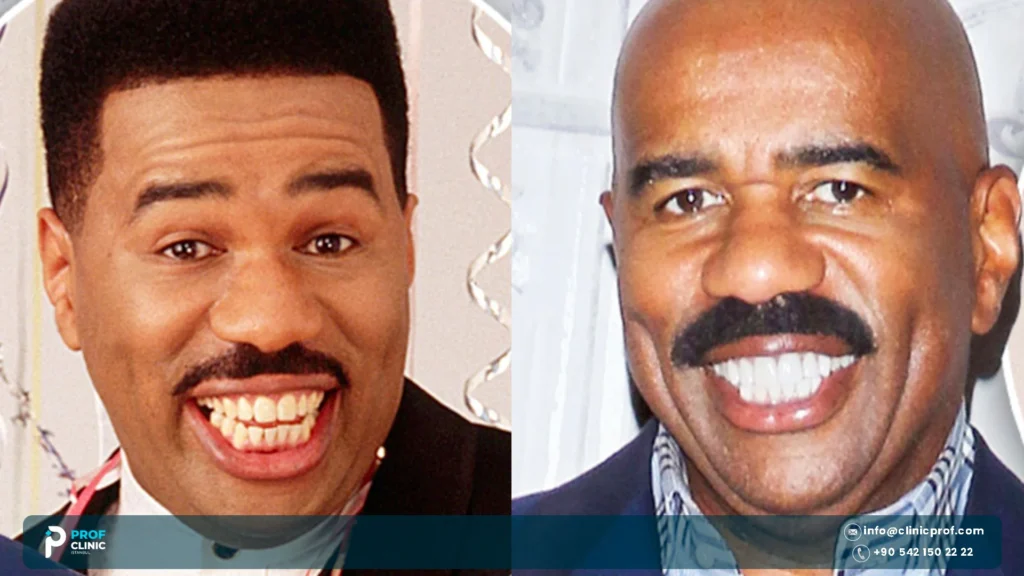
Comparing Harvey across decades suggests refinement rather than a dramatic reconstruction.
Earlier footage shows teeth that already appear relatively well aligned. In many recent television close-ups, the smile appears brighter, with a more consistent shade and a particularly even presentation across the visible upper teeth.
Those differences leave several plausible dental explanations, but no confirmed one.
This is also why comparing Steve Harvey before veneers should be done carefully. Without Harvey confirming veneers, there is no legitimate treatment date that divides his career into a clinical before and after.
Similarly, references to Steve Harvey fake teeth should not be treated as established fact. A restored tooth remains a real tooth underneath when veneers or crowns are used, whereas dentures and implant-supported prostheses replace teeth that are missing.
Veneers vs Dentures: How to Tell
Veneers and dentures can both create a more regular-looking smile, but clinically they have almost nothing in common.
A veneer is bonded to an existing tooth. A crown covers most or all of an existing tooth. A denture replaces teeth that are no longer present.
The NHS overview of dental treatments describes a crown as a cap that completely covers a real tooth, veneers as thin facings fitted over the front of teeth and dentures as replacements for missing teeth.
That distinction matters far more than whether a smile happens to look very white.
What Veneers Look Like Up Close
Well-made veneers should not announce themselves as veneers.
Each restoration is designed around the gum line, neighbouring teeth and the patient’s facial proportions. Natural-looking ceramic may contain subtle variation in translucency, surface texture and edge detail rather than presenting as a flat block of white.
The restoration also emerges from the position of the patient’s existing tooth rather than from a removable denture base.
Photographs can sometimes make restorations look more likely when several adjacent teeth share nearly identical proportions and shade. But visual uniformity alone cannot prove that veneers are present.
Also Read: Was Jim Carrey’s Chipped Tooth Real or a Movie Trick?
15 Differences Between Veneers, Crowns and Dentures
- Underlying teeth: Veneers require existing teeth, crowns usually cover existing teeth, while dentures replace teeth that are missing.
- Coverage: A veneer primarily covers the visible front surface, whereas a crown surrounds most or all of the clinical crown.
- Removability: Conventional veneers and crowns are fixed; conventional dentures can be removed.
- Main purpose: Veneers are usually chosen primarily for aesthetic correction, crowns can restore damaged or weakened teeth, and dentures replace lost teeth.
- Tooth preparation: Veneers may require limited enamel preparation, while crowns generally require more circumferential reduction.
- Missing teeth: A veneer cannot replace a tooth that is no longer present; a denture, bridge or implant-supported restoration can.
- Gum relationship: Veneers and crowns emerge individually around existing tooth positions, while a denture may also replace missing gum volume.
- Bite forces: All three treatments must account for how the upper and lower teeth meet, but the prosthetic design and load distribution differ substantially.
- Aesthetic control: Veneers offer considerable control over front-tooth shape and shade without necessarily covering the entire tooth.
- Structural protection: Crowns provide broader coverage when a tooth is extensively damaged, heavily restored or otherwise requires greater protection.
- Stability: Fixed veneers and crowns remain bonded or cemented in place, while removable dentures depend on their fit, clasps or implant attachments.
- Cleaning: Veneers and crowns are brushed and cleaned between like other fixed teeth; removable dentures need separate cleaning as well as care of the gums and remaining teeth.
- Cost: Veneer and crown costs depend heavily on material and unit count, while denture costs depend on the arch, material and whether implants or attachments are involved.
- Maintenance: Veneers may chip or debond, crowns can wear or require replacement, and dentures can loosen as the mouth changes over time.
- Treatment planning: Healthy teeth with cosmetic concerns may suit veneers, damaged teeth may require crowns, and extensive tooth loss shifts the discussion toward bridges, implants or dentures.
Why Uniformity Is the Biggest Giveaway
The feature that makes viewers suspect cosmetic dentistry most often is not whiteness by itself. It is repetition.
Natural front teeth normally differ slightly from one another in width, edge contour, translucency and surface character. A smile where every visible tooth appears almost identical can therefore look designed rather than naturally variable.
That does not mean uniform teeth prove veneers. Modern ceramics can be deliberately characterised to reproduce natural variation, while whitening can make natural teeth more consistent in colour without changing their shapes.
In Harvey’s case, the relatively even shade and proportions of his current smile explain why veneers are frequently considered a possibility. They do not tell us whether Steve Harvey’s real teeth have been veneered, crowned, whitened or otherwise restored.
Prof Clinic, Istanbul: Veneers for International Patients
The difference between veneers, crowns and dentures becomes much more important when planning treatment for an actual patient.
At Prof Clinic in Istanbul, we first assess whether the teeth are healthy enough to preserve, whether they need structural coverage or whether missing teeth require replacement. Cosmetic goals come after that diagnosis.
For patients with healthy teeth who mainly want to change shade, shape or small visible irregularities, our E-max Veneers Turkey Packages provide one restorative route. Patients with damaged or missing teeth may need a completely different plan.
We do not connect any patient plan to a celebrity smile. Steve Harvey has no known connection to Prof Clinic, and his unconfirmed dental history should not be used as a template for another patient’s treatment.
Prof Clinic’s Veneer and Prosthetic Services
Prof Clinic’s dental services include veneers, zirconia and E-max restorations, crowns, bridges and implant-supported treatment for patients whose needs extend beyond cosmetic surface correction.
Our Dental Treatment service also includes digital smile planning and 3D imaging where appropriate, allowing the team to assess the relationship between the visible smile and the underlying teeth, bone and bite.
A patient with healthy front teeth and aesthetic concerns may be considered for veneers. A heavily damaged tooth may require full crown coverage. When a tooth is missing altogether, a bridge or dental implant may become the more relevant discussion.
The restoration should follow the dental condition rather than forcing every patient into the same cosmetic treatment.
Read as well: Justin Jefferson Teeth: What Changed and What It Costs
How Prof Clinic Decides Veneers vs Crowns vs Implants
| Treatment | Tooth condition | Coverage or replacement | Cost profile | Durability considerations | Maintenance |
| Veneer | Existing tooth is generally preserved and cosmetic change is the main goal | Covers mainly the visible front surface | Driven by material and number of treated teeth | Long-term ceramic restoration but can chip or debond | Brushing, interdental cleaning and bite review |
| Crown | Tooth requires broader structural restoration | Covers most or all of the visible tooth | Depends on material, tooth condition and any supporting treatment | Designed for greater coverage and functional loading | Hygiene around margins and regular bite checks |
| Bridge | One or more teeth are missing | Fixed replacement spans the missing space | Depends on number of units and supporting teeth or implants | Support design and bite affect longevity | Special cleaning beneath the replacement teeth |
| Dental implant | Tooth is missing and bone can support implant treatment | Implant replaces the root and supports a crown or bridge | Includes surgical and restorative components | Requires successful healing and long-term tissue health | Cleaning around the implant and professional review |
| Denture or implant-supported prosthesis | Several or all teeth are missing | Replaces multiple teeth or a complete arch | Depends on arch design, material and implant support | Fit and component wear may change over time | Daily prosthesis and tissue care |
For patients comparing a missing-tooth solution with a conventional bridge, Prof Clinic’s Dental Implant vs Bridge guide explains how the two options differ in support, preparation and treatment sequence.
Restoration Results at Prof Clinic
A useful before-and-after gallery should include more than extremely white full-mouth transformations.
Veneer cases can demonstrate changes in shape and shade, while crown, implant and bridge cases show different starting conditions and different restorative goals. The most relevant comparison is a case that resembles the patient’s own dental problem.
Our Prof Clinic Before and After gallery includes consented dentistry cases across different types of treatment. These examples can help patients understand possible aesthetic directions while the clinical plan remains individual to their teeth, gums and bite.
The Steve Harvey smile has become one of the most recognisable on television, and his modern teeth often appear brighter and more uniform than in older stand-up footage. That visual change explains the long-running veneer speculation, but Harvey has not publicly confirmed Steve Harvey veneers, dentures or another specific cosmetic dental procedure.
At Prof Clinic, we choose between those options according to the condition of the mouth rather than trying to recreate a celebrity smile.
Send us clear smile photos and your dental X-rays if available, and our team can assess whether veneers, crowns, implants or another approach may better suit your case.
Steve Harvey’s Teeth: Your Questions Answered
- Does Steve Harvey have veneers?
Steve Harvey has not publicly confirmed veneers. His current teeth often appear bright and highly uniform, which can resemble a veneer result, but photographs cannot distinguish veneers confidently from whitening, crowns, bonding or naturally uniform teeth.
- Does Steve Harvey have dentures?
There is no reliable evidence that Steve Harvey wears dentures, and he has not publicly confirmed them. An official Family Feud clip even features a contestant joking about dentures in relation to Harvey, but the exchange is entertainment rather than evidence about his dental treatment.
- What did Steve Harvey’s teeth look like before?
Harvey’s early stand-up footage shows a broad smile that was already relatively well aligned. Compared with many modern television appearances, the earlier teeth generally look warmer in colour and somewhat less visually uniform, although differences in lighting and recording quality make exact comparison difficult. His official old-school stand-up footage provides a useful public baseline.
- How long do veneers last?
There is no fixed expiry date for a veneer. A systematic review of 6,500 porcelain laminate veneers estimated cumulative survival at 95.5% after 10 years, although fractures, debonding, decay and other complications can still occur.
Good oral hygiene, appropriate bite forces, avoiding damaging habits and regular dental reviews can all influence how long a restoration remains serviceable.