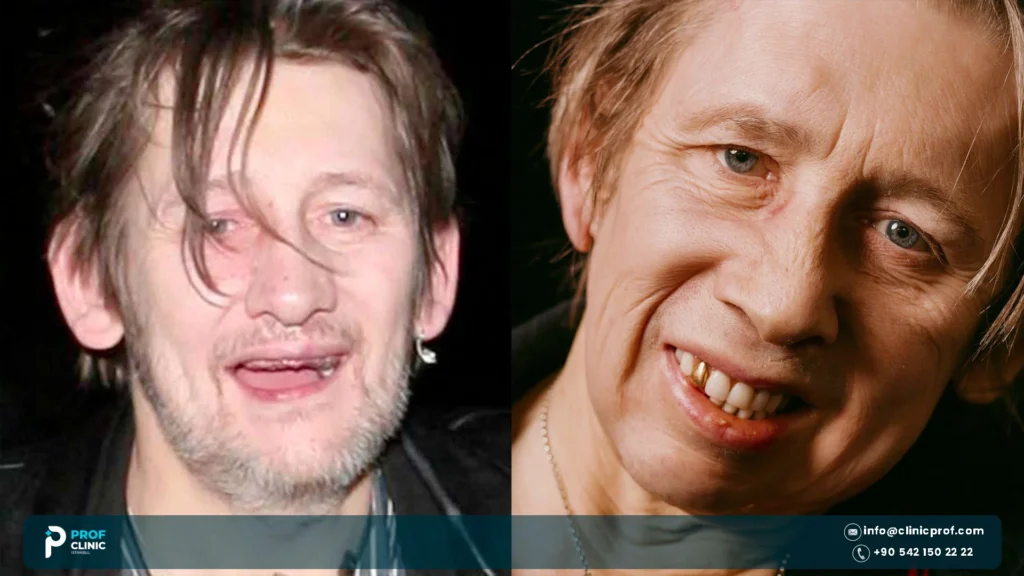
Shane MacGowan teeth were not the subject of celebrity speculation. In 2015, the late Pogues singer allowed an extensive dental reconstruction to be filmed for the Sky Arts documentary Shane MacGowan: A Wreck Reborn. The treatment rebuilt a mouth that had been without natural teeth for years with 28 teeth on a titanium framework.
MacGowan, who died in 2023 at age 65, spoke openly about the treatment and the difficulties he had experienced before it. His case became one of the better-documented examples of a severe full-mouth restoration in popular culture, showing that even extensive tooth loss can sometimes be rehabilitated through carefully staged restorative dentistry.
Medical note
This article is educational and does not diagnose Shane MacGowan or any reader. Full-mouth rehabilitation can involve implants, bridges, dentures, crowns, bone grafting or combinations of treatments depending on oral health, anatomy and remaining teeth.
Shane MacGowan had no known connection to Prof Clinic. His documented treatment is discussed here as an example of complex full-mouth rehabilitation.
The Most Documented Smile Rebuild in Music
MacGowan’s teeth had been part of his public image for decades, but his 2015 restoration was different from the usual celebrity before-and-after story.
Rather than relying on photographs and guessing what had been done, viewers could follow the process itself. His official website announced the Sky Arts documentary as a film following MacGowan while he received new dental implants, while contemporary reporting documented interviews with his dental surgeon, family and friends.
The result was not simply a cosmetic whitening or a few veneers. It was a major reconstruction intended to restore teeth across the mouth and improve everyday function as well as appearance.
Shane MacGowan’s Teeth Before: What Happened
By the time of the reconstruction, Shane MacGowan’s teeth had been lost over many years.
MacGowan discussed his dental history publicly, including unpleasant childhood experiences with tooth extraction. In the 2015 documentary coverage, he said he had been afraid of having his mouth restored but felt it had reached the point where treatment had to be done. Sky News reported MacGowan discussing both his childhood dental experiences and his anxiety before the reconstruction.
His dental surgeon Darragh Mulrooney later described the scale of tooth loss as one of the most demanding cases his team had taken on. Contemporary reporting stated that MacGowan had lost his last remaining natural teeth by 2008 and tried conventional dentures in 2009, but found them unsatisfactory.
The causes of severe tooth loss can be complex and should not be reduced to a single lifestyle factor from photographs or celebrity coverage. In MacGowan’s case, the useful clinical point is that by 2015 the problem was no longer a matter of repairing one or two teeth: the mouth required comprehensive rehabilitation.
Why His Smile Became Part of His Public Image
For decades, photographs of MacGowan performing showed an increasingly incomplete smile. Because he sang with an expressive, open mouth, missing teeth became visually inseparable from his stage image.
He was aware of that association and could joke about it himself, but his later decision to undergo treatment was not merely about looking different.
Missing most or all teeth can affect chewing, speech and the way the lips and lower face are supported. The American College of Prosthodontists notes that replacing missing teeth can improve chewing and may improve speech problems associated with tooth loss.
MacGowan’s own response after treatment was understated but revealing: he said it was good to have teeth again and that he felt better about his appearance. His dentist also described the significance of MacGowan being able to eat an apple again after many years.
Also Read: Was Jim Carrey’s Chipped Tooth Real or a Movie Trick?
The 2015 Reconstruction, Filmed and Broadcast
The reconstruction was documented in Shane MacGowan: A Wreck Reborn, broadcast by Sky Arts in December 2015.
The documentary followed MacGowan through treatment rather than presenting only a finished reveal. That makes Shane MacGowan teeth before and after unusually well documented compared with most celebrity dental transformations.
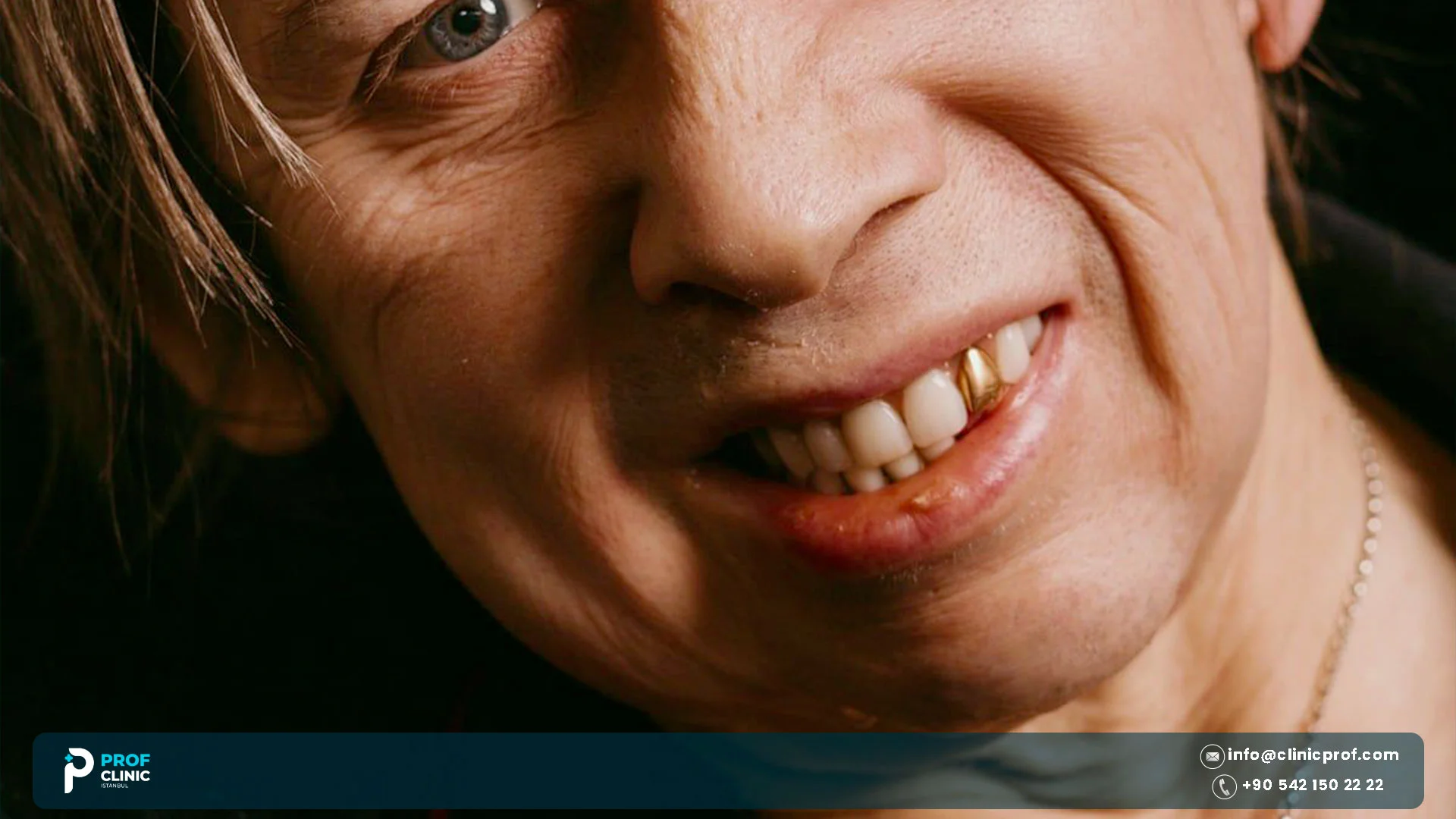
The procedure involved an interdisciplinary team, multiple treatment stages and a final set of 28 teeth supported by a titanium framework. One tooth was made gold at MacGowan’s request, preserving a small element of the unconventional image associated with him. The Independent’s interview with dental surgeon Darragh Mulrooney described the case as being about as large as restorative dental treatment gets.
The Full Mouth Reconstruction He Agreed To Film
Contemporary reports described a major procedure lasting about nine hours, with a complete set of 28 teeth fitted on a titanium framework. MacGowan had also told the press during the treatment period that he had undergone two operations and still had further work to complete, reinforcing that the reconstruction was a process rather than a one-day cosmetic makeover.
The important clinical distinction is between the implants and the visible teeth.
A dental implant is not itself a tooth. The American College of Prosthodontists explains that implants are fixtures placed into the jawbone and can then support crowns, bridges or full dentures.
In a severely compromised mouth, the final restoration may therefore combine several components:
- Implants anchored in available jawbone
- Abutments or connectors above the implants
- A supporting framework
- Fixed or removable prosthetic teeth
- Adjustments to the bite
- Temporary restorations during healing
MacGowan’s treatment was specific to his anatomy and needs, but the same basic principle remains central to modern full-arch rehabilitation: the visible teeth are only the final part of a much larger structural plan.
Shane MacGowan’s New Teeth: The Result
The visual change was striking because the starting point involved extensive tooth loss.
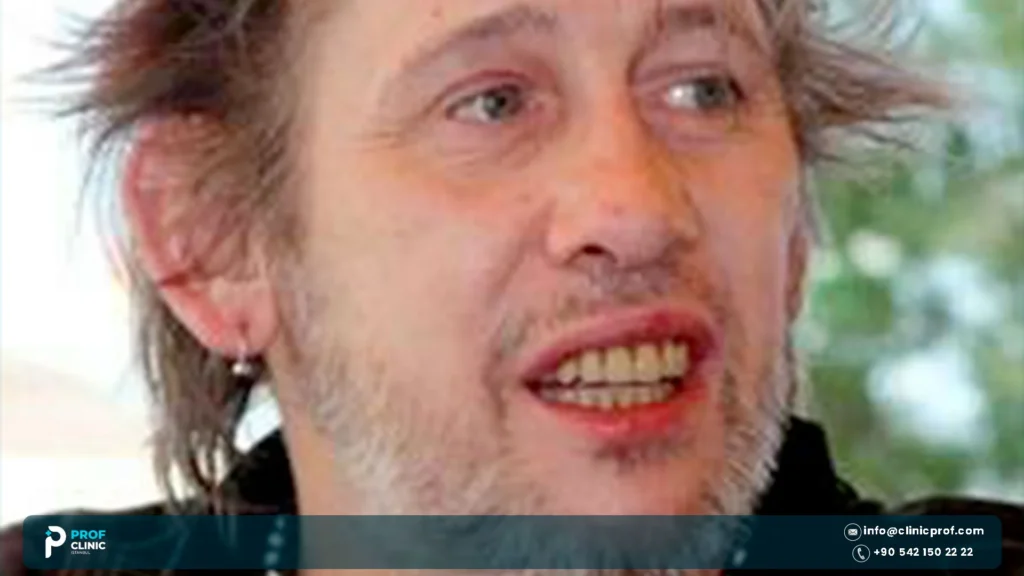
The widely circulated Shane MacGowan new teeth pic from the 2015 coverage showed a complete, evenly arranged smile with the distinctive gold tooth included among the new restorations.
Function mattered just as much as the photograph. MacGowan’s dentist explained that the new teeth could alter the way his tongue moved during speech and singing because the mouth once again contained a complete dental structure. He described the process as effectively retuning MacGowan’s instrument.
Eating also changed. Mulrooney recalled MacGowan being given an apple, something he reportedly had not eaten in around 20 years. That small detail captures what full-mouth rehabilitation is ultimately meant to accomplish: restore useful oral function, not simply produce a better photograph.
What This Case Showed About Extreme Restoration
MacGowan’s case is memorable because the starting condition was severe, yet the treatment still had meaningful restorative options.
Modern full-mouth rehabilitation can replace an entire arch even when few or no usable teeth remain. The final plan may use fixed implant-supported bridges, removable implant-supported dentures or conventional dentures depending on anatomy, bone support, medical history and patient priorities.
The American College of Prosthodontists’ full-mouth reconstruction guidance describes full-mouth rehabilitation as treatment affecting all the teeth in the mouth and notes that it can include crowns, bridges, implants and dentures, often with several dental disciplines working together.
The hopeful part of MacGowan’s story is therefore not that every severe case can receive exactly the same reconstruction. It is that extensive tooth loss does not automatically mean there is nothing left to treat.
What Full Mouth Restoration Actually Involves
Full-mouth restoration begins with diagnosis, not with choosing a set of new teeth.
The dentist needs to know what can be preserved, what has to be removed, whether the gums are healthy and whether the jawbone can support implants. Bite forces, facial proportions, speech, cleaning access and the patient’s ability to maintain the final prosthesis also influence the design.
Implant-supported treatment adds another biological requirement: bone needs time to integrate around the implants. Research on osseointegration describes this as the direct structural and functional connection that develops between living bone and the implant surface.
Also Read: Tom Hardy Teeth: Before, After and What Really Changed
18 Things to Know Before Full Mouth Restoration
- Bone volume matters. Implant number and position depend on the amount and quality of available jawbone.
- A CBCT scan may be needed. Three-dimensional imaging helps assess bone, nerves, sinuses and possible implant positions.
- Not every remaining tooth has to be extracted. Teeth with a reasonable long-term prognosis may sometimes be preserved.
- Gum health comes first. Active periodontal disease can undermine both natural teeth and implant treatment.
- Extractions can change the timeline. Some implants can be placed immediately after extraction, while other sites benefit from healing first.
- Bone grafting may add another stage. Significant bone loss can require augmentation before or during implant placement.
- All-on-4 and All-on-6 are full-arch concepts. They use four or six implants respectively to support a complete fixed bridge.
- More implants are not automatically better. Bone anatomy, implant position, bite forces and prosthetic design matter alongside implant count.
- Temporary teeth are different from final teeth. A provisional bridge may protect appearance and function while tissues heal.
- Same-day teeth do not mean the case is finished in one day. Immediate loading refers to fitting a temporary restoration soon after implant placement.
- Healing affects the final schedule. Bone integration and soft-tissue maturation continue after surgery.
- The bite has to be rebuilt carefully. Full-mouth work changes how forces are distributed across the jaws.
- Speech may need adjustment. A new arch shape can temporarily alter tongue position and pronunciation.
- Cleaning access must be designed into the prosthesis. Fixed full-arch bridges still require daily cleaning underneath and around implant supports.
- Smoking and general health matter. Healing and long-term implant maintenance can be affected by systemic and behavioural risk factors.
- Material choice affects maintenance. Acrylic, composite and ceramic restorations differ in wear, repairability and aesthetics.
- Cost includes more than implants. Extractions, grafting, abutments, temporary teeth, final restorations and additional procedures can all change the total.
- Maintenance continues for life. Implants and full-arch prostheses require home hygiene and professional review even after treatment is complete.
Implants, Bridges and Dentures Compared
Several treatment routes can restore extensive tooth loss, but they differ substantially in surgery, stability, cost and maintenance.
| Option | How it works | Main advantage | Main limitation |
| Conventional denture | Removable teeth rest over the gums | No implant surgery and generally lower cost | Can move during eating and may require adjustments |
| Implant-supported overdenture | Removable denture clips onto implants | Better stability than a conventional denture | Still removable and requires attachment maintenance |
| Implant-supported bridge | Fixed bridge attaches to implants | Stable fixed teeth and strong chewing support | Requires surgery, adequate bone and careful hygiene |
| All-on-4 | Four implants support a full arch | Full-arch fixed option with fewer implants | Suitability depends on bone distribution and prosthetic design |
| All-on-6 | Six implants support a full arch | Additional implant support and load distribution in suitable cases | Requires adequate implant sites and generally costs more |
| Individual implants and bridges | Multiple implants support smaller sections | Can closely reproduce separate tooth groups | Usually more complex and implant-intensive |
The American College of Prosthodontists explains that implants can support either removable overdentures or fixed full-arch prostheses, while the NHS lists conventional dentures, bridges and implants among the main ways of replacing missing teeth.
The right choice depends less on which option sounds most advanced and more on anatomy, health, maintenance ability and what the patient wants the final teeth to feel like.
How Long a Full Rebuild Takes Start to Finish
A complex full-mouth reconstruction is usually measured in months rather than days.
Some suitable patients can receive implants and a temporary fixed bridge quickly, but the final restoration normally comes after healing and verification that the implants are stable.
Prof Clinic’s own full-arch dental implant guide distinguishes between early temporary teeth and the final prosthesis placed after healing. Clinical research on immediately restored full arches has likewise reported placement of the definitive restoration several months after implant surgery.
A typical pathway may look like:
- Consultation, records and CBCT imaging
- Extractions or preliminary treatment where needed
- Implant placement
- Temporary teeth in suitable immediate-load cases
- Several months of healing and osseointegration
- Updated impressions or scans
- Bite and aesthetic trials
- Final fixed or removable prosthesis
- Follow-up and maintenance
Bone grafting, sinus procedures, infection, healing complications or the need to preserve and treat remaining teeth can lengthen that schedule.
Read as well: Justin Jefferson Teeth: What Changed and What It Costs
Prof Clinic in Istanbul: Full Mouth Restoration Explained
Severe tooth loss does not automatically point to one treatment.
At Prof Clinic in Istanbul, we approach full-mouth rehabilitation by first identifying what can be preserved and what must be replaced. Bone support, gum condition, bite, implant position and restorative space are evaluated before deciding whether a patient is better suited to individual implants, implant-supported bridges, All-on-4, All-on-6 or another solution.
Our Dental Implants in Turkey service explains how implants can support individual crowns, bridges or dentures and why radiographic assessment is central to planning.
Shane MacGowan was not treated at Prof Clinic, and his reconstruction is not used as a template for another patient’s mouth. A modern full-mouth plan has to be built around the individual patient’s anatomy, health and restorative goals.
Prof Clinic’s Full Mouth Restoration Services
At Prof Clinic, full-mouth rehabilitation may include:
- Single or multiple dental implants
- Implant-supported bridges
- All-on-4 full-arch rehabilitation
- All-on-6 full-arch rehabilitation
- Zirconia or other prosthetic restorations
- Extractions where teeth cannot be retained
- Temporary restorations during healing
- Final fixed bridges after implant integration
- Bone augmentation when clinically indicated
- Long-term implant and prosthesis maintenance
Prof Clinic’s All-on-4 vs All-on-6 guide explains that implant number is only one part of the decision. Ridge shape, bone volume, sinus and nerve anatomy, bite forces and prosthesis design all influence whether four implants, six implants or another approach makes more sense.
How Prof Clinic Stages a Full Rebuild
A full-mouth case is easier to understand when the surgical and restorative stages are separated clearly.
| Stage | What we assess or perform | Why it matters |
| Initial assessment | Dental history, goals, existing teeth and previous treatment | Establishes what can be preserved and what needs replacement |
| 3D imaging | Bone volume, sinuses, nerves and implant sites | Determines whether implants can be placed safely |
| Treatment planning | Implant number, extraction needs and prosthetic design | Creates the surgical and restorative roadmap |
| Extractions | Removal of teeth with a poor prognosis where required | Prepares the arch for rehabilitation |
| Implant placement | Implants positioned according to the planned restoration | Creates support for the future teeth |
| Temporary teeth | Provisional fixed or removable teeth in suitable cases | Maintains appearance and limited function during healing |
| Healing | Bone and soft tissue mature around the implants | Builds biological stability before the final restoration |
| Final records | Digital scans, bite records and aesthetic planning | Designs the definitive teeth after healing |
| Final restoration | Fixed bridge, crowns or other planned prosthesis | Restores the completed arch |
| Review and maintenance | Bite, hygiene access, screws, prosthesis and tissues | Protects the rehabilitation over time |
Patients should expect the final sequence to vary. Immediate-loading cases may receive temporary teeth quickly, while grafting or more complex bone conditions can require additional healing time.
Full Mouth Restoration Outcomes
The strongest full-mouth result is not simply a row of white teeth. A successful rehabilitation should restore stable chewing, an appropriate bite, usable speech, facial support and a smile that fits the patient’s face. It should also be possible for the patient to clean and maintain the prosthesis long after treatment.
Our Dental Implant service page includes consented before-and-after implant cases, while our implant maintenance guidance explains how cleaning differs between single implants, implant-supported bridges and full-arch restorations.
Shane MacGowan’s teeth tell a very different story from the usual celebrity smile makeover. By 2015, he had lived for years with extensive tooth loss, and the reconstruction documented in Shane MacGowan: A Wreck Reborn rebuilt an entire functional smile rather than simply changing its colour or shape.
At Prof Clinic, we plan full-mouth cases around what can be preserved, what needs replacement and how the final teeth will function over time.
If you are missing most or all of your teeth, send us your dental photos and panoramic X-ray or CBCT if available for an initial full-mouth restoration assessment.
FAQ About Shane MacGowan’s Teeth
- What happened to Shane MacGowan’s teeth?
MacGowan experienced extensive tooth loss over many years and had lost his remaining natural teeth by around 2008 according to contemporary reporting. He later tried conventional dentures before undergoing the much larger reconstruction documented in 2015. Sky News also recorded MacGowan discussing his dental history and his apprehension before the procedure.
- Did Shane MacGowan get new teeth?
Yes. His 2015 restoration was documented for the Sky Arts film Shane MacGowan: A Wreck Reborn. Contemporary coverage described a complete set of 28 teeth on a titanium framework, including one gold tooth requested by MacGowan.
- How much does full mouth restoration cost?
There is no reliable published figure for Shane MacGowan teeth cost. For current patients, the total depends on whether treatment uses removable dentures, All-on-4, All-on-6, individual implants, grafting and one or both arches.
At Prof Clinic, current full-mouth implant pricing lists All-on-4 examples from approximately €4,400 to €7,500 per arch and All-on-6 examples from approximately €5,200 to €10,000 per arch depending on implant brand and package details. Extractions, grafting, temporary restorations and other procedures can change the final treatment plan.
- Can teeth be rebuilt after severe loss?
Yes. When most or all teeth are missing, treatment can use conventional dentures, implant-supported overdentures or fixed full-arch bridges supported by implants. The appropriate approach depends on jawbone, gums, general health, bite and the patient’s ability to maintain the restoration. The American College of Prosthodontists includes implants, bridges and dentures among the established options used in full-mouth reconstruction.
References / Sources:
- Shane MacGowan Official Site — Sky Arts documentary announcement
- Sky News — Shane MacGowan discusses his dental history and 2015 restoration
- The Independent — Dental surgeon Darragh Mulrooney on MacGowan’s full-mouth reconstruction
- The Guardian — Shane MacGowan: A Wreck Reborn and the 28-tooth reconstruction
- American College of Prosthodontists — Full Mouth Reconstruction
- American College of Prosthodontists — Dental Implant FAQs
- NHS — Dentures and options for replacing missing teeth
- PubMed — Osseointegration and dental implant healing
Read as well: Jason Isbell Teeth: Before, After and What He Has Said