If you’re considering all on 4 dental implants in Turkey, you’re probably not just asking “Can I get new teeth?” You’re asking: Is it safe, how long do I need to stay, what exactly do I receive, and what happens if something goes wrong after I fly home?
This guide, by Prof Clinic in Istanbul, answers those questions with a practical, evaluation-first approach so you can book with more confidence.
Note: This article is for education and planning support only. It is not a diagnosis or a personalized treatment plan. Your final plan must be confirmed by a dentist/surgeon after clinical exam and imaging.
What Are All-on-4 Dental Implants and can they replace a full arch?
all on four turkey, 4 implants full teeth turkey
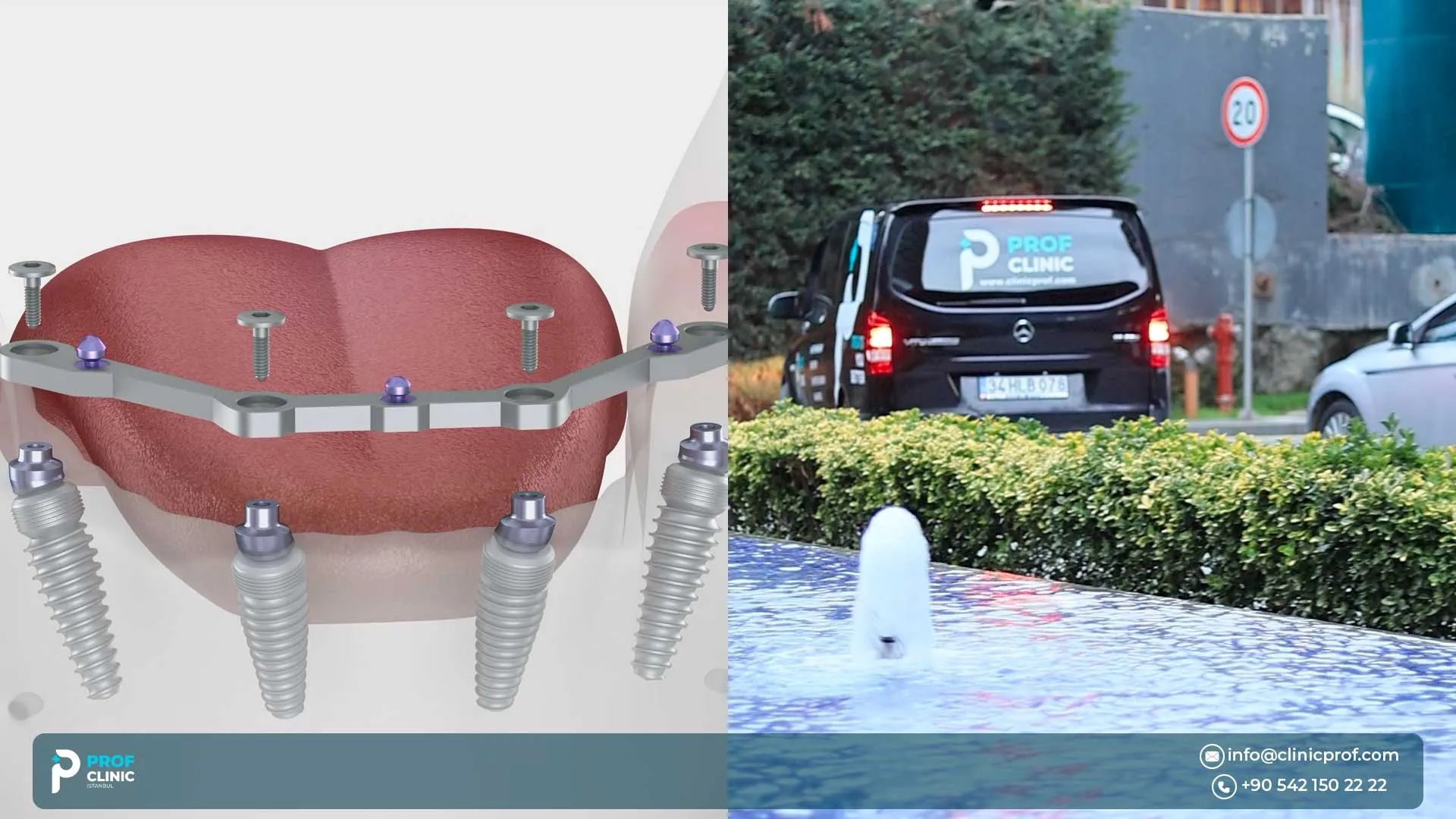
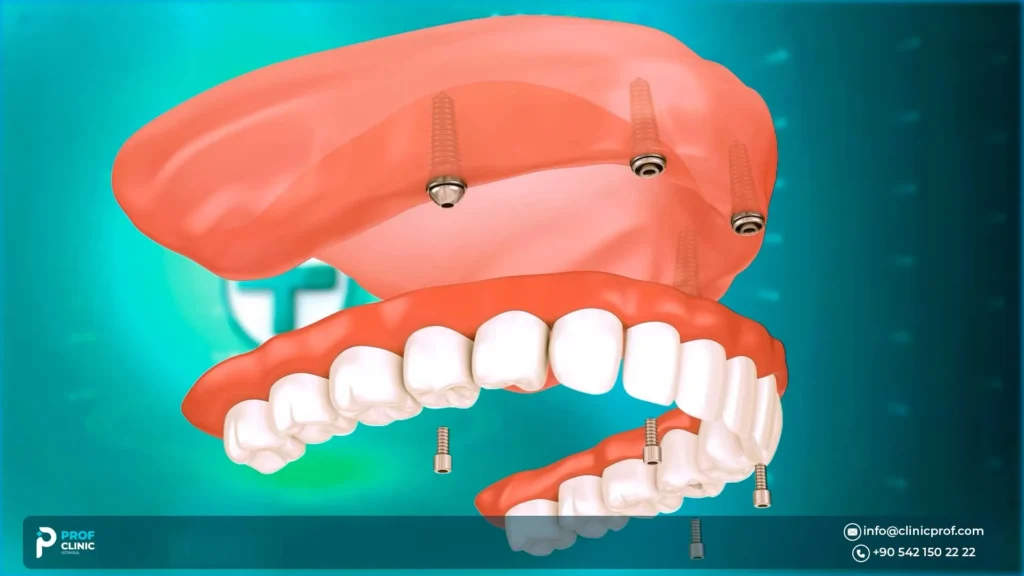
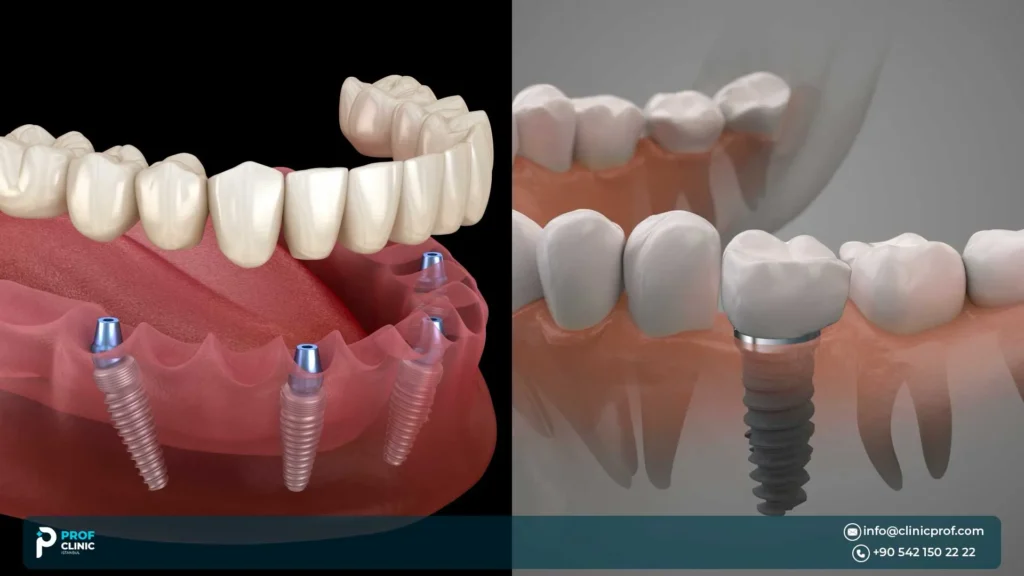
All on four is a full-arch restoration concept where 4 implants support a fixed bridge (usually per arch: upper or lower). In classic protocols, two implants are placed in the front and two are tilted in the back to maximize bone use and help avoid anatomical structures, with a prosthesis that may restore up to 12 teeth.
What 4 implants full teeth replaces:
- It replaces a full row of teeth in one jaw with a bridge anchored to implants, not one implant for every tooth.
- Full mouth usually means two arches (upper and lower), often planned separately.
Longevity:
Systematic reviews report high survival for full-arch implant bridges in many cohorts, but results vary by study design, follow-up time, and patient risk factors. One All-on-4 systematic review reported very high survival beyond 24 months while also noting limitations in evidence quality and follow-up.
What you actually get with 4 implants full teeth in Turkey?
When people say 4 implants full teeth in Turkey, they’re usually picturing permanent teeth in one day.
Here’s the more accurate expectation:
- Temporary fixed teeth: Many protocols describe an immediate, implant-supported temporary bridge placed right after surgery when clinical stability criteria are met.
- Final teeth: The final bridge is typically made after a healing phase to refine fit, bite, and aesthetics and to reduce overload risk. ClinicProf also notes that traditional loading is often delayed 3–6 months.
Also read: Immediate Load Dental Implants: Pros, Cons & Candidacy
Why does temporary vs final matter for outcomes?
- The temporary bridge protects the implants while you heal, but it may not be as strong or aesthetic as the final material you choose.
- Final teeth usually involve more detailed lab work, bite refinement, and durability choices
Here is a comparison table:
| Option | What you get | Typical surgery | Timeline reality | Best for |
| All-on-4 | Fixed full-arch bridge on 4 implants | Often fewer implants; posterior implants may be tilted | Often temporary first, final after healing | Many full-arch cases seeking fixed teeth with efficient implant count |
| All-on-6 | Fixed full-arch bridge on 6 implants | More implants; may help load distribution (case-dependent) | Similar temporary vs final concept | Higher bite forces / bone allows / clinician preference |
| Implant-supported overdenture | Removable teeth that clip onto implants | Often simpler prosthetics | Can be staged; removable for cleaning | Patients wanting easier hygiene or lower prosthetic complexity |
| Traditional multiple implants | Several implants and bridgework | More surgery sites | May require longer staging | Some cases where distribution/plan favors more implants |
For a deeper clinical explanation of All-on-4, see our All-on-4 blog.
And for the broader full-arch landscape (All-on-4 vs All-on-6 vs dentures), see the full-arch overview.
What’s the difference between All-on-4 and traditional implants?
Think of it as architecture:
- All-on-4: a designed full-arch system—implant positions, bridge design, and bite strategy are planned together for a complete arch.
- Traditional implants: often replace missing teeth in segments; may involve more implants and staged crowns/bridges, depending on goals and anatomy.
For patients, the differences are:
- Hygiene: Fixed full-arch bridges require daily cleaning under the bridge.
- Bite management: Full-arch cases demand careful bite planning to reduce overload and breakage risk.
- Bone grafting: Sometimes avoidable in All-on-4 concepts because of angulated posterior implants, but grafting may still be needed in some cases—your CBCT decides.
Why Choose Turkey for All-on-4 Dental Implants?
People choose Turkey for All-on-4 for a mix of:
- Established medical travel logistics, including coordinators, transfers, and scheduling.
- Modern digital planning and lab workflows: They include speed comes from planning and production, not rushing. Visit our dental treatment service page to know more details about what we offer.
- Value, especially when plans are itemized and materials/brands are clearly stated
If you’re prioritizing coordination, Istanbul is commonly chosen for flight access and clinic density and we, at Prof Clinic, operate in Istanbul.
Note: Value doesn’t mean cheapest. The outcome depends on:
- surgeon/prosthetic team experience,
- implant system and components,
- lab quality,
- your risk factors and maintenance.
Want to browse services and understand how cases are coordinated? Start with our dental treatment hub.
Are Turkish All-on-4 results as good as in Europe or the USA?
Country alone doesn’t guarantee quality. Your results are mainly driven by process and standards, such as:
- CBCT-based planning,
- a written treatment plan (implants, abutments, prosthesis material, timeline),
- traceable implant components,
- a real aftercare plan, including after you fly home.
Is it safe to get All-on-4 dental implants in Turkey?
It can be safe when the clinic follows strict protocols, especially for full-arch, immediate-load cases that demand planning and risk control. (Prof Clinic Turkey)
You can check its safety, based on these factors:
- 3D imaging and bite evaluation before finalizing a plan
- Written treatment plan that states: Implant count/positions, brand/system, abutments, prosthesis material, temporary vs final timeline
- Sterility and infection control: Ask what protocols followed
- Implant brand traceability: You should receive documentation of the system used
- Immediate-loading criteria explained: What makes you eligible vs not eligible
- Aftercare plan in writing: Meds, hygiene, follow-ups, what happens if a screw loosens
- Complication pathway: Who to contact urgently, and whether you may need an in-person check
But walk away or get a second opinion if you notice:
- Pressure selling
- Vague implant brand names or refusal to document components
- No CBCT/3D scan before committing to “same-day permanent teeth”
- No plan for after you return home (this is where many patients get stuck)
For a dedicated safety breakdown, see our safety guide.
To verify clinical accountability, review our medical team page.
Also read: Is it safe to have dental implants in Turkey?
What type of anesthesia is used for All-on-4 in Turkey?
Many dental implant surgeries are done with local anesthesia, sometimes combined with sedation depending on the case, anxiety level, and medical clearance. Your clinician should review your health history and explain options and risks.
If you have complex medical conditions, book a free online consultation and ask our team for pre-op medical clearance and consider a second opinion.
Can I travel to Istanbul, Turkey for All-on-4 treatment and what’s the process?
Here’s the evaluation-first travel pathway many international patients prefer:
- Share records before booking flights: Panoramic X-ray or CBCT (if available), photos, and a clear medical history/med list.
- Remote review and preliminary plan: Likely option, whether immediate temporary teeth are realistic, and a visit schedule.
- Arrive in Istanbul: Exam + CBCT/3D scan + final confirmation of plan.
- Surgery day: Implants placed; temporary teeth may be fitted if appropriate.
- Follow-ups before you fly: Swelling check, bite check, hygiene instructions, medications, and a “return-home” plan.
- Second visit (if needed): Final prosthesis after healing, with bite refinement.
Get a personalized schedule before you travel: Send your scan/X-ray and request a plan that spells out visits, days in Istanbul, and what’s included. Contact us to coordinate, including WhatsApp).
How many visits are needed and how many days should I stay in Istanbul?
Most our international patients plan around one main visit for surgery and early checks, and, if a final bridge is made later, a second visit after healing. The deciding factors are:
- extractions,
- whether you qualify for immediate temporary fixed teeth,
- swelling/fit checks,
- lab steps for your final prosthesis,
- your bite forces and habits.
Contact us via WhatsApp and request a written day-by-day outline of what happens during your stay.
What tests are required before traveling to Turkey for All-on-4?
Commonly requested, based on the case:
- Dental imaging: Panoramic X-ray and/or CBCT for bone and anatomical planning
- Medical history and medication list: Especially blood thinners, diabetes meds, bisphosphonates, and immunosuppressants
- Possible lab tests: Some clinics request blood tests for higher-risk patients
Tip: disclose smoking, diabetes control, and gum disease history early, these can materially change risk and protocol.
How much do All-on-4 implants cost in Turkey and what drives the total price?
You’ll see wide price ranges online. The safer way to judge cost is to compare itemized plans not starting from numbers.
Here is the table of what factors driving the total price:
| Cost driver | What it changes | What to ask for |
| Implant system & components | Longevity, warranty terms, component traceability | Exact brand/model & documentation |
| Prosthesis material (temporary & final) | Strength, aesthetics, repair frequency | What’s temporary vs final, and material options |
| Extractions & infection control | Surgical complexity and comfort | What’s included if extractions are needed |
| Bone management (if needed) | Timeline and cost | Is grafting likely on your CBCT? |
| Sedation/anesthesia | Comfort and monitoring requirements | What type, who provides it, medical clearance process |
| Number of visits | Travel & accommodation | One-visit vs two-visit plan, and why |
| Aftercare & complication policy | Risk control | Written aftercare & what’s covered if issues arise |
At Prof Clinic in Turkey, we publish example implant cost information and emphasizes confirming details via consultation and an individualized plan.
Also read: Cost of Dental Implants in Turkey: Everything you want to know
What’s usually included vs not included in the cost:
- Often included: consultation, imaging, surgery, temporary teeth (if eligible), scheduled follow-ups
- Sometimes included: transfers/hotel options (varies by clinic/package)
- Often not included: unexpected complex extractions, additional grafting, night guards for grinders, long-term maintenance visits in your home country
Ask for an itemized plan after imaging; this is the only reliable way to compare true total cost.
Is the All-on-4 procedure painful and how long is the recovery after?
For patients traveling to Istanbul for All-on-4 treatment, the early recovery period also affects flight timing, hotel stay, and when the first bite adjustments should be done.
Most our patients report the first days are about swelling, soreness, and adapting to a new bite—not sharp pain when anesthesia and aftercare are appropriate. Your clinician should set expectations and prescribe a plan for pain control and hygiene.
Here is the recovery milestones
- First 72 hours: swelling peaks; soft diet; careful oral hygiene
- First 1–2 weeks: stitches (if used) and gum healing; bite adjustments may be needed
- Healing phase before final teeth: often 3–6 months in traditional workflows.
But there are a few warning signs to notice, including: fever, rapidly increasing swelling, pus/bad taste, uncontrolled bleeding, numbness that doesn’t improve, or a bridge that suddenly shifts.
What are the risks and complications of All-on-4?
All implant treatments carry risk. Full-arch cases add mechanical and bite-related variables, so honesty here is a trust signal—not a scare tactic.
Biological risks
- infection, poor healing, peri-implant mucositis/peri-implantitis (inflammation around implants)
- higher risk in people with poor oral hygiene, history of periodontal disease, smoking, and uncontrolled hyperglycemia
Mechanical risks
- screw loosening, bridge fracture/chipping, bite imbalance
Can All-on-4 fail?
Yes, implants can fail to integrate, and prostheses can break or need revisions. Many issues are manageable if caught early, which is why we prioritise a written follow-up plan.
Can smokers get All-on-4 dental implants?
Some smokers still receive implants, but smoking is commonly cited as a risk factor for peri-implant disease and complications, and many clinicians will advise quitting or reducing, especially around surgery and healing.
The right approach is individualized: disclose your smoking level honestly and ask what protocol changes the clinic requires.
What happens if I have complications after returning home?
Your take-home pack should include
- Implant system and component documentation
- Post-op instructions and medication list
- A summary of the prosthesis type/material and screw channels
- Your follow-up schedule and emergency contact pathway
What can often be handled locally vs may require return travel
- Often local: Hygiene therapy, bite adjustment, temporary stabilization of a loose screw
- May require return: Major prosthesis remake, complex surgical complications, or system-specific component replacement
This is where a responsive coordinator and clear written policy matters. Use our contact options for coordination and documentation requests.
Also read: Is it safe to have dental implants in Turkey?
How do I choose a clinic in Istanbul, Turkey for All-on-4?
If you want one rule, make it this: Choose the clinic that documents the plan and owns the aftercare.
Here is the checklist to follow:
- Do they require CBCT before finalizing the plan?
- Will they give you an itemized written plan (implants, abutments, prosthesis, timeline)?
- Are implant brands/components named and traceable?
- Who does surgery and who designs the prosthesis (and can you verify credentials)?
- Do they explain temporary vs final teeth without promising “permanent in 24 hours”?
- What is the aftercare schedule, and what’s the plan if you have an issue at home?
Materials
- Temporary bridges are often acrylic/hybrid for safety and adjustability.
- Final bridges may be zirconia/ceramic or hybrid designs—each has pros/cons for strength, weight, repairability, and cost.
Warranties
- What’s covered: implant fixtures vs prosthetic teeth vs screws/repairs
- What’s excluded: smoking, grinding without a night guard, missed maintenance, accidents
- What happens if you’re abroad: local repair reimbursement vs return visit terms
Rather than chasing hype, choose the city that makes follow-up easy and offers reliable flight access. Istanbul is a common hub and Prof Clinic is based there.
Ask for our medical team review of your scans, with a written plan and travel timeline.
To see visual case examples, review our before and after gallery, then ask what’s comparable to your case.
What should I ask an Istanbul clinic before booking All-on-4 in Turkey?
Use these questions to filter clinics fast:
- Will you review my CBCT (or do you require one on arrival) before finalizing the plan?
- Which implant system and components will you use (brand/model), and will I receive documentation?
- Am I a candidate for immediate temporary fixed teeth and why?
- What is my “temporary vs final teeth” timeline, and what determines delays?
- How many days do you recommend I stay for the first visit, and what happens each day?
- Who performs surgery and who designs/fits the prosthesis (names + roles + credentials)?
- What anesthesia/sedation options are available, and what medical clearance is needed?
- What are my personal risk factors (smoking, diabetes, gum disease, grinding) and how do you mitigate them?
- What is your protocol if a screw loosens or the bridge cracks after I return home?
- What is included/excluded in the quote (extractions, grafting, follow-ups, repairs)?
- What warranty terms apply to implants vs the prosthesis and what voids them?
- What maintenance schedule do you recommend, and what hygiene tools should I use?
- If immediate loading is planned, what stability criteria do you require?
- What documentation will you send me for my local dentist at home?
FAQs about All-on-4 Dental Implants in Turkey
1) What are All-on-4 dental implants?
A full-arch restoration approach where four implants support a fixed bridge (upper or lower jaw). Planning is case-dependent and typically relies on 3D imaging.
2) Why choose Turkey for All-on-4 dental implants?
Many patients choose Turkey for a balance of organized medical travel logistics and modern clinic workflows—but outcomes depend on clinic standards, materials, and case planning rather than country alone. (Prof Clinic Turkey)
3) How much do All-on-4 implants cost in Turkey?
Costs vary by implant system, prosthetic material, extractions/grafting needs, sedation, and number of visits. The safest way is an itemized plan after imaging. (Prof Clinic Turkey)
4) Is it safe to get All-on-4 dental implants in Turkey?
It can be safe when the clinic follows strict protocols (CBCT planning, sterile surgery, brand-traceable components, and a clear aftercare plan). Avoid clinics that won’t provide these in writing.
How long is the recovery after All-on-4?
Expect swelling/soreness early on, then gradual improvement. Final teeth timing often depends on healing and loading protocol; many workflows reference a 3–6 month healing phase before final restorations.
What should I ask a Turkish clinic before booking All-on-4?
Ask about CBCT planning, implant brand/traceability, temporary vs final teeth timeline, number of visits, complication handling after you return home, and warranty terms.
How soon can I eat normally after All-on-4 treatment?
Usually progresses from liquids or soft foods to more normal textures as advised. Even with fixed temporary teeth, many clinics recommend a cautious diet early to reduce overload.
Will I get temporary teeth on the same day?
Possible for many patients when stability criteria are met; it’s a clinical decision, not a promise.