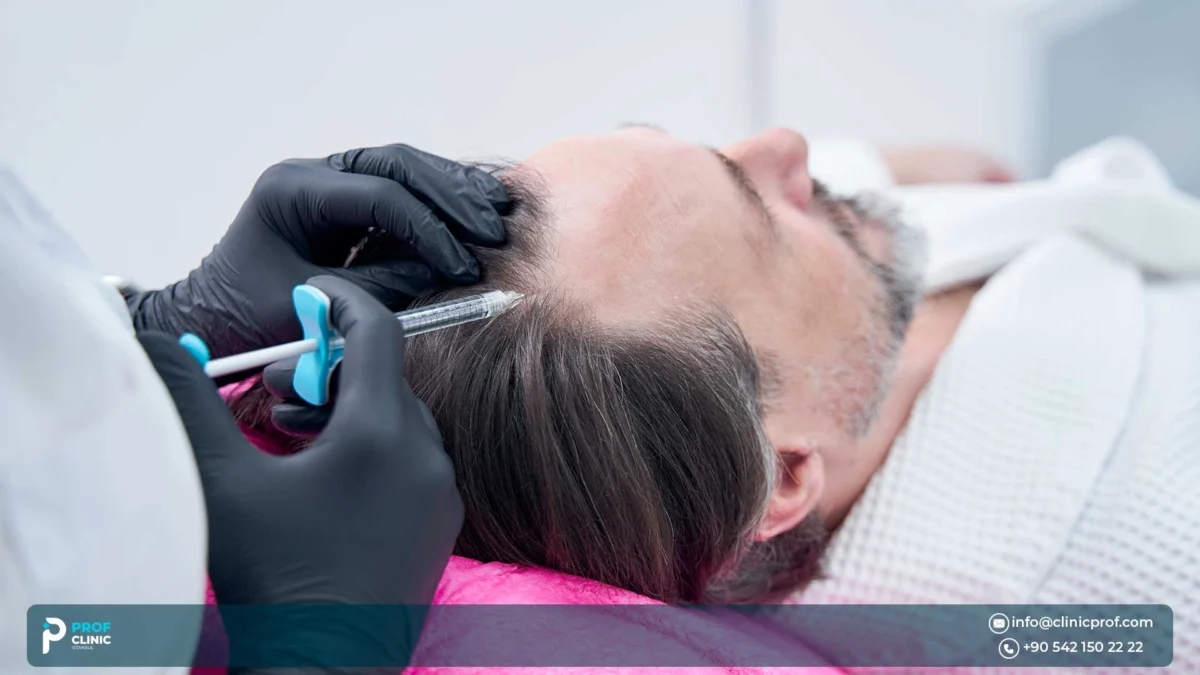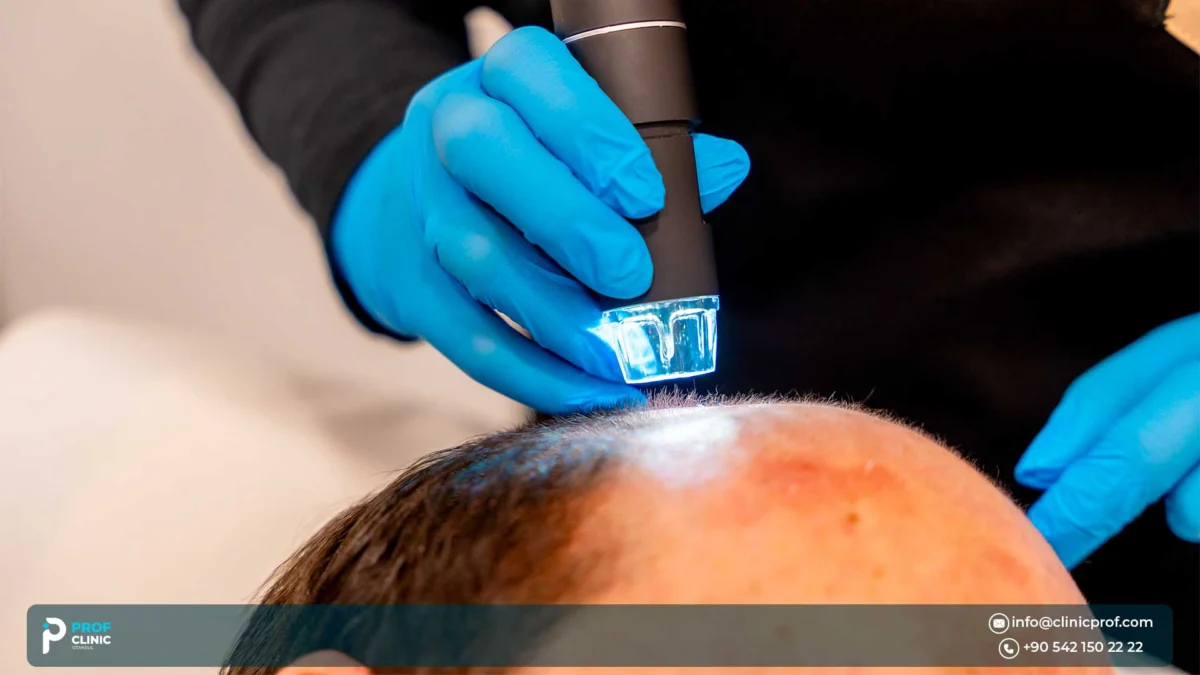
Your moustache is thin, patchy or broken by an old scar above the lip: can a transplant really fix it? In most cases, yes. A moustache transplant moves follicles from the back of your scalp and places them one hair at a time, at a sharp angle above the lip; new hair usually appears after three to four months, and the full result settles between months 10 and 14.
In this article from Prof Clinic, we explain who a moustache transplant suits, how it differs from a beard transplant, how it is done step by step, what to expect in Istanbul and back home, and when to treat the moustache and beard together.
Medical note: This information is educational, and the figures quoted are averages from medical sources. Your graft number and plan are set by a doctor after an examination.
What Is a Moustache Transplant and Who Is It For?
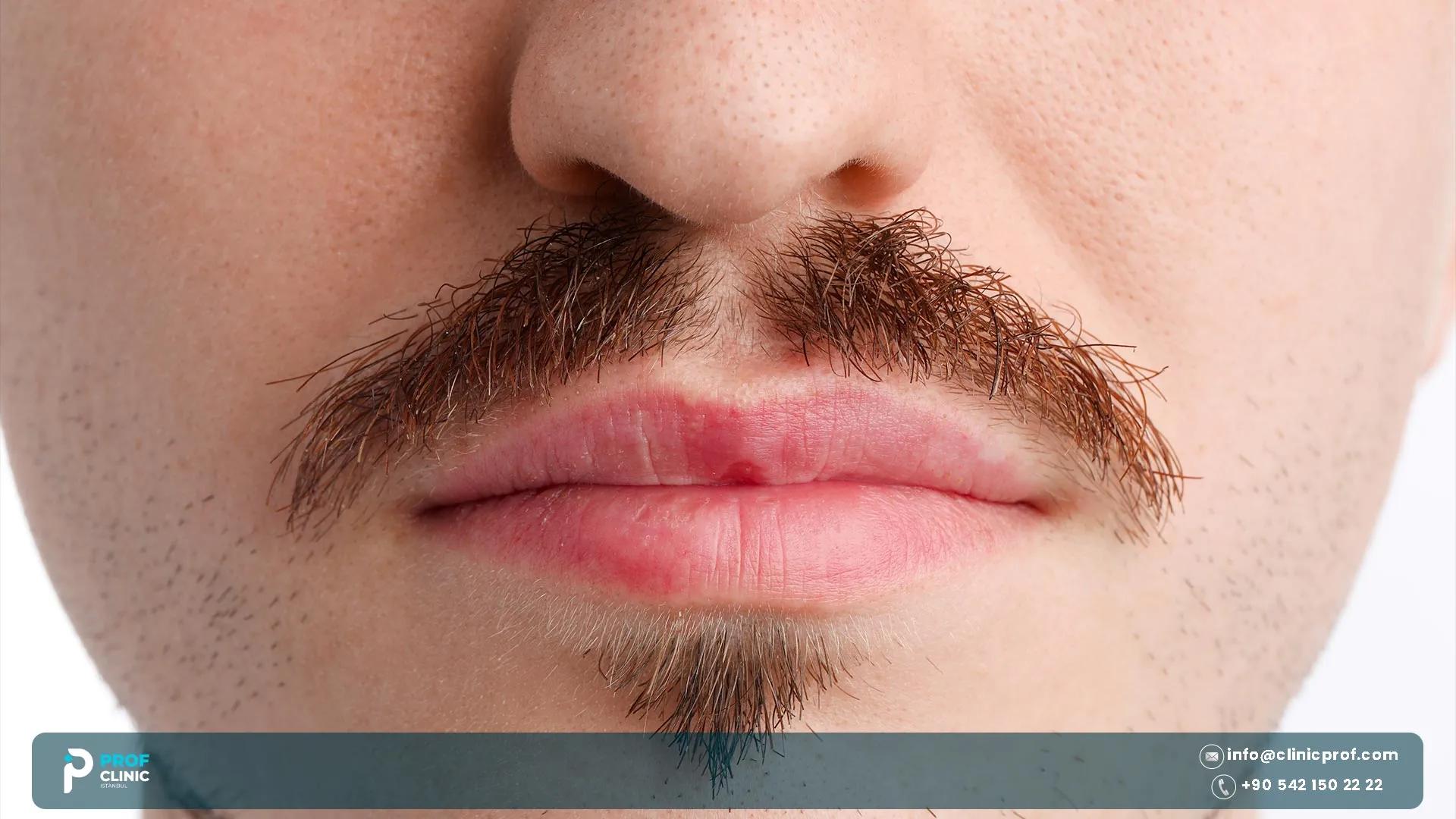
A moustache transplant fills gaps or adds density to the upper lip using your own follicles. It usually suits men whose moustache has stayed thin since puberty, men with patchy areas that never fill in, and men with a scar from a burn, an accident or cleft lip surgery.
How a Moustache Transplant Differs From a Beard Transplant
Follicles are taken from a donor area, usually the back of the scalp, and implanted into the upper lip with follicular unit extraction (FUE) under local anaesthetic. Many men have a beard and moustache transplant in one session, but the moustache itself demands more precision:
- One hair per graft: moustache and chin hairs grow mostly singly; in an Iranian study of 56 scar patients, one-hair grafts were used in every moustache case.
- Almost flat to the skin: the International Society of Hair Restoration Surgery (ISHRS) advises placing grafts as parallel to the skin as possible, following the local hair direction.
- Outward and downward: natural moustache hair points slightly outward and downward, so the sites follow that line.
- Delicate skin near the lip: a 2021 review in the Indian Journal of Plastic Surgery notes that bumpy skin can appear particularly in the moustache and goatee areas.
So what is the real difference? Not the technique but the precision: fewer grafts, yet every hair sits in the centre of your face.
When Is a Thin Moustache Worth Transplanting?
When the thinness has been stable for years, or a scar cuts through the moustache and no hair grows there. The ISHRS lists these situations among the candidates for facial hair transplantation:
- Thin since puberty: no hair, or low density with clear gaps.
- Scars: from burns, road accidents, acne, and cleft lip repair.
- A specific shape: adding density to an existing moustache, which the 2021 review also lists as an indication.
Cleft lip scars are a special case: after a bilateral cleft lip, the centre of the moustache stays naturally sparser even after repair, according to a maxillofacial surgery review. In a randomised trial of 40 men with cleft lip scars, FUE gave clearer results and fewer side effects than the strip method (FUT) over a year.
Deep scars may need more than one session, as a study of 20 men with FUE beard reconstruction found. The ISHRS also advises treating active skin problems first, and a sudden round bald patch deserves a dermatologist’s view: it may be alopecia areata, which that study excluded.
Also read: Everything to Know About a FUE Hair Transplant
What a Moustache Hair Transplant Can Give You
A moustache hair transplant gives you hair grown from your own follicles, shaped around your features, that you shave and style like the rest of your beard. A good result is not maximum density but a moustache that looks as if it had always been there.
A Balanced Moustache That Suits Your Face
Balanced density means more hair in the upper part of the moustache than in the lower half, a fuller centre under the nose, and hair running consistently outward and downward towards the corners of the mouth. The 2021 review explains how this is achieved:
- Single hairs at the edge: they make the upper border look natural rather than drawn on.
- Overlapping hair: angled hairs cover one another, so fewer grafts look denser.
- Matching donor hair: hair from the middle of the back of the scalp is close to moustache hair in thickness and texture.
- A design that fits: width, height and reach towards the mouth corners are agreed before surgery.
The ISHRS warns that the design you choose now is permanent, especially if you plan to shave your beard in future. Choose a moustache that will still suit you in ten years, not one copied from a photo.
Moustache and Beard Transplant Together or Separately?
It depends on where the gaps are and how much donor hair you have. The moustache joins the chin along the sides of the mouth, so when both are thin, one design for both is easier. Published studies, including the 2021 review, a 2021 series in the International Journal of Trichology and a 2002 case report from Istanbul, put the moustache and chin together at about 550 to 700 grafts to fill in, rising to about 1,000 to 1,200 for a dense moustache with a full goatee.
| Your situation | What usually fits | Why |
|---|---|---|
| A small gap or scar in the moustache only | Moustache transplant alone | Few grafts, which may come from under the beard |
| Thin moustache and thin chin | Moustache and goatee transplant together | They connect, and one design keeps them in proportion |
| Patchy beard and moustache | A full beard transplant including the moustache | One plan for graft numbers and spread |
| A deep scar or burn | A staged plan | Scars may need more than one session |
| Scalp hair loss, now or likely | A plan that counts the scalp first | Donor follicles do not renew |

The ISHRS calls donor follicles a non-renewable resource. If your hairline is receding, or you may want a hair transplant later, ask for your scalp’s needs to be counted before follicles go to the face. Some cases need a second or third session for density.
Mustache Transplant Before and After: What Changes
Before and after a mustache transplant, the change is gradual: the lip looks full straight after surgery, then almost as before, and only later fills in. In Istanbul you go through the first stage; the rest happens at home. So get a draft design, a graft estimate with the donor site, and the follow-up plan in writing, and, as the NHS advises, choose a qualified, experienced surgeon. The usual timeline:
- Your days in Istanbul: mild redness, swelling and small scabs; avoid pressing on the grafts and strong sun, as the ISHRS advises.
- About two weeks: the scabs are gone, and most patients can shave, according to the ISHRS.
- Weeks 2 to 8: the transplanted hairs shed temporarily, as the American Academy of Dermatology (AAD) describes, while the follicles stay in place.
- Months 3 to 4: new hair appears, fine and uneven at first.
- Months 10 to 14: the result is usually complete and the direction has settled.
Not sure whether your moustache needs a transplant or another treatment? Send a clear photo of your moustache to the Prof Clinic team on WhatsApp before you book your trip.
Also read: Beard Transplant Before and After: Results Month by Month
How a Moustache Transplant Works, Step by Step
A moustache transplant is usually done in one session, in six stages from design to implantation; the fewer the grafts, the shorter it takes.
From Moustache Design to Graft Placement
- Examination and design: the doctor examines your lip and donor area, then draws the moustache outline on your face for you to approve.
- Preparation: existing facial hair is trimmed to 3–5 mm, and the ISHRS advises stopping topical minoxidil in the recipient area beforehand.
- Anaesthetic: local anaesthetic, and you stay awake; the ISHRS says sedation is rarely needed. The whole upper lip can be numbed with an injection from inside the mouth.
- Extraction: follicles are removed one by one with a fine round punch, usually from the middle of the back of the scalp; when only a few hundred grafts are needed, they may come from the beard under the jawline.
- Recipient sites: tiny sites are made at an acute angle, pointing outward and downward.
- Implantation: one-hair grafts line the upper edge; two-hair grafts may be used where scalp hair is finer than facial hair.
In a 2024 review of more than 700 beard transplants, the surgeon Epstein names the keys to a natural look: one- and two-hair grafts with minimal surrounding skin, acute angles, the smallest possible blades and careful design. On the moustache, in the centre of the face, they matter most.
13 Things to Know Before a Moustache Transplant
Check these points before you book:
- Cause of thinning: make sure it is not an active condition such as alopecia areata.
- Skin health: treat any facial inflammation or skin problem first.
- A drawn design: see the outline on your face before the anaesthetic.
- Graft numbers: studies put moustache and chin at about 550–700 grafts; a small scar needs fewer.
- Graft source: ask whether grafts come from the scalp or from under the beard.
- Scalp reserve: donor follicles do not renew, so consider future scalp needs.
- Graft type: single-hair grafts along the edge look natural.
- Angle and direction: errors here are a risk the ISHRS names specifically.
- Skin tone: darker skin is more prone to colour changes around grafts.
- Scars: a cleft lip or burn scar may need more than one session.
- Minoxidil: stop it in the recipient area as your doctor instructs.
- First days: no pressure on the grafts and no strong sun.
- Patience: do not judge the result before roughly month 10.
To find out how many grafts your own moustache needs, book a consultation and ask for a draft design before you decide to travel.
Also read: Beard Transplant Cost in Turkey: What Really Sets the Price?
Prof Clinic: Moustache and Beard Transplant in Turkey
At Prof Clinic we start from your moustache: where the gaps are, what caused them, how many grafts you need and what your donor area can spare. We perform each beard transplant and moustache transplant with Micro FUE, and also offer Sapphire FUE, where sapphire blades open the channels, all under local anaesthetic. Grafts usually come from the back of the scalp or dense areas around the neck and jawline, chosen for your case.
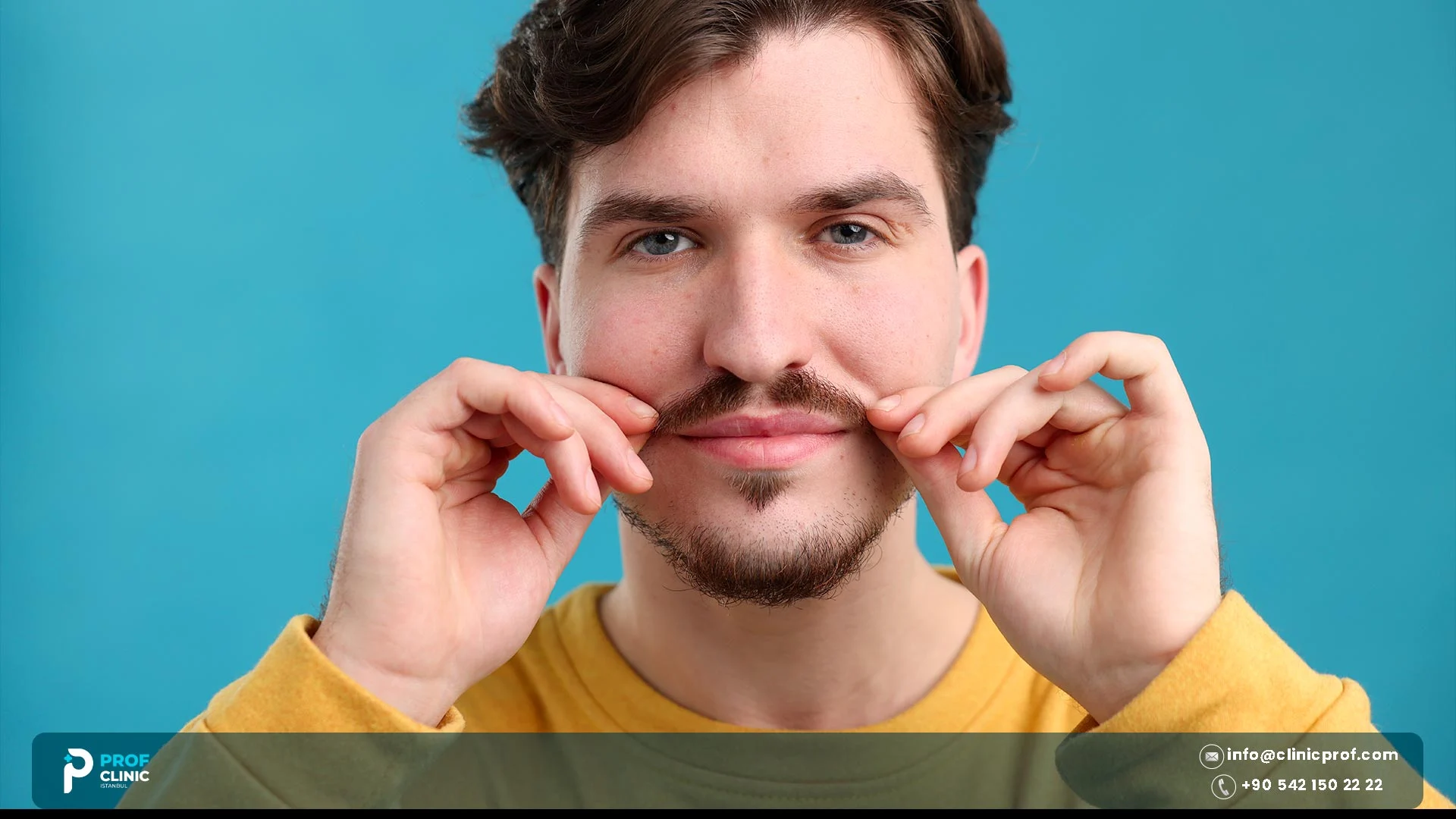
For a moustache and beard transplant in Istanbul, planning starts before you travel: you can send photos to the Prof Clinic team on WhatsApp for a first look at your case. As a beard and moustache transplant clinic in Turkey, Prof Clinic follows your case after the operation and gives you advice while your moustache transplant result develops; you can send photos and questions on WhatsApp.
Prof Clinic vs Other Moustache Transplant Options: Comparison Table
Compare what you actually receive, not only price:
| Criterion | At Prof Clinic | What to ask any other offer |
|---|---|---|
| Moustache design | Tailored to your face before surgery | Who draws it? Will you see it on your face first? |
| Technique | Micro FUE, with a Sapphire FUE option for the channels | Which technique? Are single-hair grafts used along the edge? |
| Donor area | Back of the scalp or dense areas around the neck and jawline | How many grafts, from where, and what is left for your scalp? |
| Anaesthetic and duration | Local anaesthetic; time depends on grafts, and a full beard usually takes six to eight hours | What anaesthetic? How long will your case take? |
| Aftercare | Detailed instructions, including sleeping position | Will you get written instructions before you leave? |
| Follow-up at home | The team follows your case after surgery and gives you advice; send photos and questions on WhatsApp | Who follows you up after you return, and how? |
How Prof Clinic Helps Patients Get a Natural-Looking Moustache
A natural moustache starts with the design and ends with the follow-up. Its shape is tailored to your face before surgery, and you leave with detailed aftercare instructions, including sleeping position. Swelling may appear for two or three days; most patients return to work within a week, and we recommend allowing at least a week.
Once grown in, the moustache can be shaved and styled like natural hair. Most patients reach their result in one session; some need another for density, decided after growth is complete. Meanwhile, a monthly photo in the same light and angle shows whether growth matches that month’s expected stage.
To see cases like yours, browse our before-and-after gallery and patient testimonials, or send photos of your moustache through our contact page for the Prof Clinic team’s opinion.
Moustache Transplant: FAQs
Is a moustache transplant painful?
Discomfort is usually limited, because local anaesthetic numbs the upper lip and donor area. You stay awake, and sedation is rarely needed. Mild swelling may follow for two or three days.
How many grafts does a moustache need?
It depends on the gap: published studies put the moustache and chin together at about 550 to 700 grafts, and about 1,000 to 1,200 for a dense moustache with a full goatee. A small scar needs fewer, and the doctor sets your number after examining the gaps and donor area.
When do moustache transplant results show?
New hair usually appears in months three to four, and the result is complete between months 10 and 14. Before that, the transplanted hairs shed between weeks two and eight, which is normal, not a sign of failure.
Can you shave a transplanted moustache?
Yes. Most patients can shave about two weeks after surgery, once the scabs are gone, and later shave and style it like natural hair. Wait until your doctor confirms the timing.
References / Sources
- ISHRS — Beard and Mustache Transplant
- ISHRS — Beard Transplants: Hollywood Hype or True Trend?
- NHS — Hair transplant
- American Academy of Dermatology — Hair transplants
- Dua K, Verma V, Dua A — Beard and Moustache Reconstruction, Indian Journal of Plastic Surgery, 2021
- Noori A, Rabiee M, Mehrabani D, Namazi MR — Head and Neck Restoration in Scar Alopecia: Hair Transplantation in Scalp, Eyebrows, Beard and Mustache, World Journal of Plastic Surgery, 2021
- Manodh P et al. — Macro Photography-Based Comparison of Follicular Unit Extraction and Follicular Unit Transplant Techniques for Correction of Mustache Alopecia in Cleft Lip Patients, Journal of Maxillofacial and Oral Surgery, 2025
- Weill P et al. — Embryological approach to philtral hair sparsity in bilateral cleft lip deformities, Journal of Stomatology, Oral and Maxillofacial Surgery, 2023
- Yaseen U, Ahmed S, Ahmed M — Beard Reconstruction, International Journal of Trichology, 2021
- Sahinoglu K, Ergün SS — Follicular unit transplantation: the option of beard construction in eunuchoid men, Dermatologic Surgery, 2002
- Epstein JS — Facial Hair in Hair Restoration Surgery: Beard Transplantation and Beard-To-Scalp Hair Restoration, Facial Plastic Surgery Clinics of North America, 2024