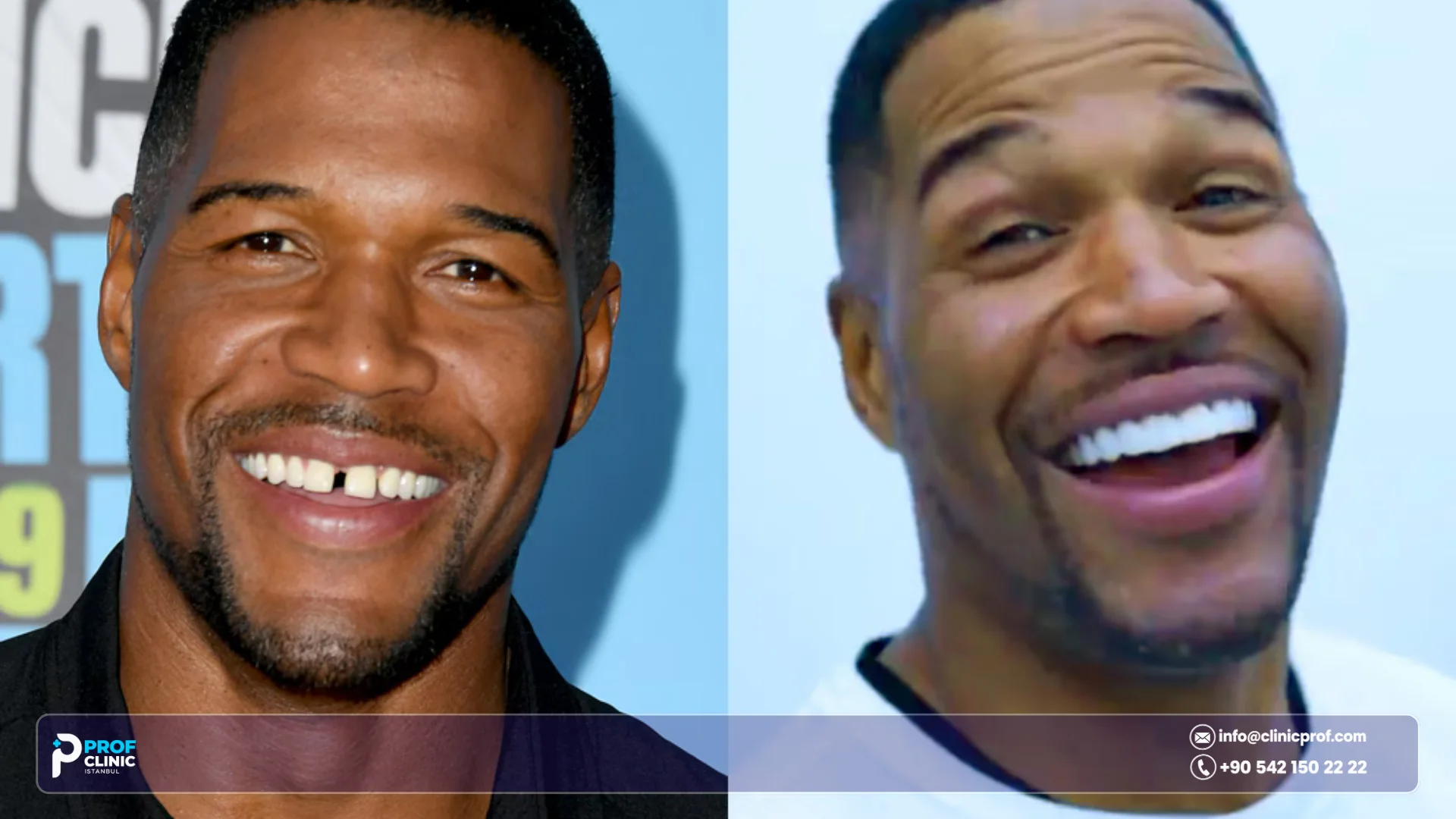
Michael Strahan’s famous tooth gap has been part of his smile for decades — but did he ever close it? No. Strahan has publicly said he chose to keep the gap, even after considering what his smile might look like without it. A 2021 video suggesting he had finally closed it was later revealed to be an April Fools’ prank.
So, what makes Michael Strahan’s teeth gap so recognizable, and what would actually be involved in closing a similar space? Here’s what Strahan has said about his smile, what the public record shows, and the dental options available for people who want to close a diastema.
Medical Note:
A gap between teeth is known as a diastema. It can be a natural feature, but a new or widening gap should be assessed by a dentist. Michael Strahan has no known connection to Prof Clinic. His smile is discussed here only as a public example.
The Most Famous Gap on American Television
Michael Strahan’s gap became one of the most recognizable features of his smile during his NFL career and later television career. Unlike many celebrity dental stories, however, there is a clear public explanation for why it remained.
Michael Strahan’s Gap Tooth: How It Became a Trademark
The space between Strahan’s upper front teeth was visible throughout his public career, from his years with the New York Giants to his television work.
In a 2012 interview with ELLE, Strahan explained that he had actually considered closing the gap while he was in his twenties and playing for the Giants. He had a dentist create mock-ups so he could see what the change might look like.
But he ultimately decided against it.
That decision turned the Michael Strahan gap from something he had once considered changing into one of the features most strongly associated with his appearance.
What He Has Said About Closing It
Strahan was unusually direct about the decision.
He told ELLE that he was really close to closing it up and had considered the mock-ups at the dentist, but then made a conscious decision that the gap was part of who he was.
His explanation was essentially about identity rather than dentistry. He did not want to create a more conventionally perfect smile simply because cosmetic dentistry made it possible.
That makes the story behind the Michael Strahan teeth gap different from a typical celebrity transformation. The important point is not that the gap could not be treated. It is that he chose not to permanently change it.
Read as well: Bad Bunny Teeth & Veneers: Before and After His Smile

Did Michael Strahan Fix His Teeth?
No permanent closure of his signature gap has been publicly confirmed. In fact, Strahan himself has repeatedly said that he wanted to keep it.
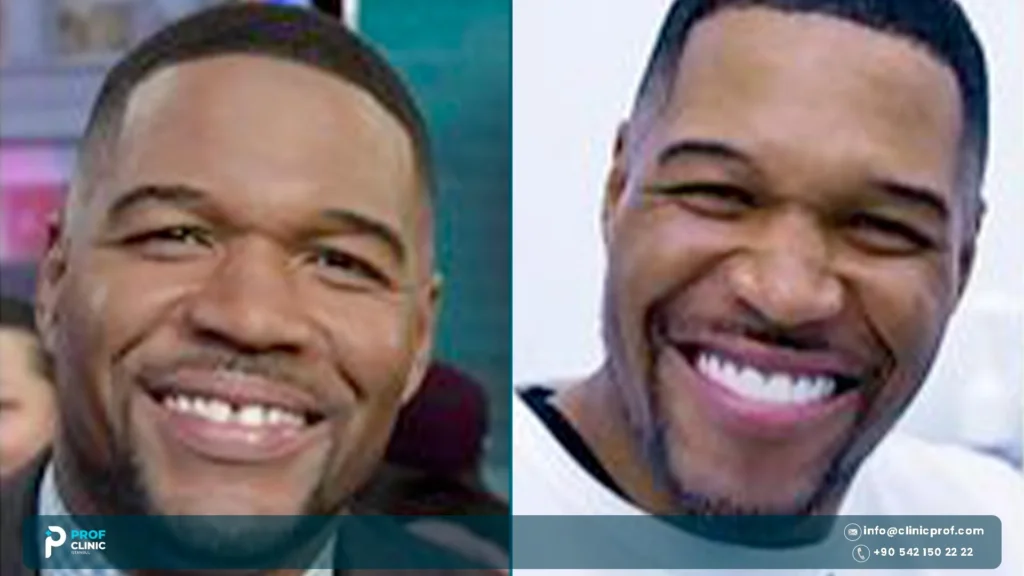
The biggest source of confusion came in March 2021, when he appeared to document a dental procedure that seemed to eliminate the space between his front teeth. The footage showed him visiting a dentist and revealing a gap-free smile, creating immediate speculation that his Michael Strahan fixed teeth era had begun. It had not.
The Gap Closed Rumour
The 2021 story was deliberately designed to look convincing.
Strahan posted a video appearing to show his gap being closed and captioned it “#GoodbyeGap.” News outlets and fans then debated whether he had actually decided to change his smile.
On April 1, 2021, he revealed the truth. In coverage from Good Morning America, Strahan pulled down his mask and showed that the gap was still there, confirming that the apparent transformation had been an April Fools’ joke.
He said the gap was here to stay and explained that he appreciated how strongly people identified with it.
So if you are searching Michael Strahan gap closed, Michael Strahan closed gap, or did Michael Strahan get his teeth fixed, the answer is that the widely discussed 2021 closure was not a permanent dental transformation.
Michael Strahan’s New Teeth: What Actually Changed
The phrase Michael Strahan new teeth can be misleading because the most famous new smile associated with him was part of the 2021 prank.
There is no reliable public evidence establishing a permanent makeover that removed his signature gap.
The temporary gap-free appearance demonstrated an important dental point, though: changing the apparent width and proportions of two front teeth can dramatically change the character of a smile. Closing a space can be done in several ways, depending on the size of the gap, tooth shape, alignment, bite and oral health.
That is why photographs alone should not be used to determine whether someone has bonding, veneers, orthodontic treatment or another restoration.
Why Some Public Figures Keep a Signature Gap
A smile does not have to be conventionally uniform to be memorable.
For some people, a spacing feature becomes closely associated with their identity. Strahan himself has explained that he eventually viewed his gap as part of who he was rather than as something that needed correction.
There is also a practical lesson here: cosmetic dentistry should not automatically be about removing every difference. If the teeth and gums are healthy and a person likes the way a gap looks, keeping it can be a perfectly reasonable choice.
Closing a Tooth Gap: The Options
For someone who does want to close a diastema, the right approach depends on why the space exists and what the person wants to change.
According to Cleveland Clinic’s guidance on diastema, treatment options can include dental bonding, porcelain veneers, braces or clear aligners, and in selected cases treatment of the gum tissue or replacement of a missing tooth.
The key is to distinguish between moving teeth and changing the appearance of teeth.
Bonding and veneers can make teeth appear wider and therefore close a visible space. Orthodontic treatment actually moves the teeth closer together.
13 Things to Weigh Before Closing a Gap
- Gap width: A very small space may be suitable for conservative cosmetic treatment, while larger spaces may require tooth movement or a combined approach.
- Tooth proportions: Closing a gap by adding material can make teeth look too wide if their existing proportions are not considered.
- Tooth position: If the teeth are also rotated or misaligned, orthodontics may make more sense than simply adding material.
- Bite: The way the upper and lower teeth meet can influence which treatment is appropriate.
- Frenum position: A prominent or thick frenum can sometimes contribute to a space between the front teeth and may need assessment.
- Gum health: A new or widening gap can sometimes be associated with periodontal problems and should be evaluated before cosmetic treatment.
- Tooth size: Small or unusually shaped teeth may influence whether bonding, veneers or orthodontics creates the most balanced result.
- Reversibility: Composite bonding is generally more conservative and reversible than veneers.
- Enamel preservation: Veneers may involve preparation of the tooth, while bonding usually requires little or no enamel removal.
- Retention: After orthodontic gap closure, retainers are important because teeth naturally tend to move over time.
- Relapse risk: Some spacing problems are more likely to reopen than others, making long-term retention particularly important.
- Maintenance: Bonding can chip or stain more easily than porcelain, while veneers may require repair or replacement over time.
- Whether you actually want the change: A gap is not automatically a dental problem. If you like your smile and your oral health is good, there may be no reason to close it.
Bonding vs Veneers vs Braces for a Diastema
| Option | Main approach | Typical advantage | Main consideration |
| Composite bonding | Adds tooth-colored resin to reshape the teeth and hide the gap | Conservative and usually fast | Can chip or stain and may need maintenance |
| Veneers | Covers the front surface of the teeth and can change their apparent width and shape | Can combine gap closure with broader cosmetic changes | More permanent and may require enamel preparation |
| Braces / clear aligners | Physically moves teeth toward one another | Addresses tooth position rather than simply masking the space | Takes longer and normally requires retention |
Cleveland Clinic notes that bonding can close gaps and is generally reversible, while its veneer guidance explains that veneers cover the front surface of teeth and can disguise spaces. The American Association of Orthodontists notes that braces and clear aligners can close spaces by moving the teeth and that retainers help maintain the result.
Also Read: Young Thug’s Teeth Before Fame and After: What Changed?
When Keeping the Gap Is the Better Choice
Closing a gap is not automatically an improvement.
If the teeth are healthy, the gums are healthy and the person likes the proportions of their smile, keeping the space can be the most conservative option.
Michael Strahan’s own story illustrates this clearly. He had considered changing the gap when he was younger, even went through dental mock-ups, and ultimately decided that the feature belonged to his identity.
For someone else, the decision may be different. The best smile design is not necessarily the one with the fewest spaces. It is the one that fits the person’s dental health, facial proportions and preferences.
Prof Clinic: Smile Design in Istanbul, Turkey
At Prof Clinic, we approach smile design as an individualized planning process rather than a celebrity template. A photograph can help communicate what a patient likes, but it cannot replace an assessment of the patient’s teeth, gums, bite, proportions and goals.
Prof Clinic’s Smile Design Services
At Prof Clinic, our smile-design approach can include composite bonding, veneers, orthodontic assessment, whitening and digital smile design, depending on the patient’s clinical needs.
Our dental treatment services cover cosmetic and restorative dental options, while our approach to digital smile planning focuses on creating a design that works with the patient’s own facial and dental proportions.
Our current clinical information also describes digital smile design, aesthetic composite restorations and minimally invasive restorative options as part of the planning process. The aim is not simply to make teeth look different, but to determine which changes are actually appropriate for the individual case.
How Prof Clinic Plans Gap Closure
When a patient asks us about closing a gap, we do not begin by assuming that veneers are the answer.
| Planning stage | What we assess | Why it matters |
| Measurement | Gap size, tooth width and visible tooth proportions | Determines whether the space can be closed conservatively |
| Proportion analysis | Tooth length, width, symmetry and smile line | Prevents teeth from appearing excessively wide |
| Alignment review | Tooth position and spacing | Helps determine whether orthodontics may be more appropriate |
| Gum assessment | Gum health and tissue contours | Rules out problems that should be treated before cosmetic work |
| Treatment options | Bonding, veneers, orthodontics or a combination | Matches the procedure to the actual problem |
| Retention planning | Retainers where orthodontic movement is involved | Helps reduce the risk of the gap reopening |
| Expected result | Proposed shape, proportions and overall smile balance | Keeps expectations realistic before treatment |
Our digital smile design approach can help visualize the intended aesthetic direction before definitive treatment. For suitable patients, that planning can be particularly useful when deciding whether a small gap needs a conservative correction or whether broader smile-design changes are appropriate.
Gap Closure Results
At Prof Clinic, we publish before-and-after dental cases to show how different starting conditions can produce different treatment plans and outcomes.
We do not use Michael Strahan’s smile — or any celebrity smile — as a promise of what a patient will receive. A gap-closure result depends on the patient’s tooth size, enamel, gum health, bite, facial proportions, chosen treatment and maintenance.
In suitable cases, conservative bonding may be enough to close a small space without committing the patient to veneers. In other cases, orthodontic movement or a broader restorative plan may be more appropriate.
Our Smile Design and dental treatment information explains how we use individualized planning rather than applying the same number or type of restorations to every smile.
The story behind Michael Strahan’s teeth is unusually well documented. He has said that he once seriously considered closing the gap and even had dental mock-ups made, but ultimately chose to keep it because he saw it as part of who he was.
The 2021 Michael Strahan gap tooth closure story created a second wave of speculation, but he later revealed that the transformation was an April Fools’ prank and that the gap remained.
If you are considering closing your own gap, the more useful question is not whether a celebrity fixed theirs. It is whether bonding, veneers, orthodontics or simply keeping the space best fits your teeth, bite, facial proportions and goals.
At Prof Clinic, we can assess your smile and help you understand your options before you decide whether treatment is actually necessary. Book a smile assessment with our team in Istanbul to discuss the right approach for your teeth and goals.
Frequently Asked Questions About Michael Strahan’s Teeth
- Did Michael Strahan close his gap?
No permanent closure has been publicly confirmed. Strahan has repeatedly said he intended to keep the gap, and his apparent 2021 gap closure was revealed as an April Fools’ prank. Good Morning America documented his reveal that the gap was still there.
- Why does Michael Strahan have a gap in his teeth?
The public record establishes that Strahan has had the gap for decades, but it does not establish its exact anatomical cause. In 2021, he said he had had it for almost 50 years. A gap between teeth is clinically called a diastema and can have several causes, including inherited tooth spacing, tooth size, missing teeth or gum-related problems.
So it is more accurate to describe Strahan’s as a long-standing diastema rather than claiming a specific cause that has not been publicly confirmed.
- How much does closing a tooth gap cost?
There is no single price because treatment depends on the size of the gap and the chosen procedure.
For a U.S. reference, CareCredit lists dental bonding at about $431 per tooth on average. Its current veneer data gives an average of about $1,455 for a single porcelain veneer, while orthodontic treatment can average roughly 5,108–9,221 depending on the type. These are U.S. reference figures, not Prof Clinic or Turkey prices.
- Can a closed gap reopen?
Yes. If the gap is closed through orthodontic tooth movement, teeth can shift after treatment, which is why retention is an important part of the process. The American Association of Orthodontists explains that teeth naturally tend to move back toward their previous positions and that consistent retainer use helps maintain the orthodontic result.
A gap can also change for other reasons. If an adult gap is newly developing or becoming wider, a dental examination is appropriate because periodontal disease can sometimes contribute to spacing changes.
Sources
- ELLE — Michael Strahan interview on his decision to keep his gap
- Good Morning America — Strahan reveals the 2021 gap-closure story was an April Fools’ prank
- Cleveland Clinic — Diastema: causes and treatment options
- Cleveland Clinic — Dental Bonding
- Cleveland Clinic — Dental Veneers
- American Association of Orthodontists — Teeth Spacing
- American Association of Orthodontists — Retainers
- CareCredit — Dental Procedure Costs
- CareCredit — Dental Veneers Cost
- CareCredit — Dental Braces Cost