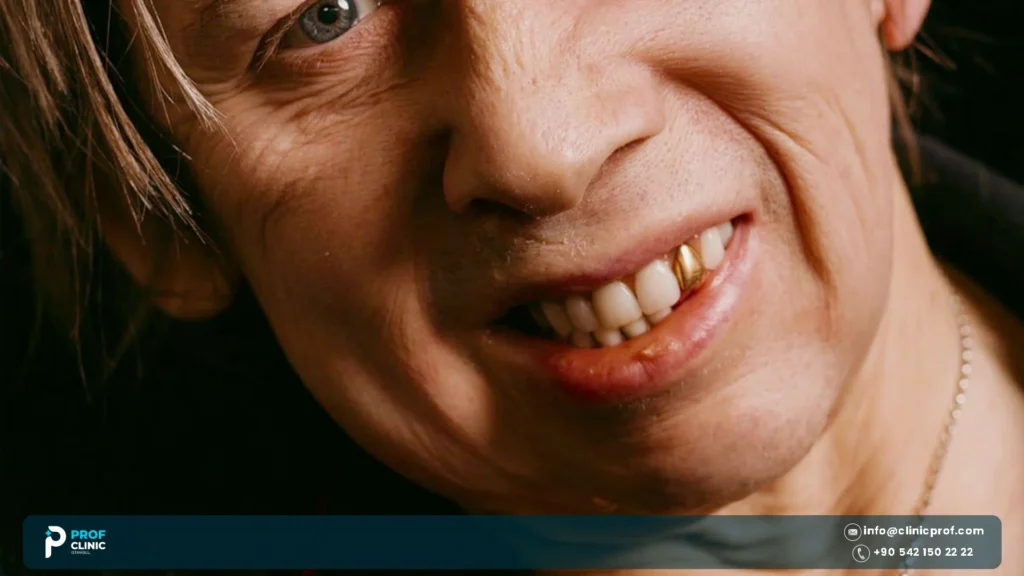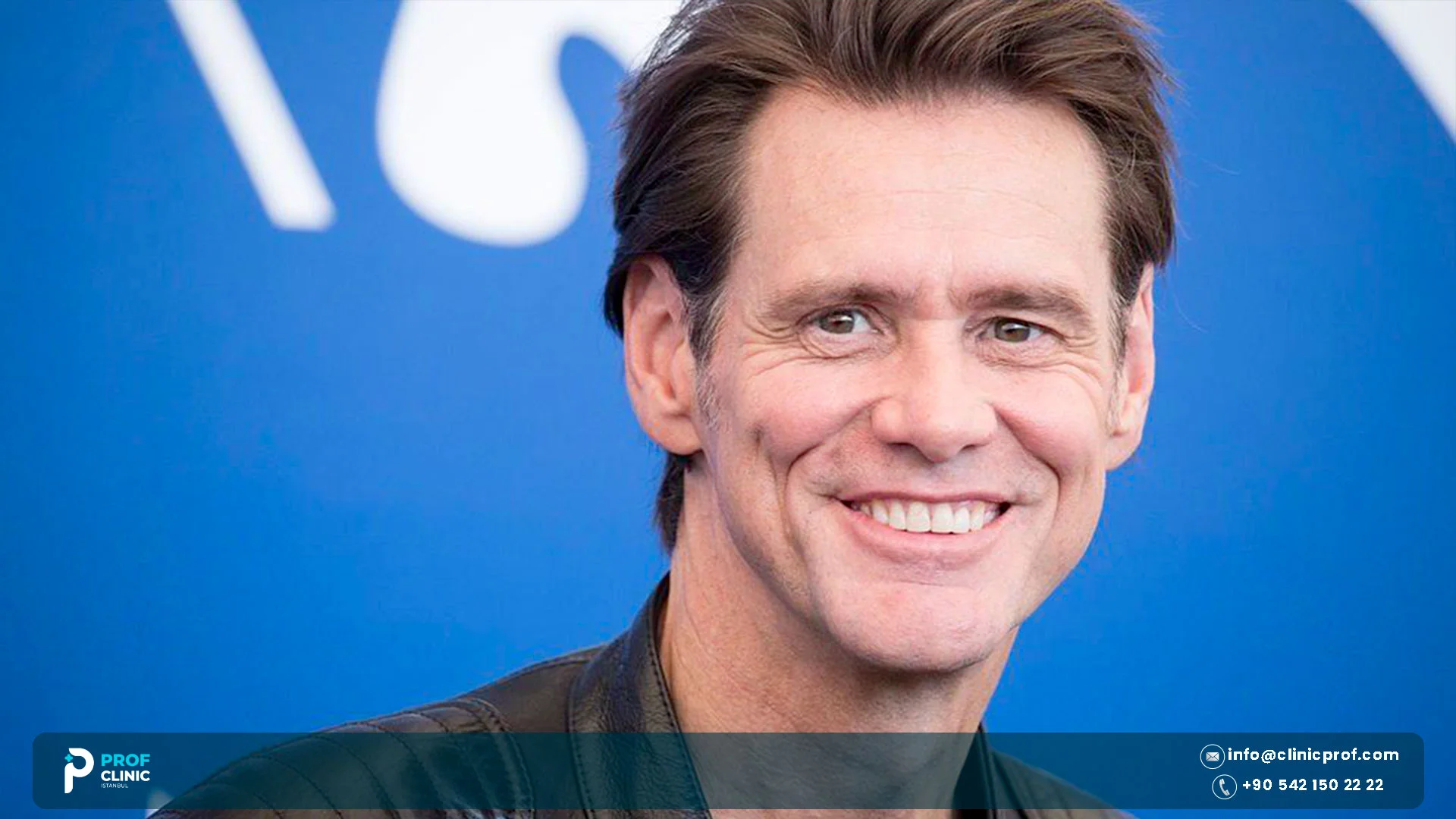
Yes, the famous Jim Carrey chipped tooth in Dumb and Dumber was real. Carrey damaged the front tooth as a child and later had it restored. For Lloyd Christmas, he deliberately removed the restoration so the original broken edge would show on camera.
The story is even more interesting than the usual movie-prosthetic trick because Carrey later described the restoration himself as bonding. Older coverage often called it a cap, but the damaged tooth underneath was genuine. His deliberately imperfect Jim Carrey smile became one of the most recognisable details of Lloyd Christmas.
Medical note
This article is for educational purposes only. It does not diagnose Jim Carrey or any reader. A chipped front tooth can involve enamel, dentin or the dental pulp, so the appropriate repair depends on the extent of damage and the condition of the remaining tooth.
Jim Carrey has no known connection to Prof Clinic. His story is discussed only as a useful example of front-tooth trauma and restorative dentistry.
One of Cinema’s Best Dental Stories
Hollywood usually creates damaged teeth with prosthetics, makeup or visual effects. Dumb and Dumber did not need to.
A contemporary Los Angeles Times profile of Jim Carrey, published before the film reached cinemas, noted that his chipped front tooth was genuine and traced it to an accident during grade school.
Carrey later gave more detail about the accident. He recalled being in school detention when another child landed on his head, sending his tooth into the desk. The damaged front tooth was eventually restored, allowing his smile to look intact in everyday life and in most of his other roles.
For Dumb and Dumber, he reversed that repair temporarily and turned the original damage into part of Lloyd Christmas.
Is Jim Carrey’s Chipped Tooth Really Chipped?
Yes. Jim Carrey’s tooth in Dumb and Dumber was not simply painted black or replaced with a movie prosthetic.
In a later WTF with Marc Maron interview, Carrey explained that he had bonding on the damaged tooth and deliberately knocked the bonding off when preparing to play Lloyd.
That clarification matters because the story is often simplified into Carrey removing a crown. Older reports frequently use the general term cap, while Carrey’s own later account specifically refers to bonding.
Either way, the central answer to is Jim Carrey’s tooth really chipped is yes: the underlying childhood injury was real.
The Dumb and Dumber Tooth Explained
The Jim Carrey Dumb and Dumber tooth became a character choice rather than an accidental production detail.
J.B. Rogers, the film’s first assistant director, recalled in The Ringer’s history of Carrey’s extraordinary 1994 that Carrey wanted Lloyd to have the split-tooth look and removed the restoration before filming.
The result worked because nothing had to be sculpted over the tooth. The original damage was already there.
That makes the Jim Carrey tooth chip unusual in movie history: dentistry had repaired the defect, and the actor temporarily reversed the cosmetic repair to make his character look less polished.
The deliberately damaged-looking smile worked with Lloyd’s bowl haircut, wardrobe and exaggerated expressions. One small dental detail changed the way the entire face read on screen.
Jim Carrey’s Missing Tooth in Other Roles
The phrase Jim Carrey missing tooth slightly exaggerates what viewers see. The front tooth was damaged rather than completely absent.
The broken appearance returned when Carrey played Lloyd again in Dumb and Dumber To. In his Marc Maron interview, Carrey explained that whenever he returned to the Dumb and Dumber character, the restoration had to come off again.
His other famous 1994 comedy offers the opposite example.
Jim Carrey’s teeth in The Mask were intentionally oversized and unusually white as part of the character’s exaggerated appearance. According to the Museum of the Moving Image, the prosthetic design included prominent rectangular teeth that helped create the Mask’s distinctive look.
Director Chuck Russell has also explained that different tooth sizes were tested as part of the character design. Those Jim Carrey fake teeth were therefore a movie effect, while Lloyd Christmas’s broken front tooth came from Carrey’s real childhood injury.
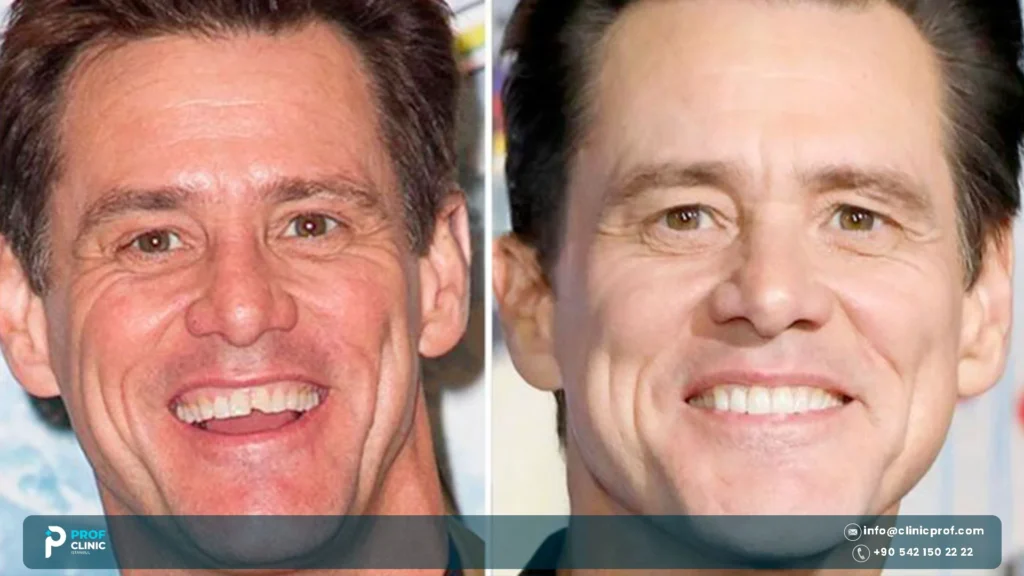
Jim Carrey’s Teeth Before and After
The unusual thing about Jim Carrey teeth before and after is that the transformation went in both directions.
His front tooth was damaged in childhood, restored for normal appearance, uncovered again for Dumb and Dumber, and then restored again afterward. He repeated the damaged look when returning to Lloyd Christmas years later.
So this is not the typical celebrity timeline where increasingly polished teeth appear over time. In Carrey’s case, the imperfect version was deliberately brought back for a character.
Also Read: Justin Jefferson Teeth: What Changed and What It Costs

How His Smile Looks With the Cap In Place
Outside the Lloyd Christmas role, Jim Carrey’s teeth generally appear continuous across the upper front smile rather than showing the deep broken edge seen in Dumb and Dumber.
That restored front tooth has an outsized effect because central incisors sit directly at the visual centre of a smile. Repairing one damaged front tooth can restore symmetry even when nothing else in the mouth changes.
Older descriptions call the repair a cap, while Carrey later referred to bonding. Without his dental records, there is no reason to convert those descriptions into a more specific diagnosis.
The important point is that the visible defect could be concealed well enough that many viewers only learned about the childhood injury after seeing Lloyd Christmas.
Are Jim Carrey’s Teeth Real?
Most of Carrey’s visible smile appears to be his own natural dentition, but the damaged front tooth has been restored.
There is no reliable public confirmation that he has a full set of veneers. So the answer to does Jim Carrey have veneers is not established by the available evidence.
That also means claims about Jim Carrey veneers should not be confused with his well-documented front-tooth repair. A single bonded or otherwise restored tooth is very different from covering multiple teeth with veneers.
The answer to are Jim Carrey’s teeth real is therefore largely yes, with a known restoration associated with the childhood-damaged front tooth.
Why a Single Crown Can Change a Whole Smile
A central incisor occupies some of the most visually important space in the smile.
A large chip can change the apparent symmetry of the front teeth, interrupt the incisal line and create a dark space that draws the eye immediately. Restoring that single tooth can therefore make the whole smile look more balanced even when the neighbouring teeth remain untouched.
This is also why repairing one front tooth can be technically demanding. The dentist is not creating an entire set of identical restorations. One artificial surface has to disappear beside natural enamel.
Shape, translucency, surface texture, brightness and edge characteristics all have to work together.
Depending on how much healthy tooth structure remains, that restoration may be achieved with composite bonding, a veneer or a crown.
Repairing a Chipped Front Tooth
A chipped front tooth does not automatically need a crown.
The correct repair depends on how much structure was lost, whether the crack extends deeper into the tooth and whether the dental pulp has been affected.
The NHS guidance on chipped, broken and cracked teeth lists several possible treatments, including reattaching the broken fragment, filling the tooth, fitting a crown or performing root canal treatment when a badly broken tooth exposes the nerve.
That range explains why two chips that look similar in a photograph may require completely different treatment.
Read as well: Tom Hardy Teeth: Before, After and What Really Changed

Bonding, Crown or Veneer: Choosing the Repair
For a small or moderate front-tooth chip with plenty of healthy enamel remaining, composite bonding can rebuild the missing contour directly.
Bonding is conservative because tooth-coloured resin is shaped onto the existing tooth rather than covering the entire crown.
A veneer covers mainly the visible front surface. The NHS overview of dental treatments notes that veneers can disguise chipped or discoloured teeth by adding a thin tooth-coloured facing.
A dental crown covers much more of the remaining tooth and becomes more relevant when the damage or existing restoration is extensive enough that the tooth requires greater structural coverage.
The practical distinction looks like this:
| Repair | Often considered when | Main advantage | Main consideration |
| Composite bonding | Small to moderate chip | Conservative and repairable | Can stain or chip over time |
| Veneer | Front surface needs broader aesthetic correction | Strong control over shape and shade | Usually requires some tooth preparation |
| Crown | Larger structural loss or heavily restored tooth | Covers and protects more of the tooth | Requires more preparation than bonding |
| Root canal + crown | Damage reaches or compromises the pulp | Treats internal tooth injury and restores structure | More extensive treatment |
The smallest effective treatment is often preferable when sufficient healthy tooth structure remains.
Matching Shade to Surrounding Teeth
A single front-tooth restoration can be more demanding aesthetically than restoring several teeth together.
Natural teeth are not one flat shade. The cervical area near the gum, central body and incisal edge can differ in opacity, translucency and colour.
Neighbouring enamel also reflects light differently according to hydration, surface texture and thickness.
That means shade matching should account for more than a simple white-to-yellow scale. The dentist and laboratory may need to reproduce translucency, tiny surface contours and the way the incisal edge interacts with light.
This is where the restored Jim Carrey smile becomes a useful real-world illustration. When the damaged edge is covered, the tooth stops dominating the smile. When the restoration is removed for Lloyd Christmas, the same single tooth immediately becomes a central character feature.
12 Things to Know Before Repairing a Chipped Tooth
- Find out how deep the chip is. Damage limited to enamel is very different from a fracture extending toward the pulp.
- Check for sensitivity. Pain with cold, heat or biting can indicate deeper involvement that needs assessment.
- Do not assume a crown is necessary. Small chips may be restored with bonding or another conservative option.
- Ask how much natural tooth can be preserved. The treatment should match the amount of healthy structure remaining.
- Check the bite before restoring the edge. Heavy contact on the repaired area can increase the risk of another fracture.
- Discuss grinding or clenching. Repeated excessive forces can damage both natural enamel and restorations.
- Compare bonding, veneer and crown options. Each changes a different amount of tooth structure.
- Take shade matching seriously. A single front restoration has to blend with teeth that remain natural.
- Ask about repairability. Composite is often easier to modify or repair than an indirect ceramic restoration.
- Understand expected maintenance. Bonding, veneers and crowns can all require repair or replacement over time.
- Ask what happens if the tooth darkens later. Trauma can sometimes alter the colour of the underlying tooth and affect the aesthetic plan.
- Do not ignore a fresh injury. Significant pain, swelling, bleeding, mobility or a deep fracture should be assessed promptly.
Considering Dental Crowns in Turkey? Inside Prof Clinic, Istanbul
A memorable chipped tooth like Carrey’s shows why front-tooth repair should begin with the amount of healthy tooth still available.
At Prof Clinic in Istanbul, a chipped or damaged tooth can be assessed for conservative repair or broader restorative treatment depending on its structure, appearance and bite.
Our Smile Makeover service includes composite bonding for minor chips and uneven edges alongside other restorative and cosmetic options. For teeth requiring greater coverage, Prof Clinic also provides zirconia and E-max crown options as part of its dental services.
Jim Carrey has no known connection to Prof Clinic. His case is an example of the type of dental problem being discussed, not a Prof Clinic result.
Also Read: Matt Rife Teeth: What the Close-Ups Smile Show
Prof Clinic’s Crown and Repair Services
Front-tooth restoration at Prof Clinic can involve different approaches according to the amount of remaining tooth structure.
Composite bonding can be used for smaller cosmetic defects and chipped edges. A more extensively damaged tooth may need a crown, while an E-max veneer may suit selected cases where the main correction is on the visible surface.
Our Hollywood Smile and dental crown service includes zirconia and E-max crowns as well as porcelain laminate veneers. The service describes E-max crowns as a translucent option particularly suited to visible front teeth.
For a single front tooth, material is only one part of the decision. The restoration also needs to match the neighbouring teeth closely enough that it does not become the first thing someone notices.
How Prof Clinic Matches a Single Restoration
A single-tooth repair requires careful planning because the restoration has natural teeth on either side for comparison.
| Stage | What Prof Clinic assesses | Why it matters |
| Examination | Chip depth, remaining tooth, gums and bite | Determines which repair is appropriate |
| Imaging when needed | Root, pulp and underlying structures | Checks for deeper trauma or previous treatment |
| Shade analysis | Colour, translucency and neighbouring teeth | Helps the restoration blend naturally |
| Material choice | Composite, E-max, zirconia or another suitable option | Balances conservation, appearance and strength |
| Tooth preparation | Amount of structure that must be altered | Helps preserve healthy tooth where possible |
| Trial and fitting | Shape, contacts, margin and edge position | Confirms appearance and comfort |
| Bite check | Contacts during biting and jaw movement | Reduces unwanted pressure on the repaired tooth |
| Final review | Shade, polish and patient comfort | Checks the completed restoration before finishing |
| Aftercare | Hygiene and protection guidance | Supports maintenance of the repaired tooth |
The aim with a single restoration is not to redesign the entire smile. It is to make the repaired tooth fit back into it.
Single-Tooth Repair Results
A good front-tooth repair is often successful precisely because it is difficult to identify.
Before-and-after cases should therefore be judged on more than brightness. Look at whether the repaired tooth matches its neighbour in width, length, edge shape, translucency and gum relationship.
Prof Clinic’s Before and After gallery shows consented dental transformations across different restorative and cosmetic treatment plans.
For a patient with one chipped tooth, the most useful comparison is a case with a similar starting problem rather than a full-mouth Hollywood Smile.
The Jim Carrey chipped tooth story is one of the rare celebrity dental stories that is both memorable and well documented. The childhood injury was real, and Carrey deliberately removed the restoration so Lloyd Christmas could wear the damaged tooth on screen.
It also demonstrates how much influence one front tooth can have on an entire smile. A small chip may need only bonding, while deeper structural damage can require a veneer, crown or even root canal treatment before the tooth is restored.
At Prof Clinic, the treatment choice begins with the tooth itself rather than a preselected procedure. Send us clear photos of the chipped tooth and any available dental X-rays for a personalised assessment of the repair options that may suit your case.
FAQs on Jim Carrey’s Teeth and Smile
- Was Jim Carrey’s chipped tooth real?
Yes. Was Jim Carrey’s tooth really chipped? Carrey has explained that the front tooth was damaged during a childhood school incident. He later had it restored, then removed the restoration to create Lloyd Christmas’s distinctive smile in Dumb and Dumber. His own WTF with Marc Maron interview describes the restoration as bonding.
- Does Jim Carrey have veneers?
There is no reliable public confirmation that Jim Carrey has veneers. What is documented is the restoration of the childhood-damaged front tooth. Claims about broader veneer treatment should therefore not be presented as established fact.
- How much does fixing a chipped tooth cost?
Cost depends on the size of the fracture and the treatment required. A small chip repaired with composite is generally less expensive than covering the tooth with ceramic. Prof Clinic’s current published restorative pricing lists composite veneers at €150 per tooth, zirconium crowns at €225 and E-max crowns at €350; a chipped-tooth treatment plan may differ depending on how much tooth remains and whether additional treatment is needed.
- Does a chipped tooth need urgent treatment?
A small painless chip is usually not a medical emergency, but it still deserves a dental appointment. Seek faster care when the tooth is badly broken, very painful, loose, bleeding, extremely sensitive or appears to expose deeper tissue. The NHS guidance for chipped and broken teeth recommends dental assessment and notes that badly broken teeth with exposed nerves may require root canal treatment.
References / Sources:
- Los Angeles Times — Jim Carrey’s real childhood tooth injury and the chipped-tooth look in Dumb and Dumber
- WTF with Marc Maron — Jim Carrey discussing the bonding on his damaged front tooth
- The Ringer — J.B. Rogers on Carrey removing the restoration for Lloyd Christmas
- Museum of the Moving Image — Prosthetic makeup and oversized teeth used in The Mask
- NHS — Chipped, broken or cracked tooth treatment
- NHS — Crowns, veneers and treatment for broken teeth
- American Dental Association — Materials used for indirect restorations and dental crowns