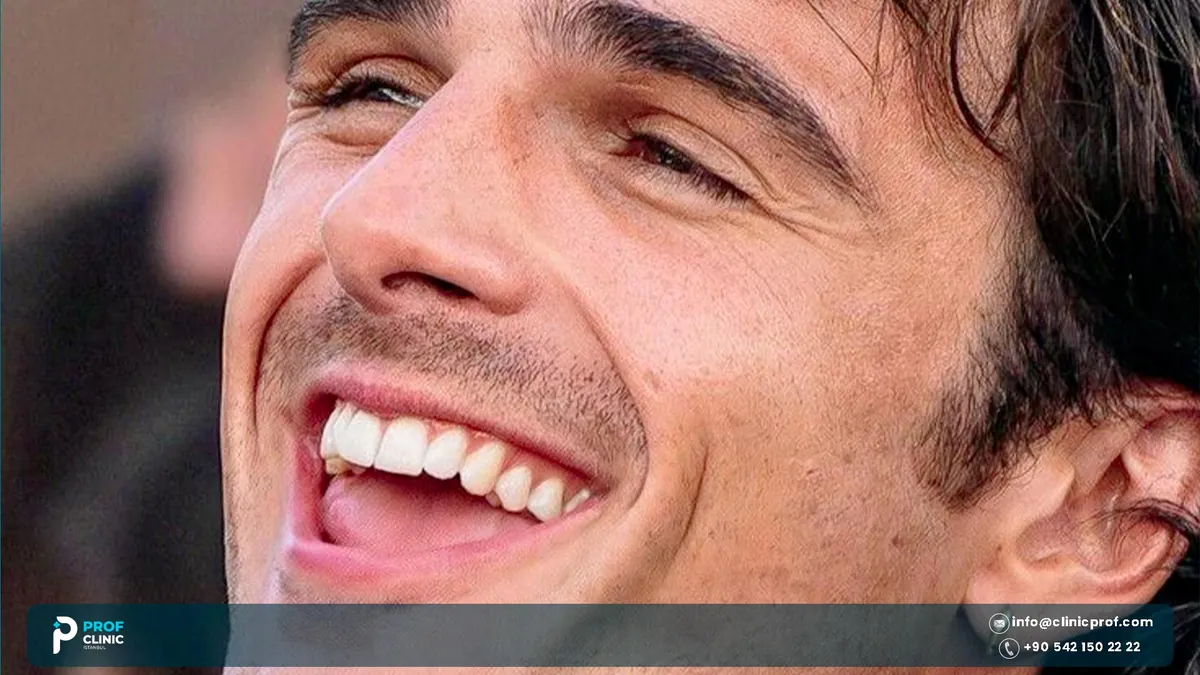
Matt Rife teeth changed noticeably before his rise to mainstream fame, and this is one celebrity veneer story that does not depend on guesswork. During a Cancelled podcast interview, Rife directly confirmed that he had veneers, describing his teeth as the cosmetic feature he had changed.
That makes matt rife teeth before and after comparisons more useful than the typical celebrity speculation article. Earlier footage shows more spacing and less uniformity, while later close-ups show a brighter, more consistent front-tooth line. The useful dental question is therefore not whether treatment happened, but what veneers changed, what photographs cannot tell us, and what a veneer case with similar goals actually involves.
Medical note
This article is for educational purposes only. It does not diagnose Matt Rife or any reader. Veneers should be planned after examination of the teeth, gums and bite, with X-rays or other imaging when clinically necessary.
Matt Rife has no known connection to Prof Clinic. His public dental history is discussed only as a familiar example of how veneers can change shade, shape, spacing and overall smile balance.
How a Comedian’s Smile Became Part of the Act
Matt Rife became especially visible in an era of front-facing video. Crowd-work clips, TikTok posts, podcasts and close-up interviews put his expressions and teeth directly in front of the camera rather than several metres away on a stage.
That matters because the matt rife smile became part of the visual conversation around his rise. Vogue’s profile of Matt Rife describes how his viral crowd-work clips accelerated his fame and also records Rife saying that, apart from getting his teeth done, he had not undergone procedures to enhance his looks.
The dental transformation itself happened much earlier. During a later Club Shay Shay conversation, Rife explained that he got his teeth fixed at 19 after his first season of Wild ‘n Out. He also described how insecure he had been about his earlier smile and how strongly fixing his teeth affected his confidence.
Matt Rife’s Teeth Before the Fame
Early matt rife teeth before footage shows a younger smile with more visible spacing, less regular alignment and greater variation between individual tooth shapes.
That earlier period is what searchers usually mean by phrases such as matt rife before teeth fixed, matt rife before teeth, matt rife before dental treatment, matt rife before teeth done and matt rife before he got his teeth fixed. They broadly refer to his teenage years and early Wild ‘n Out appearances before the dental treatment he later confirmed.
Rife himself has used harsh language about his old teeth, but matt rife bad teeth is not a useful clinical description. Spacing, rotation, tooth-size differences and uneven edges may affect appearance without automatically meaning the teeth are unhealthy.
Older photographs also have limits. They can show visible spacing and shape differences, but they cannot reveal enamel thickness, gum condition, bite forces, decay, existing restorations or how much preparation was ultimately required.
Why TikTok Close-Ups Changed the Conversation
Modern video makes cosmetic dentistry much easier to notice. High-resolution front-facing footage can show tooth edges, shade variation, translucency, gum symmetry and small differences in width that older television footage often concealed.
Lighting can also distort the comparison. Ring lights may make teeth look brighter and flatter, while phone processing can increase contrast and sharpen edges. A single freeze-frame is therefore a poor dental record.
That is important when interpreting matt rife new teeth searches. It is also important for the unusual search phrase before surgery glow up matt rife teeth, because it mixes a confirmed dental procedure with separate facial-surgery speculation. Rife has repeatedly denied facial cosmetic surgery while openly acknowledging his dental veneers. The two claims should not be treated as interchangeable.
Matt Rife Teeth Before and After
The clearest difference in matt rife teeth before and after comparisons is the overall consistency of the visible smile rather than one isolated tooth.
Older footage shows more spacing and greater variation in tooth shape. Later footage shows front teeth that appear brighter, more symmetrical and more consistent in width and along the biting edge.
The same pattern is visible in matt rife before and after teeth searches across his earlier stand-up years and more recent appearances.
Unlike many celebrity dental stories, we do not have to infer whether cosmetic treatment occurred. Rife confirmed it himself. What we still cannot reconstruct from photographs is the complete clinical plan.
Shade and Shape: What Actually Looks Different
Compared with earlier footage, the later smile appears brighter, less spaced and more uniform across the visible upper teeth. The incisal edge also appears more regular, and neighbouring teeth show less variation in apparent width and shape.
Those differences explain why matt rife before veneers, matt rife teeth before veneers and matt rife pre veneers remain common searches. They also explain interest in matt rife veneers before and after, because veneers can alter several visual features at the same time rather than only whitening enamel.
However, appearance cannot tell us how much enamel was removed, which specific ceramic was used, how his bite was managed or whether any preparatory dental treatment occurred first.
Did Matt Rife Get Veneers?
Yes. The answer to did matt rife get veneers is directly supported by Rife himself. In his Cancelled podcast appearance, he explicitly said that he had veneers and distinguished the dental work from the other cosmetic procedures people had speculated about online.
That also answers does matt rife have veneers. The veneers themselves are confirmed; the exact preparation design, laboratory process, material and complete treatment chart remain private.
The search does matt rife have fake teeth is less accurate. Veneers are not dentures and do not replace an entire tooth. They are restorations placed over the visible surface of existing teeth to alter features such as shade, shape, size or proportion.
Reading Veneers From a Photo: What Gives It Away
A photograph alone cannot prove that someone has veneers. In Rife’s case we have confirmation from him, but these six visual clues help explain why cosmetic dental work may become noticeable in before-and-after images:
- Shade consistency: Natural teeth usually contain subtle colour differences, while several adjacent restored teeth may show a more controlled and consistent shade.
- Tooth proportions: Veneers can change the apparent width and length of narrow, short or irregular teeth, producing a more coordinated smile line.
- Incisal edges: The biting edges may become more symmetrical and consistent after restorative redesign.
- Surface texture: Natural-looking ceramic generally includes subtle anatomy and texture rather than a perfectly flat glossy surface.
- Translucency: Natural enamel handles light differently across different areas of a tooth, so high-quality ceramics try to reproduce that variation rather than appearing uniformly opaque.
- Gum relationship: Even technically good veneers can look unnatural when tooth width, length and margins do not harmonise with the gum line.
These are design observations, not a method for diagnosing a stranger from photographs.
Read as well: Roman Reigns Teeth: Ring Damage, Repairs and Smile Today

What a Veneer Case Like This Involves
A major smile transformation begins before any ceramic is made.
The dentist first needs to determine whether veneers are appropriate, which teeth actually need treatment, how much enamel can be preserved, how the bite distributes force and whether another option such as whitening, bonding or orthodontics could achieve part of the goal more conservatively.
The American Dental Association guidance on veneers explains that conventional veneer treatment is generally irreversible because enamel is removed. It also advises that decay or gum disease should be treated before veneers are placed and notes that veneers may chip, crack, loosen or eventually need repair or replacement.
This is why a veneer case should not begin with a patient requesting Matt Rife teeth.
We do not connect any patient plan to a celebrity smile. A celebrity photograph can communicate preferences, but treatment has to be designed around the patient’s own enamel, teeth, gums, bite, face and long-term goals.
How Many Veneers a Smile Like This Needs
There is no universal veneer number. An eight-unit upper plan may cover the central incisors, lateral incisors, canines and first premolars in a relatively narrow smile. A ten-unit plan extends further into the smile and may provide better continuity when more posterior teeth remain visible.
Larger 16- or 20-unit plans may involve upper and lower visible teeth and represent a much broader smile makeover. They should not be treated as automatically better simply because more teeth are included.
The dentist should decide the number after evaluating smile width, tooth display, untreated tooth colour, existing crowns or fillings, gum display and whether whitening could help untreated teeth blend with the restorations.
The principle is simple: choose enough veneers to create a coherent result, not as many veneers as possible.
Avoiding the Overdone Look
Natural-looking veneers usually depend on restraint rather than maximum whiteness or perfect repetition.
Shade should suit the patient’s face, age and remaining natural teeth. Tooth shapes should be related but not identical. Central incisors, lateral incisors and canines have different visual roles, so turning every tooth into the same rectangle can make a smile look artificial.
Width is equally important. Closing spacing by simply making every front tooth broader can distort the proportions of the smile. Length and edge design also affect how youthful, soft or dominant the teeth appear.
Texture and translucency matter because real enamel is not optically flat. Good ceramic design uses surface detail and controlled translucency to prevent the restorations from appearing opaque.
Enamel preservation matters clinically as well. A 2025 systematic review and meta-analysis on ceramic veneers found higher survival and success rates for veneers bonded to enamel than for restorations involving greater dentin exposure.
That makes conservative preparation more than an aesthetic preference. Preserving appropriate enamel can also improve the foundation on which the veneer is bonded.
Read as well: Walton Goggins’ Teeth: The Real Story Behind His Distinctive Smile

16 Things to Ask Before Booking Veneers
- Do I actually need veneers? Ask whether whitening, bonding or orthodontics could achieve part of your goal more conservatively.
- Which teeth really need treatment? The number should follow the visible smile and clinical need rather than a fixed package.
- Which material is being recommended? Ask why E-max, porcelain, composite, zirconia or another material is suitable for your case.
- How much enamel will be removed? Understand how conservative the preparation can be before treatment begins.
- How much of the final bond will remain in enamel? Enamel preservation can matter for long-term veneer performance.
- Can I preview the design? Digital smile planning can expose proportion or length problems before irreversible treatment.
- Can I try a mock-up or trial smile? A preview may help you assess tooth length, shape and overall balance before the final restorations are made.
- How will the shade be selected? Discuss brightness in relation to skin tone, age, untreated teeth and the look you actually want.
- Who fabricates the veneers? Ask how the dentist and dental laboratory or ceramist work together.
- How will natural texture and translucency be created? These details influence how ceramic behaves under daylight and camera lighting.
- How will my bite be checked? Veneers must function comfortably during chewing and jaw movement, not only look good in photographs.
- What if I grind or clench my teeth? Bruxism may change the design, material choice or need for a protective night guard.
- What lifespan should I realistically expect? Veneers are long-term restorations, but they should not be marketed as permanent for life.
- What happens if one chips or debonds? Ask how repairs and replacements are handled before you commit.
- What does the warranty actually cover? Written conditions and exclusions are more useful than vague lifetime promises.
- What aftercare is required? Hygiene, dental reviews, bite protection and maintenance continue after the cosmetic treatment is finished.
Where Veneers in Turkey Starts: Prof Clinic, Istanbul
A veneer transformation should begin with assessment and design rather than trying to reproduce somebody else’s smile.
At Prof Clinic in Istanbul, we plan cosmetic dental treatment around the patient’s own tooth structure, gum health, bite and facial proportions. Our E-max Veneers Turkey Packages explain the veneer service and package-based planning available for international patients.
We do not connect any patient plan to a celebrity smile. Matt Rife’s transformation can illustrate what veneers may change visually, but it does not tell another patient which teeth should be treated or which material should be used.
Also Read: Matthew Perry Teeth: How His Smile Changed Through Friends

Prof Clinic’s Veneer Services
At Prof Clinic, veneer and smile-design planning may include E-max or zirconia options and digital smile design depending on the dental condition and aesthetic goal. Our Dental Treatment services describe the use of digital smile design for custom veneers and list E-max and zirconia among the available restorative options.
For patients who want a broader cosmetic transformation rather than an isolated veneer case, our Hollywood Smile service covers veneers, crowns, whitening and personalised smile-design considerations.
A strong treatment plan should still be willing to recommend fewer restorations when that is enough. Healthy teeth should not automatically be prepared just to increase the number of veneer units.
What a Prof Clinic Veneer Plan Covers
| Planning stage | What we assess | Why it matters |
| Consultation | Goals, concerns and dental history | Establishes what the patient actually wants to change |
| Dental assessment | Teeth, gums, previous restorations and bite | Identifies conditions that should be treated first |
| Imaging when needed | Roots, bone and underlying dental structures | Supports diagnosis when clinically necessary |
| Smile analysis | Tooth display, width, length and symmetry | Helps determine which teeth influence the visible smile |
| Digital smile design | Proposed proportions and aesthetic direction | Lets the design be assessed before final restorations |
| Material discussion | E-max, zirconia, porcelain or composite where suitable | Matches aesthetics and function to the case |
| Trial smile or preview | Proposed shape and proportion when suitable | Helps the patient assess the planned result |
| Tooth preparation | Amount of enamel reduction required | Encourages preservation of healthy structure where possible |
| Laboratory stage | Fabrication of the final restorations | Converts the approved design into the finished veneers |
| Final fitting | Margins, contacts, shade and bite | Confirms appearance and function before completion |
| Aftercare | Hygiene, bite protection and follow-up | Helps protect the restorations over time |
This is where a matt rife before teeth fixed photograph stops being clinically useful. A celebrity transformation can show what cosmetic dentistry may alter visually, but it cannot determine another patient’s preparation depth, veneer count or material.
Veneer Results at Prof Clinic
Before-and-after examples are most useful when the starting condition resembles the patient’s own problem.
A person with spacing should compare spacing cases. Someone primarily concerned about shade should look at cases where colour was the main issue. A patient with significant alignment problems should not assume a veneer-only case represents the right treatment for them.
When reviewing veneer cases, pay attention to tooth proportions, gum health, shade, edge shape, consistency of photography and whether the final smile still fits the patient’s face.
Prof Clinic publishes consented dental transformations in our Before and After gallery. These examples can demonstrate different aesthetic approaches, but they are not guarantees because every result depends on tooth structure, bite, gum health, material choice and treatment planning.
The useful lesson from matt rife veneers is therefore not that every patient should reproduce his smile. It is that changing spacing, shade and tooth proportions together can substantially change the way a smile appears.
The matt rife teeth transformation is much better documented than most celebrity veneer stories. Rife has publicly confirmed veneers and has described how self-conscious he was about his earlier teeth and how important getting them fixed felt to him.
That makes searches such as matt rife teeth before, matt rife before veneers, matt rife teeth before veneers, matt rife pre veneers and matt rife veneers before and after legitimate before-and-after questions rather than pure speculation.
At Prof Clinic, we do not connect any patient plan to a celebrity smile. We build the plan around the individual patient’s anatomy, health and aesthetic goals.
If you are considering veneers, contact Prof Clinic with clear smile photographs and available dental records so our team can assess which cosmetic approach may suit your case.
Matt Rife’s Teeth: Your Questions Answered
- Does Matt Rife have veneers?
Yes. Matt Rife publicly confirmed that he has veneers during his Cancelled podcast interview. The veneers themselves are therefore confirmed, although the precise preparation design, material and complete treatment chart remain private.
- What did Matt Rife’s teeth look like before?
Early matt rife before teeth footage shows more spacing and less uniformity than his later smile. During his Club Shay Shay interview, Rife said that he got his teeth fixed at 19 and described being very self-conscious about his earlier teeth. Searches for matt rife before he got his teeth fixed and matt rife before teeth done refer to this earlier period.
- How much do veneers cost in Turkey?
Prof Clinic’s current dental veneers cost guide lists approximately €120 to €350 per tooth depending on veneer type. The final cost can change with the material, number of teeth, preparation required and wider treatment plan, so an individual assessment is more useful than simply multiplying a headline per-tooth price.
- How many veneers do most people need?
There is no medically standard number. Cosmetic planning often discusses eight or ten upper veneers because those teeth may cover much of the visible upper smile, while broader smile makeovers can involve 16 to 20 restorations across more visible teeth. The correct number depends on smile width, untreated tooth colour, existing restorations, gum display and whether fewer veneers can achieve a coherent result.
References / Sources:
- Cancelled with Tana Mongeau and Brooke Schofield — Matt Rife confirming his veneers
- Club Shay Shay — Matt Rife discussing getting his teeth fixed at 19 and his earlier insecurity
- Vogue — Matt Rife discussing his appearance, fame and confirmed dental work
- American Dental Association — Veneers: treatment, preparation and limitations
- PubMed — Clinical survival of ceramic veneers bonded to enamel and dentin
Read as well: Simon Cowell Teeth: Veneers, Whitening or Natural?