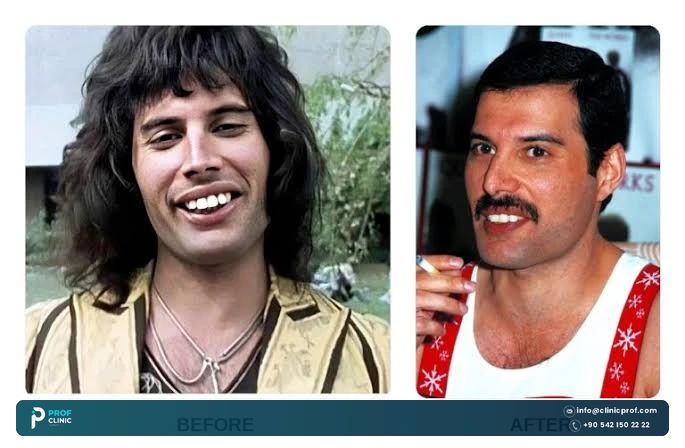
Freddie Mercury teeth became almost as famous as his voice because he was widely reported to have had four extra upper teeth, which pushed his front teeth forward and created his famous overbite. He reportedly chose not to correct them because he feared changing his mouth might affect his singing.
This article explains what was unusual about Freddie Mercury’s teeth, why he kept them, what modern dentistry calls this condition, and how similar crowding or overbite cases can be diagnosed and planned today.
Medical note:
This article is for educational purposes only. It does not diagnose Freddie Mercury or any reader. Orthodontics, extractions, crowns, veneers, bite correction and smile design should be planned only after a dental examination, X-rays or CBCT when needed, bite analysis, gum assessment and medical history review.
This article discusses Freddie Mercury’s smile from biographies, media coverage and publicly available reporting only. Freddie Mercury has no known connection to Prof Clinic, and his smile is used only as a public example to explain extra teeth, overbite, orthodontic planning and smile identity.
If Freddie Mercury’s story made you think about your own crowding, overbite or smile shape, send your smile photos and X-rays to Prof Clinic for a personalised dental assessment in Istanbul.
The Most Famous Overbite in Music History
Freddie Mercury did not become iconic because he had perfect teeth. He became iconic because his voice, performance, confidence and appearance worked together in a way nobody could copy.
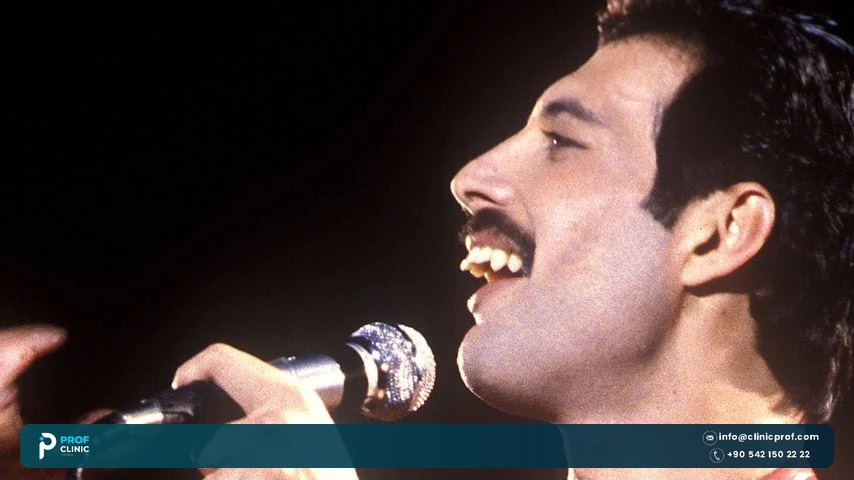
The Freddie Mercury smile was bold, expressive and instantly recognisable. His upper front teeth looked prominent, and that feature became part of how people remembered him on stage. Unlike many celebrity dental stories, this is not a simple before-and-after transformation. It is an anatomy and identity story.
Many fans still wonder what was wrong with Freddie Mercury’s teeth, especially because his smile looked so different from the polished celebrity smiles we see today. The widely reported explanation is hyperdontia, a condition where extra teeth develop beyond the usual number and can push the front teeth forward.
Did Freddie Mercury Have Extra Teeth? The Short Answer
Yes. Did Freddie Mercury have extra teeth? According to widely cited media coverage, he was born with four extra upper teeth, often described as extra incisors, which pushed his front teeth forward.
TIME reported that Mercury was born with four extra upper teeth and that they caused his front incisors to protrude. TIME also reported that his personal assistant Peter Freestone said Mercury’s teeth were a source of insecurity, and that he allegedly feared corrective surgery could affect his singing.
There is one important limit: no verified dental records have been made public.
Freddie Mercury’s Teeth Condition Explained
The Freddie Mercury teeth condition is usually described as hyperdontia, also called supernumerary teeth. This means a person develops extra teeth in addition to the normal set.
A medical review in PubMed Central explains that supernumerary teeth can affect diagnosis, treatment and complications, and that panoramic radiography is one of the most effective diagnostic tools for detecting them.
This matters because Freddie Mercury dentition was not just ordinary crowding. Ordinary crowding happens when there is not enough space for the normal number of teeth. Hyperdontia means there are additional teeth, which may push other teeth out of alignment, delay eruption, create crowding or complicate the bite.
Some search phrases, such as xray Freddie Mercury teeth diagram, Freddie Mercury teeth xray, Freddie Mercury teeth diagram, double row xray Freddie Mercury teeth and xray overbite Freddie Mercury teeth, show that readers want to visualise the structure. However, there is no verified public X-ray of Freddie Mercury’s actual teeth. Any diagram online should be understood as an educational illustration unless it comes from confirmed dental records.
How Many Teeth Did Freddie Mercury Have?
The usual adult dentition is often described as 32 teeth when wisdom teeth are included. So, if the widely reported story is accurate, the answer to how many teeth did Freddie Mercury have would be around 36 teeth.
The more precise search question is how many extra teeth did Freddie Mercury have. The commonly cited answer is four extra upper teeth.
NPR’s Fresh Air interview with Rami Malek also discussed Mercury’s appearance for the film Bohemian Rhapsody, with host Terry Gross noting that Mercury had four extra teeth in his upper mouth while asking Malek about wearing prosthetic teeth for the role.
Freddie Mercury is widely described as having four extra upper teeth, but his personal dental records were never made public. That means the story is best understood through biographies and media coverage rather than a confirmed dental chart.
Why He Never Fixed Them
The question did Freddie Mercury fix his teeth has a direct answer: according to public reporting, he did not have them corrected during his career.
That decision has become part of his legend. Mercury was reportedly self-conscious about his teeth, but he also believed that altering his mouth might affect his voice. Whether that belief was medically correct is a separate question.
The emotional truth is still important: for a singer, the mouth is not just appearance. It is also speech, resonance, identity and performance. Mercury may have decided that the risk, even if uncertain, was not worth it.
The Voice Theory: Fact or Myth?
The voice theory says that Freddie Mercury kept his teeth because he believed they helped his singing range or resonance. This is widely repeated, but it should be handled carefully.
TIME reported that Mercury allegedly feared corrective surgery would affect his singing abilities.
A scientific study of Freddie Mercury’s voice analysed recordings and found distinctive vocal features including an unusual vibrato rate and evidence related to subharmonic phonation. The study focused on acoustic and voice-production analysis, not on proving that his teeth caused his vocal ability.
So the honest answer is: Freddie Mercury reportedly believed changing his teeth might affect his voice, but there is no clinical proof that his extra teeth created his vocal range.
Read as well: How Jurgen Klopp’s Veneers Changed His Whole Smile
Did Freddie Mercury Get His Teeth Fixed? What We Know
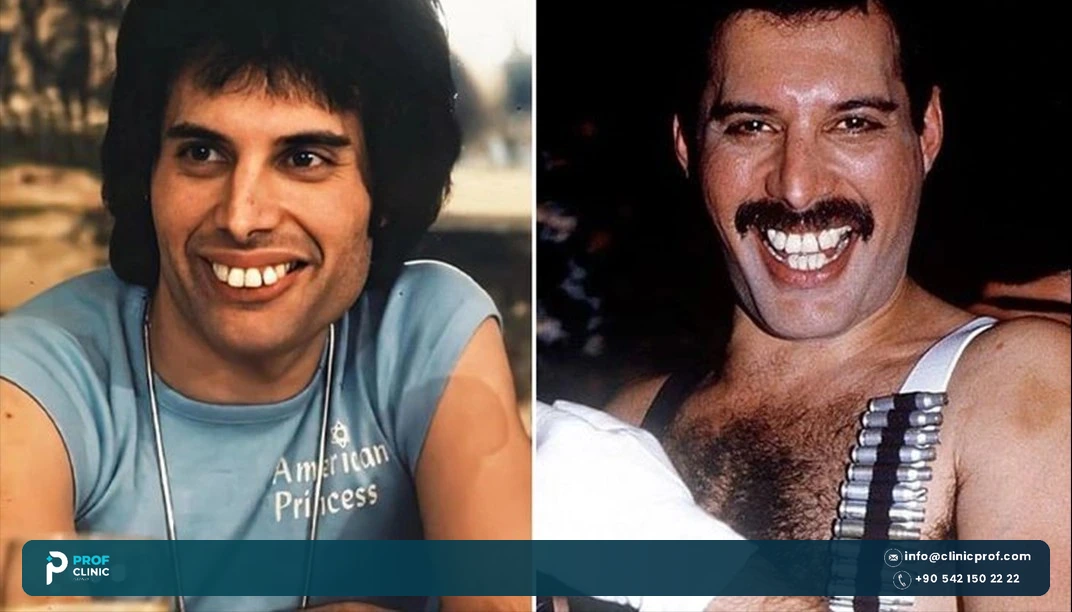
Did Freddie Mercury get his teeth fixed? Based on public photos and widely available reporting, no — he did not appear to have his famous overbite corrected during his career.
Searches such as did Freddie Mercury get his teeth fixed and did Freddie Mercury fix his teeth usually come from readers who expect a celebrity makeover story. But Mercury’s case is different. There was no public “new smile” reveal, no confirmed orthodontic correction and no widely documented cosmetic transformation.
That is part of why the story remains powerful. He kept a feature that many modern celebrities might have changed early in their careers.
Freddie Mercury’s Smile as Part of His Identity
The Freddie Mercury smile was not a flaw to erase from history. It became part of his stage image.
His prominent teeth were visible when he sang, laughed and spoke. In private, according to accounts from people who knew him, he could be self-conscious about them. In public, he performed with a kind of force that made the feature inseparable from his presence.
Some fans describe the look as Freddie Mercury buck teeth, but clinically, the issue was likely about tooth position rather than tooth size. The reason Freddie Mercury had big teeth in appearance is that his extra upper teeth may have pushed the front teeth forward, creating the prominent smile that became part of his stage identity.
How Supernumerary Teeth Are Treated Today
Modern dentistry would not treat a Freddie-like case as a simple cosmetic issue. It would usually be evaluated as a combination of supernumerary teeth, overbite, crowding, bite function and smile design.
A patient with extra teeth may need orthodontics, extraction, oral surgery, restorative dentistry or a staged plan. Veneers alone would usually not be the first answer if the true problem is tooth position or extra teeth.
NHS guidance explains that orthodontic treatment is commonly used to improve the appearance and alignment of crooked, protruding or crowded teeth and to correct bite problems.
How Extra Teeth Are Diagnosed on an X-Ray
Extra teeth are diagnosed with a clinical exam and imaging. A dentist may use:
- Panoramic X-ray to screen the whole mouth
- Periapical or occlusal X-rays for local detail
- CBCT scan when three-dimensional location is needed
- Photographs and bite records to connect the X-ray findings with the visible smile
- Orthodontic assessment to understand crowding, overbite and tooth movement options
A recent review of radiographic localisation explains that panoramic, periapical and occlusal radiographs can often provide useful information, but CBCT may be needed when two-dimensional images do not show the three-dimensional relationship clearly enough for surgical planning.
This is why online searches like Freddie Mercury teeth xray or Freddie Mercury teeth diagram can be misleading. A diagram may explain the idea, but a real patient needs imaging of their own mouth.
Braces, Extraction or Smile Design: Which Applies When
A Freddie-like dental pattern would often require staged planning.
| Situation | Possible treatment path | Why it matters |
| Extra teeth are present but not causing problems | Monitoring or planned removal | Not every extra tooth is treated the same way |
| Extra teeth block eruption or crowd the front teeth | Extraction and orthodontics | Creates space and guides teeth into better position |
| Overbite or overjet affects function | Braces, aligners or bite correction | Moves teeth instead of only covering them |
| Tooth shape or shade remains a concern after alignment | Smile design, crowns or veneers | Refines appearance after the foundation is stable |
| Severe skeletal bite problem exists | Specialist orthodontic and surgical review | Some cases need more than cosmetic dentistry |
A PubMed Central review on management of supernumerary teeth notes that supernumerary teeth may cause delayed eruption, displacement, crowding, root issues, inflammation, caries from hard-to-clean areas and other complications.
That is why treatment should not begin with the question “Should I get veneers?” It should begin with: What is causing the overbite, crowding or spacing?
12 Things to Know Before Treating an Overbite
Before treating an overbite, crowding or extra teeth, patients should understand:
- Age matters because jaw growth affects timing in children and teens.
- X-rays are essential when extra teeth are suspected.
- CBCT may be needed if the tooth position is complex.
- Extraction is not always automatic; the risk and benefit must be assessed.
- Orthodontics may take months or years, not days.
- Speech may temporarily change during braces, aligners or appliances.
- Retention is necessary after orthodontics to reduce relapse.
- Gum health must be stable before complex movement.
- Bite forces matter because grinding can damage restorations.
- Veneers do not move roots; they change visible tooth surfaces.
- Smile design should come after diagnosis, not before it.
- Long-term follow-up matters because alignment can shift over time.
The GDC advises people considering dental treatment abroad to ask about risks, aftercare, expected outcomes and who will handle problems after treatment.
Also Read: Tom Cruise Teeth: The Middle Tooth Story, Before and After
Prof Clinic: Orthodontics and Smile Design in Istanbul, Turkey
A case inspired by Freddie Mercury teeth should be matched honestly to the right service. This is not mainly a veneer story. It is an orthodontics, diagnosis and smile design story.
At Prof Clinic in Istanbul, we assess complex smile concerns by looking at tooth position, bite, gum health, facial balance and whether cosmetic treatment should wait until alignment is improved.
For international patients, our Dental Tourism Turkey guide explains how photos, X-rays or CBCT, medical history and treatment goals can help build a clearer plan before travelling.
Prof Clinic’s Orthodontic and Smile Design Services
At Prof Clinic, orthodontic and smile design planning may include fixed braces, clear aligners, Invisalign-style planning, crowns, veneers, whitening and digital smile design, depending on the case.
Our Perfect Teeth guide explains that orthodontics can correct spacing, crowding, bite issues and jaw alignment, while options such as whitening, crowns, veneers or implants may be used for other smile goals.
For patients who need a broader smile upgrade, our Smile Makeover guide explains that a smile makeover may include whitening, veneers, crowns, orthodontics or implants depending on dental condition and goals.
At Prof Clinic, we do not start by forcing one treatment. We first ask: Is this an alignment problem, a tooth-shape problem, a colour problem, a bite problem, or a combination?
How Prof Clinic Plans Complex Alignment Cases
Complex alignment cases need a staged plan. A patient with crowding, overbite or suspected extra teeth should not be rushed into cosmetic work.
| Planning step | What it checks | Why it matters |
| Smile photos | Lip line, tooth display and symmetry | Shows what appears when you speak and smile |
| Panoramic X-ray or CBCT when needed | Roots, bone, impacted or extra teeth | Helps diagnose hidden causes |
| Bite assessment | Overbite, overjet and chewing contacts | Prevents cosmetic work from fighting the bite |
| Gum health review | Inflammation, recession or periodontal risk | Keeps treatment safer and more stable |
| Orthodontic review | Whether teeth should move first | Avoids unnecessary tooth reduction |
| Smile design | Shape, shade and proportion | Builds a natural result after function is understood |
| Timeline expectations | Stages and visit planning | Helps international patients plan realistically |
| Follow-up plan | Retainers, hygiene and maintenance | Protects the result after treatment |
Prof Clinic’s Dental Treatment Services page explains that patients can share photos or X-rays for a personalised treatment plan and a clear quote tailored to their needs.
Patient Outcomes in Crowding and Overbite Cases
Patient outcomes in crowding and overbite cases should be realistic. Some improvements can be cosmetic, but many cases need orthodontic movement before final smile design.
A good outcome may include:
- Better tooth alignment
- Improved bite comfort
- Less visible crowding
- Cleaner smile proportions
- More balanced shade and shape
- A result that still looks like the patient
Prof Clinic’s 3D Hollywood Smile guide explains that digital smile design can help patients preview tooth shape, colour and alignment before treatment, while also noting that active gum disease, severe decay or untreated bite issues may need to be addressed first.
That is especially important for Freddie Mercury-style cases. A dramatic smile should never come at the expense of tooth health, bite function or long-term stability.
The story of Freddie Mercury teeth remains powerful because it is not only about dentistry. It is about identity, confidence and the choice to keep a feature that became part of a legendary stage presence.
For modern patients, the lesson is not to copy or reject Freddie’s decision. The lesson is to get a proper diagnosis. If you have crowding, an overbite, suspected extra teeth or a smile concern, the right plan may involve orthodontics, extraction, smile design or a staged combination.
At Prof Clinic in Istanbul, we help international patients understand complex alignment and smile design options with a personalised assessment. Send your smile photos, close-up teeth photos and X-rays if available to Prof Clinic to learn which treatment path may fit your case.
Common Questions About Freddie Mercury’s Smile
- Was Freddie Mercury born with extra teeth?
Yes, Freddie Mercury was widely reported to have been born with extra teeth, usually described as four extra upper teeth. TIME reported that those extra teeth caused his front incisors to protrude. However, no verified dental records are public, so the exact clinical anatomy should be described carefully.
- Why did Freddie Mercury have big teeth?
Why did Freddie Mercury have big teeth? The widely reported explanation is that extra upper teeth pushed his front incisors forward, creating a prominent overbite or overjet. This made the front teeth look larger and more projected, especially when he sang or smiled on stage.
- Did extra teeth affect Freddie Mercury’s voice?
Freddie Mercury reportedly believed changing his teeth might affect his voice, and TIME reported that he allegedly feared corrective surgery could affect his singing. But there is no clinical proof that his extra teeth created his vocal range. A PubMed-listed acoustic study analysed his voice, not his teeth as the cause.
- Can supernumerary teeth be removed safely?
Yes, supernumerary teeth can often be removed safely, but the plan depends on their position, roots, nearby teeth and whether orthodontic movement is needed. Imaging is important. A radiographic review explains that CBCT may help when three-dimensional detail is needed for surgical planning.
References / Sources:
- TIME, The True Story Behind Bohemian Rhapsody
- NPR Illinois, Rami Malek on embodying Freddie Mercury
- PubMed, Freddie Mercury acoustic voice analysis
- PubMed Central, Prevalence, etiology, diagnosis, treatment and complications of supernumerary teeth
- PubMed Central, Management of supernumerary teeth
- PubMed Central, Radiographic localization of supernumerary teeth
- NHS, Orthodontics
- General Dental Council, Going abroad for dental treatment
Read as well: Wayne Rooney Teeth: Did He Really Have Veneers Fitted?
Read as well: A$AP Rocky Teeth: Old Smile, Grills and the Veneer Question