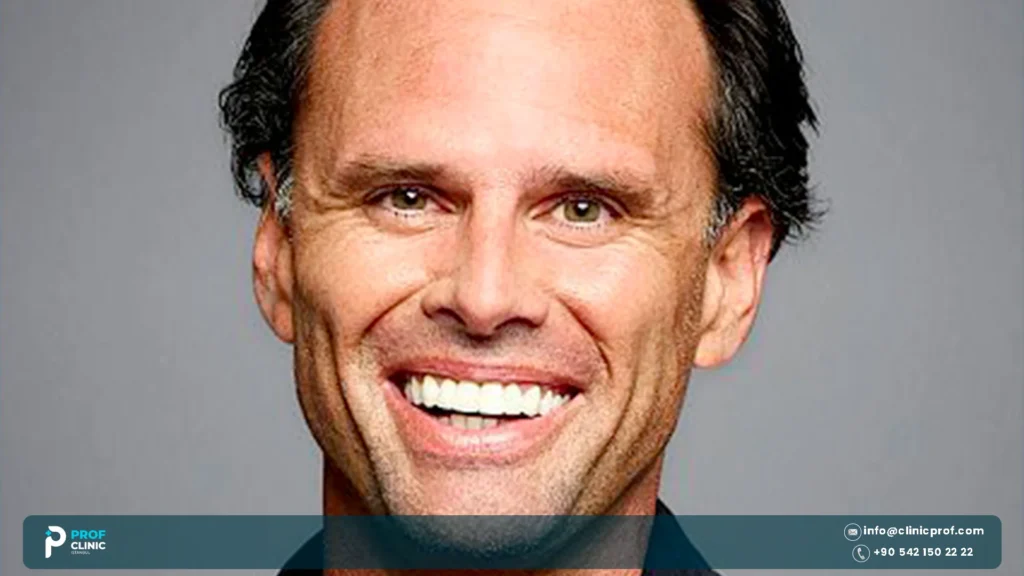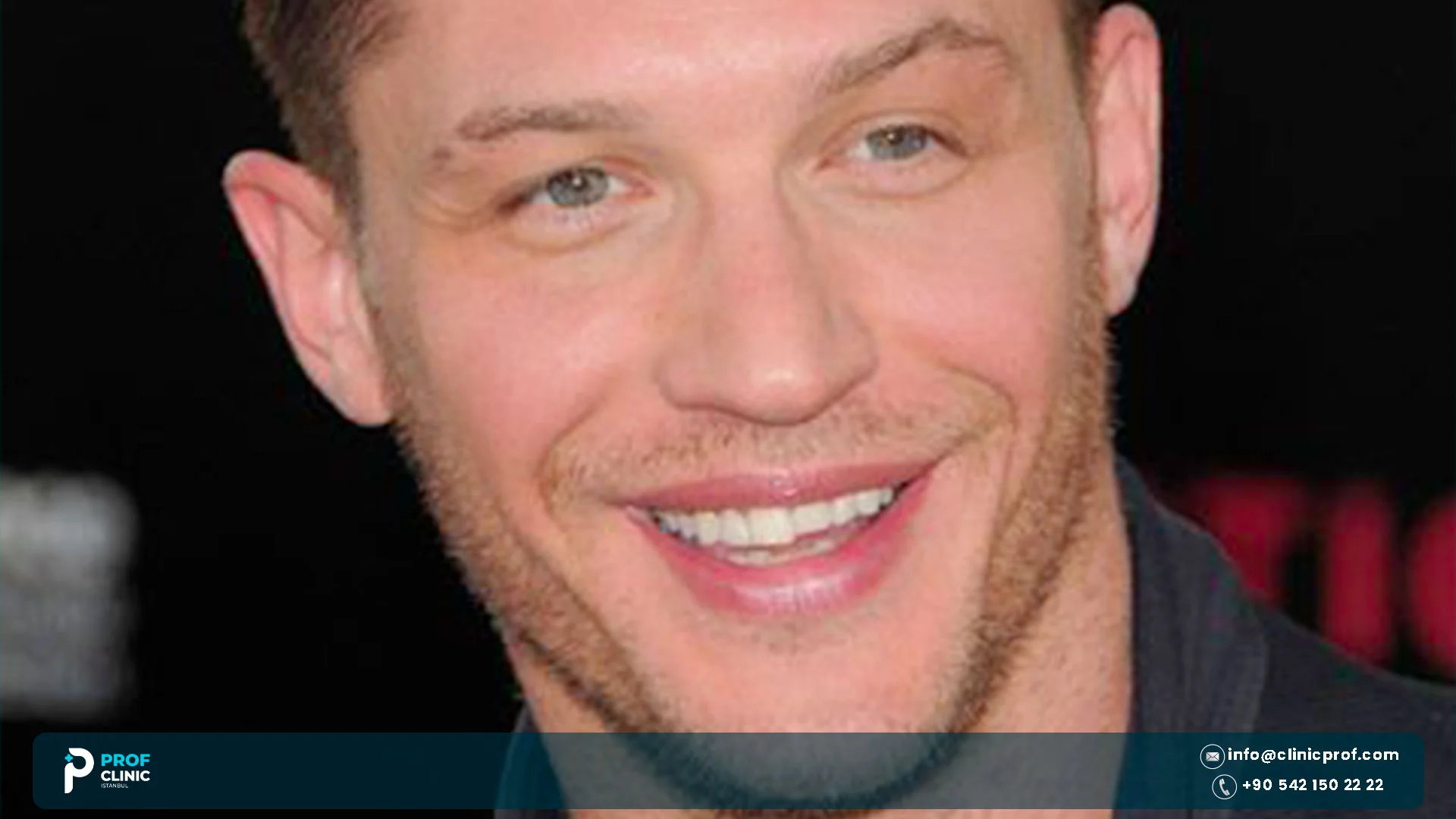
Tom Hardy teeth have always looked more individual than the standard Hollywood smile. Earlier public appearances show visible crowding, irregular front-tooth edges and a less uniform smile, while some later appearances look cleaner and more even. However, Tom Hardy has never publicly confirmed veneers or another cosmetic dental procedure.
That distinction matters because searches for tom hardy teeth fixed and tom hardy teeth before and after often turn visual changes into a treatment claim. The more accurate story is that Hardy’s smile has looked different across years and roles, while the exact dental work, if any, remains private.
Medical note
This article is for educational purposes only. It does not diagnose Tom Hardy or any reader. Crowding, tooth wear, veneers and orthodontic treatment should be assessed after examining the teeth, gums and bite, with X-rays or other imaging when clinically necessary.
Tom Hardy has no known connection to Prof Clinic. His public smile is discussed only as a familiar example of how crowding, tooth wear, alignment and restorative treatment can affect the appearance of a smile.
The Smile Behind the Tough-Guy Roles
The tom hardy smile is easy to overlook because many of his best-known characters do not spend much time giving the camera a full, relaxed grin. Hardy’s screen image has often been built around clenched expressions, masks, beards, injuries, prosthetics and physically imposing characters.
That makes tom hardy smiling teeth searches interesting. When he does smile broadly in interviews or public appearances, viewers get a clearer look at a smile that has historically been more irregular than the highly uniform teeth associated with many leading actors.
A 2014 Esquire profile of Tom Hardy actually described him as having crooked teeth. The description fits earlier public photographs, but it still does not tell us whether any later cosmetic treatment occurred.
Tom Hardy’s Teeth Before: Crowding and Wear
Early-career photographs show Tom Hardy’s teeth with mild visible crowding and irregularity across the upper front teeth. The biting edges also appear less even than the polished edge line seen in many veneer makeovers.
Those are visual observations, not diagnoses. A photograph cannot tell us:
- Whether an edge is naturally shaped or worn
- Whether there is enamel loss
- Whether a tooth has been bonded
- Whether whitening has been performed
- Whether alignment changed orthodontically
- Whether a restoration is present
The search term tom hardy tooth often appears when viewers focus on one irregular front tooth, but a single tooth rarely explains an entire smile. Tooth position, neighbouring teeth, bite and the facial midline all affect how one irregular tooth appears.
Even the unusual international query tom hardy denti points to the same broader curiosity: people notice that his teeth have never looked like a perfectly standardised celebrity smile.
Why We Rarely See Tom Hardy Smiling With Teeth
Part of the reason Hardy’s teeth attract attention is that his screen persona often hides them.
Bane in The Dark Knight Rises covered much of his lower face. Mad Max spent significant screen time bruised, bloodied or restrained. Venom relies heavily on altered facial expressions and visual effects. Other Hardy characters use heavy facial hair, damaged-looking makeup or tense expressions.
Hardy has also spoken about resisting the conventional leading-man image. In an interview later republished by Gulf News, he recalled feeling pressure early in his career to have things such as straight teeth, a tan and a stereotypically polished appearance, while saying that was not an image he felt able or interested to maintain.
That makes his smile unusually useful for this discussion. A distinctive tooth arrangement can remain part of an actor’s appearance without automatically requiring cosmetic correction.
Tom Hardy Teeth Fixed: Reading the Difference
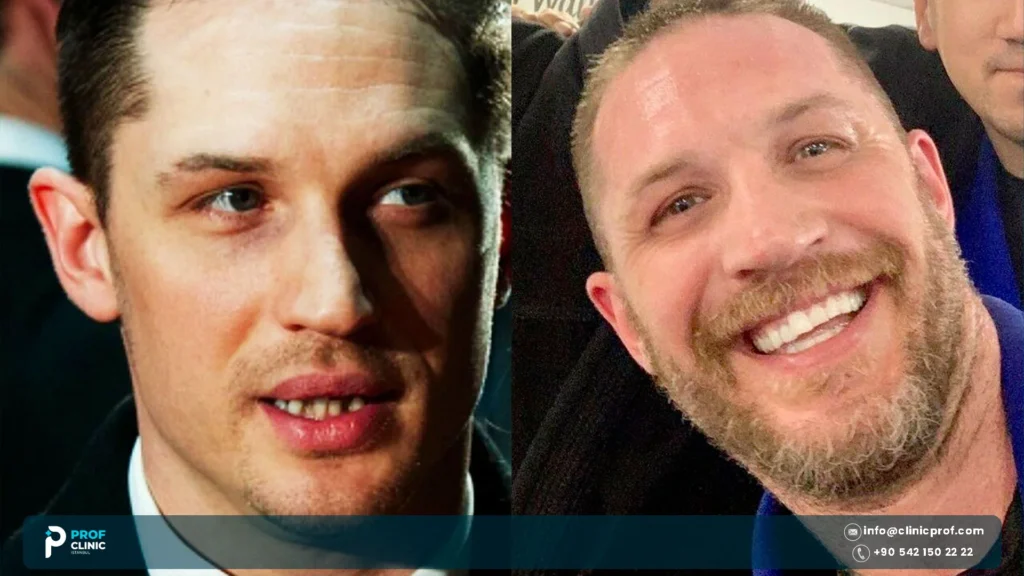
Earlier photos show more visible irregularity and crowding. In some later public appearances, the teeth can look brighter and the visible front edge line can appear cleaner. Those differences may come from several possibilities, including whitening, bonding, orthodontic movement, restorative treatment, photography or a combination of factors.
What Looks Different in Recent Appearances
The most defensible observations concern three things: shade, apparent alignment and tooth-edge consistency.
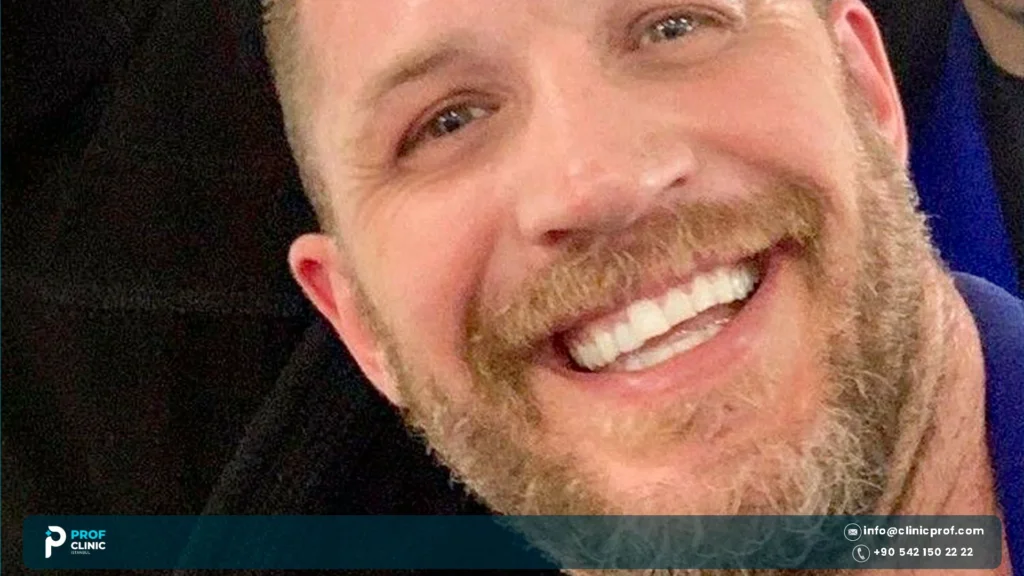
Some recent photographs show a brighter-looking smile than older photographs. The front teeth may also appear somewhat more orderly in certain angles, although Hardy still retains an individual rather than highly uniform smile.
Photos of Tom Hardy teeth 2022 and 2023 sometimes show a brighter, slightly more even-looking smile than in his earlier career. The difference is subtle rather than dramatic, and lighting, camera angle and image processing can all affect how alignment and tooth shade appear.
Similarly, tom hardy teeth fixed before and after should be understood as a visual comparison rather than a clinical before-and-after record.
Lighting matters too. Event photography, whitening, camera processing and changes in facial hair can all alter how teeth appear.
Did Tom Hardy Get Veneers?
There is no reliable public confirmation that Tom Hardy has veneers.
Veneers are frequently suggested in online celebrity-dentistry discussions because some later photographs can look more polished than earlier ones. But appearance alone cannot establish the treatment.
So the safest answer is: Tom Hardy’s smile appears to have changed somewhat over time, but veneers have not been publicly confirmed by Hardy.
That distinction is important because several procedures can produce overlapping visual results.
Professional whitening can change shade without changing tooth shape. Composite bonding can alter individual edges or small irregularities. Orthodontics can move crowded teeth without covering them. Veneers can change shape, shade and apparent alignment simultaneously.
Without a statement or dental record, a photograph cannot tell us which occurred.
How Film Roles Can Disguise Dental Work
Tom Hardy is an especially difficult actor to analyse from film stills because his characters frequently use dental and facial prosthetics.
For Legend, Hardy played both Kray twins. While discussing the transformation into Ronnie Kray, Hardy explained that the character required fake teeth along with a wig, altered nose and other makeup. A contemporary interview about the Legend transformation records Hardy describing the teeth as part of the rapid prosthetic change between the brothers.
Hardy has also talked more broadly about using false teeth, rubber noses and other physical devices to disappear into characters.
That creates an important rule for celebrity dentistry: Character teeth are not dental records. Film roles may use:
- Removable false teeth
- Prosthetic dental overlays
- Tooth staining
- Altered gum effects
- Facial prosthetics that change lip position
- Makeup that changes apparent tooth contrast
A screenshot from Legend cannot prove anything about Hardy’s everyday teeth, just as a highly processed premiere photograph cannot establish veneers.
Read as well: Matt Rife Teeth: What the Close-Ups Smile Show
Correcting Crowding and Worn Edges
Crowding plus uneven front edges is a common real-world treatment question.
The main decision is whether the teeth should be moved, reshaped, restored or treated with a combination of methods.
Orthodontics moves teeth into better positions. Bonding can rebuild small worn or chipped edges. Veneers can modify visible shape, colour and minor apparent alignment. In some cases, moving the teeth first allows the dentist to use less restorative material later.
The NHS orthodontics guidance explains that orthodontic treatment is specifically used to correct crooked or crowded teeth and improve how the teeth meet.
That is why crowded teeth should not automatically be covered with veneers.
14 Things to Check Before Treating Crowded Teeth
- How severe is the crowding? Mild rotation and major overlap are not the same problem.
- Is there enough space in the arch? Space analysis helps determine whether teeth can be moved predictably.
- What does the bite look like? Front teeth cannot be planned independently of how the upper and lower arches meet.
- Are the gums healthy? Inflammation or periodontal disease should be addressed before elective cosmetic treatment.
- Is the problem tooth position or tooth shape? Orthodontics changes position; veneers primarily change the visible surface.
- How thick is the enamel? Enamel availability affects whether conservative veneer bonding is possible.
- Are the edges genuinely worn? Chipping, erosion and natural irregularity require different treatment plans.
- Does the patient grind or clench? Heavy forces may affect veneers, bonding and long-term maintenance.
- Could aligners solve most of the problem? Moving healthy teeth can sometimes avoid unnecessary restorative preparation.
- Would bonding be enough after alignment? Minor edge defects may need only conservative composite finishing.
- Would veneers make the teeth look too wide? Masking crowding restoratively can create bulky proportions if space is limited.
- How much tooth preparation would be needed? The less favourable the tooth position, the more difficult truly conservative veneers may become.
- What retention will orthodontics require? Teeth can shift after movement, so retention should be planned from the beginning.
- What does the long-term maintenance plan look like? Aligners end with retainers; veneers still need hygiene, reviews and eventual maintenance or replacement.
The central question is not how quickly the teeth can look straight. It is which route solves the problem while preserving the most healthy tooth structure.
Why Crowded Teeth Wear Down Faster
Crowding does not automatically mean that teeth will wear faster. The relationship is more complicated than that.
Poorly aligned teeth can create different contact patterns, and some types of malocclusion may concentrate forces on certain surfaces. Crowded teeth can also be harder to clean, which is one reason orthodontic treatment may have functional as well as cosmetic benefits.
However, tooth wear should not automatically be blamed on crowding. A 2024 PubMed review of tooth wear and bruxism found that even the relationship between bruxism and wear is more complex than dentists once assumed and cautioned against diagnosing grinding from tooth wear alone.
The more useful clinical approach is to check several possible contributors:
- Bite contacts
- Grinding or clenching
- Acid erosion
- Tooth position
- Previous restorations
- Enamel thickness
- Diet and habits
In other words, crowded teeth and worn edges may appear together, but one photograph cannot establish why the wear happened.
Veneers vs Aligners for Mild Crowding
Veneers and aligners can both make a mildly crowded smile look straighter, but they achieve that result in completely different ways.
| Factor | Clear aligners | Veneers |
| What changes | Tooth position | Visible tooth surface |
| Typical timeline | Months | Usually fewer dental visits |
| Healthy enamel | Usually preserved | Some enamel removal may be required |
| Shade change | No direct whitening effect | Shade can be changed |
| Tooth shape change | Limited | Major control over visible shape |
| Reversibility | Tooth movement itself is not restorative preparation | Conventional veneers are generally irreversible |
| Retention | Retainers required | No orthodontic retainer solely because of veneers |
| Best fit | Position is the main problem | Shape, colour or minor visual alignment are the main problems |
The American Association of Orthodontists guidance on clear aligners explains that aligners can treat crowded and crooked teeth by gradually moving them into new positions.
By contrast, the American Dental Association veneer guidance explains that veneers can improve the appearance of crooked or misshapen teeth but are generally irreversible because enamel is removed.
That makes aligners particularly important when the teeth are healthy and position is the primary problem.
Veneers may make more sense when mild visual crowding exists together with concerns such as worn edges, tooth shape, old restorations or shade that the patient also wants to change. Sometimes the best plan is both: alignment first, then minimal restorative finishing afterward.
Prof Clinic: Veneers in Istanbul, Turkey
A Tom Hardy-style irregular smile illustrates why cosmetic dentistry should not automatically start with veneers.
At Prof Clinic in Istanbul, we assess whether the visible problem comes mainly from tooth position, tooth shape, colour, wear or a combination of factors.
We do not connect any patient plan to a celebrity smile. A celebrity photograph may communicate what a patient likes or dislikes, but treatment has to be built around that patient’s own enamel, gums, bite, tooth position and facial proportions.
Our Prof Clinic Smile Makeover guide describes both porcelain veneers and orthodontic options such as clear aligners as possible parts of a personalised smile plan rather than presenting one procedure as the answer for everyone.
Prof Clinic’s Veneer Services
At Prof Clinic, cosmetic smile planning can include E-max or zirconia restorations, clear-aligner assessment and digital smile design depending on the case.
Our Prof Clinic dental treatment information explains that our Istanbul dental team uses 3D imaging and digital smile design for personalised veneers, including E-max and zirconia options.
For patients whose main problem is tooth position, orthodontic assessment may come first. Prof Clinic’s own treatment guidance also includes braces and clear aligners such as Invisalign for correcting spacing, crowding and alignment.
The goal is not to prepare healthy teeth simply because veneers are faster.
Read as wel: Walton Goggins’ Teeth: The Real Story Behind His Distinctive Smile
How Prof Clinic Chooses Between Aligners and Veneers
The decision should follow the diagnosis.
| Case factor | Aligners may be preferred | Veneers may be preferred |
| Main problem | Tooth position or crowding | Shape, shade or minor cosmetic irregularity |
| Treatment time | Usually months | Often completed in fewer treatment visits |
| Tooth reduction | Usually none | May require enamel preparation |
| Colour change | Does not directly alter enamel shade | Can change visible shade |
| Shape control | Limited | High |
| Relative cost | Depends on complexity and treatment length | Depends on material and number of units |
| Reversibility | Teeth are moved biologically | Conventional veneer preparation is irreversible |
| Long-term care | Retainers after alignment | Hygiene, bite monitoring and restoration maintenance |
| Longevity issue | Teeth can relapse without retention | Veneers can chip, loosen or eventually require replacement |
For a patient with healthy but mildly crowded teeth, aligners may preserve more natural tooth structure.
For a patient with minor crowding plus worn, heavily discoloured or poorly shaped front teeth, veneers or a combined approach may make more sense.
For international patients comparing ceramic options, we also offers E-max Veneers Turkey Packages with dental check-up and treatment-related package inclusions.
Veneer and Alignment Results at Prof Clinic
Before-and-after results should be viewed according to the treatment route.
An orthodontic case should show actual tooth movement. A veneer case should demonstrate how ceramic changed shape, shade or proportion. A combined case should make clear that more than one treatment was used.
When reviewing results, look for:
- Similar starting crowding
- Natural tooth width
- Healthy-looking gums
- A balanced edge line
- Realistic shade
- Clear treatment identification
- Consistent photography
- No promise that another patient will get an identical result
Prof Clinic publishes consented dentistry cases in our Before and After gallery. Those cases can help patients understand different treatment possibilities, but they are not guarantees because every result depends on tooth position, enamel, gums, bite and treatment choice.
The tom hardy teeth story is less dramatic than many online before-and-after claims suggest.
Earlier public photographs clearly show a more crowded and irregular smile, and even a 2014 Esquire profile referred to Hardy’s crooked teeth. Some later appearances can look brighter or more orderly, but Tom Hardy has not publicly confirmed veneers or another specific cosmetic dental treatment.
His film career adds another complication because character teeth, prosthetics, makeup and lighting can deliberately change his appearance. Legend is a documented example where Hardy wore false teeth for a role.
For patients with similar mild crowding and worn-looking edges, the useful question is not whether Hardy had veneers. It is whether the teeth need movement, restoration or both.
At Prof Clinic, we do not connect any patient plan to a celebrity smile. We compare alignment, enamel condition, bite, tooth shape and aesthetic goals before deciding between clear aligners, bonding, veneers or a combined plan.
Common Questions About Tom Hardy’s Smile
- Did Tom Hardy fix his teeth?
His smile appears somewhat different across years, but Tom Hardy has not publicly confirmed a specific cosmetic dental procedure. Earlier photographs and interviews show visible crowding, while some later appearances look brighter or more orderly. That is not enough to prove veneers, bonding or orthodontics.
- Does Tom Hardy have veneers?
Veneers are widely speculated online, but there is no reliable public confirmation from Hardy. Photographs alone cannot distinguish confidently between veneers, bonding, whitening, orthodontic movement and natural differences caused by lighting or angle.
- What did Tom Hardy’s teeth look like before?
Earlier public photographs show mild crowding, irregular front-tooth alignment and less even edges. A 2014 Esquire profile also referred directly to his crooked teeth, supporting the observation that his earlier smile was visibly less uniform.
- Can veneers fix crowded teeth?
Veneers can mask some mild crowding by changing the visible shape of teeth, but they do not actually move the teeth. The American Dental Association notes that veneers can improve the appearance of crooked teeth, while orthodontic treatment is designed to reposition crowded teeth. More significant crowding often benefits from orthodontics before restorative treatment.
References / Sources:
- Esquire — Tom Hardy profile describing his earlier crooked teeth
- JOE — Tom Hardy discussing the fake teeth and prosthetics used for Ronnie Kray in Legend
- The A.V. Club — Tom Hardy discussing false teeth and prosthetics as part of character transformation
- NHS — Orthodontics for crooked and crowded teeth
- American Dental Association — Veneers, indications and irreversible preparation
- American Association of Orthodontists — Clear aligners for crowded and crooked teeth
- PubMed — Tooth wear and bruxism scoping review