Many patients do not search this topic because they want theory. They search it because they have a real concern: a diagnosis, a medication, or a previous medical event that may affect whether implants are safe or predictable. In many cases, a medical condition does not automatically rule dental implants out. What it often changes is timing, risk level, healing expectations, and the way the case should be planned.
In this guide, we at Prof Clinic in Istanbul explain how medical conditions dental implants planning can be affected by, which health issues implants cases often need extra caution with, and how contraindications dental implants discussions should be handled in a practical way. We will also cover when treatment may still be possible, when a delay is wiser, what information to prepare before a consultation in Turkey, and how to request a scan-based review of your case.
If you already have a diagnosis list, medication list, panoramic X-ray, or CBCT, we at Prof Clinic can review the basics before you book travel to Istanbul. Start with Dental Implants in Turkey, then check our Medical Team and Contact page for the next step.
Medical Conditions Dental Implants: why the medical history matters
When a patient loses a tooth, the visible problem is simple. The planning behind treatment is not. Before we tell you whether an implant is realistic, we need to understand more than the gap itself. We look at gum stability, jawbone support, healing capacity, medication use, smoking status, and the wider medical picture.
That is why we do not treat medical history as a formality at Prof Clinic. We treat it as part of case selection. Some patients remain good implant candidates with only minor adjustments to the plan. Others benefit from periodontal treatment, better disease control, extra imaging, or a staged approach before surgery.
Key medical conditions that may affect implant planning in Turkey
The most useful way to think about this topic is not to ask, “Do I have a diagnosis?” but rather, “How could my diagnosis change healing, infection risk, bone support, or surgical planning?” That shift matters because many cases are not a simple yes-or-no decision.
The table below shows the practical issues we review most often before we confirm whether implant treatment in Turkey should proceed now, later, or with a modified protocol.
| Condition | Why it matters | What we check | Can implants still be possible? |
| Diabetes | Can affect infection control and healing if poorly controlled. | Control level, gum status, current infection, home care. | Often yes, but sometimes after better stabilization. |
| Active gum disease | May weaken the tissue and bone foundation needed for implants. | Bleeding, pocketing, plaque, bone loss, periodontal stability. | Often only after treatment and stabilization. |
| Low bone support | Does not decide the case alone; local jaw anatomy matters. | Bone volume, density, site anatomy, need for grafting. | Often possible with case-specific planning. |
| Autoimmune | Healing and infection response may be less predictable. | Disease activity, medication load, oral inflammation. | Sometimes yes, but selection is more cautious. |
| Heart disease | Usually changes surgical planning more than candidacy. | Medical stability, bleeding risk, procedure extent. | Often yes with coordinated planning. |
| Cancer history | May affect bone healing and long-term predictability. | Treatment history, timing, radiation field, tissue status. | Sometimes yes, but work-up is more complex. |
Diabetes and dental implants
Diabetes does not automatically exclude implant treatment, but control matters. When blood sugar is poorly controlled, gum inflammation, infection risk, and healing problems may be harder to manage. For implant treatment, that means the discussion is not only about the implant itself; it is also about the quality of the tissues expected to heal around it.
In practical terms, we usually want to understand whether the condition is stable, whether there is current gum disease, and whether the patient can maintain good oral hygiene throughout healing. If your diabetes is well managed and the mouth is in healthier condition, treatment may still be realistic. If control is poor or the gums are active and inflamed, delaying surgery can be the safer decision.
Gum disease, bone loss, and local oral infection
Some of the most important risk factors are not systemic diseases at all. They are local oral conditions. Active gum disease, untreated infection, heavy plaque accumulation, and advanced bone loss can reduce the predictability of implant treatment even in otherwise healthy patients.
This is why wanting implants is not always the same as being ready for implants. At Prof Clinic, we first want to know whether the tissues can support a stable result. In some cases, the right sequence is periodontal treatment first, then reassessment, then implant planning. That approach is slower, but often safer and more durable.
Osteoporosis, low bone density, and bone-related conditions
Patients with osteoporosis often assume the diagnosis alone means implants are impossible. In reality, the better question is what the local jawbone looks like where the implant would be placed. Bone density in the skeleton and available bone in the implant site are related issues, but they are not identical.
This is one reason CBCT-based planning matters. In our clinic, we use imaging to assess bone height, width, angulation, anatomical limits, and whether grafting or an alternative restoration route may be more sensible. Some patients with bone-related conditions remain candidates. Others need a different design, extra preparation, or a more conservative timeline.
Autoimmune conditions and immunosuppressive therapy
Autoimmune disease is not one single implant category. The real questions are whether the condition is active, how stable the patient is, and what medications are being used. A patient with a controlled condition may look very different from a patient in an active inflammatory phase or on a heavier immunosuppressive regimen.
For that reason, we do not reduce these cases to a generic internet rule. We review the diagnosis, current medication list, oral inflammation, and the likely healing burden of the proposed procedure. In selected cases, treatment may still be possible. In others, physician coordination or a delay is more responsible.
Heart disease, blood thinners, and bleeding-related risk
Many patients think any heart history means they cannot have dental implants. Usually, the issue is not automatic exclusion. It is careful surgical planning. Bleeding tendency, anticoagulant use, overall cardiovascular stability, and the expected invasiveness of the procedure all affect how treatment should be approached.
This is exactly why self-adjusting medication before treatment is a bad idea. If you take blood thinners or have a complex cardiac history, the plan should be coordinated properly. Sometimes the pathway remains straightforward. Sometimes it needs a more controlled surgical setup, a staged approach, or communication with your physician.
Cancer history, chemotherapy, and head-and-neck radiotherapy
A history of cancer treatment does not always make implants impossible, but it can make planning much more sensitive. This is especially true after head-and-neck radiotherapy, where bone healing, tissue response, and long-term implant stability may be affected.
These are cases where we prefer a non-rushed work-up. We need to understand the radiation field if relevant, the timing of treatment, the current oral condition, and whether the jawbone can support the kind of implant plan being considered. For some patients, implants remain possible. For others, the plan may need to be delayed or changed.
Health issues implants planning must also account for: medications and smoking
Many health issues implants decisions are shaped by do not come only from the diagnosis name. Sometimes the medication or habit changes the risk profile just as much. Antiresorptive drugs, anticoagulants, corticosteroids, and smoking are common examples that can alter healing expectations or surgical strategy.
Smoking deserves direct attention here. It affects gum health, tissue quality, and long-term maintenance. That does not mean every smoker is excluded, but it does mean the discussion must be honest. In our clinic, we would rather explain the risk clearly and plan accordingly than give a false sense of certainty.
Contraindications dental implants: absolute vs relative
When patients search contraindications dental implants, they often expect a short list of people who can never have treatment. Real life is more nuanced. There are relatively few situations where the answer is a firm and immediate no. Much more often, the real answer is: not yet, not under these conditions, or not with this exact plan.
A relative contraindication usually means the case should be stabilized first. That may involve controlling diabetes better, treating gum disease, reviewing medications, reducing smoking, or waiting for tissues to recover. An absolute problem is rarer and usually relates to major medical instability or a situation where elective surgery is simply not justified at that time.
How we evaluate medically complex implant cases at Prof Clinic in Istanbul
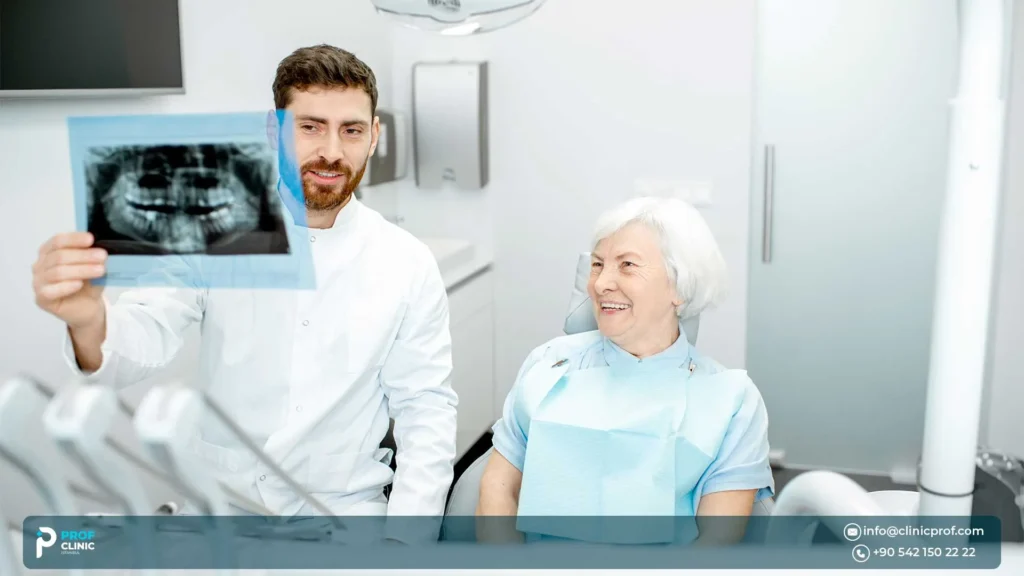
At Prof Clinic, we do not try to answer medical implant questions from a diagnosis label alone. We evaluate the whole picture. That usually includes your medical history, medication list, oral examination, gum status, and imaging. When the anatomy or medical complexity requires more detail, we may rely on panoramic imaging and CBCT-based planning before giving a meaningful answer.
This evaluation-first model is especially important for international patients considering treatment in Turkey. It helps prevent rushed travel decisions, unrealistic same-day expectations, and misunderstandings about whether the case is ready for immediate treatment, staged treatment, or an alternative solution.
Also read: Dental Implants Istanbul |Immediate Load Dental Implants |Dental Implant Surgery Duration in Turkey
What to prepare before your implant consultation in Turkey
You can make your consultation more useful by preparing a few basics in advance: a diagnosis list, your current medications, details of any major surgery or cancer treatment, any history of gum disease, smoking status, and any recent panoramic X-ray or CBCT you already have.
When patients send us organized medical information early, we can usually give more precise guidance about whether they need a straightforward implant plan, further tests, prior periodontal care, or a more cautious medical work-up. That is one of the simplest ways to move from uncertainty to a realistic treatment pathway.
Can risk be reduced before implant placement?
Often, yes. Preparation can meaningfully improve the conditions under which treatment is performed. In some cases, the most patient-centered step is not immediate surgery; it is better disease control, cleaner gums, reduced smoking, improved home care, or a short delay for safer planning.
We explain this clearly because good outcomes are not built on surgery day alone. They are built on preparation, case selection, and aftercare. If your case sits in a gray zone, a short delay can sometimes protect the long-term result far better than forcing treatment too early.
Also read: Dental Implant Aftercare in Turkey — because preparation and aftercare work best as one system, not two separate conversations.
When implants may need to be delayed in Istanbul
There are times when the right answer is to wait. Active gum infection, uncontrolled systemic disease, unresolved medication-related concerns, recent radiotherapy-related healing risk, or poor local tissue conditions can all make delay the more responsible option.
That does not mean your case is a dead end. Sometimes a bridge-based solution, an interim restoration, or staged treatment is the smarter route while the biology becomes more favorable. In our view, delaying treatment for the right reason is not a failure of planning. It is good planning.
Also read: Dental Implant vs Bridge
When to contact Prof Clinic for a case review
You should consider a consultation if you have been told your case is medically complex, if you take long-term medication, if you have a chronic disease that may affect healing, or if you keep receiving vague online answers that do not apply clearly to your situation.
If you already have a panoramic X-ray or CBCT, send it with your medical information before you commit to travel. We at Prof Clinic in Istanbul can review the basics of the case, explain whether treatment looks straightforward or staged, and tell you what further information would make the decision safer.

Quick interpretation: delay/modify vs stronger reasons to avoid elective surgery for now
| Usually delay, stabilize, or modify | Stronger reasons to avoid elective surgery for now |
| Active gum disease or untreated oral infection | Major medical instability that makes elective surgery inappropriate |
| Poorly controlled diabetes or other unstable chronic disease | A situation where the overall medical burden makes implant surgery unjustified at present |
| Medication-related risk that needs review and coordination | Conditions where safe surgical conditions cannot yet be achieved |
| Recent healing issues after cancer therapy or radiotherapy | Cases where the required clearance or stabilization is not available yet |
FAQs about Medical Conditions
Can you get dental implants if you have diabetes?
Often, yes. The more important issue is whether diabetes is well controlled and whether the gums are healthy enough for predictable healing.
Are there medical conditions that completely rule out dental implants?
Some situations can make elective implant surgery inappropriate for now, but many cases are better understood as relative risks that require stabilization or modified planning rather than a permanent no.
Do osteoporosis medications automatically prevent implants?
Not automatically. These cases need careful medication review and individualized planning, especially when antiresorptive therapy is involved.
Should gum disease be treated before implant placement?
Usually yes. Active periodontal disease and untreated oral infection often need to be controlled before implant surgery is considered.
Can blood thinners or heart disease stop implant treatment?
Not always. These factors usually change surgical planning and medication coordination rather than creating an automatic exclusion.
What should I send before asking for an implant opinion from Turkey?
The most helpful starting package is your diagnosis list, medication list, smoking status, relevant medical history, and any recent panoramic X-ray or CBCT.