Losing a whole arch of teeth, or living with teeth that are all failing, makes the idea of leaving the clinic with fixed teeth very appealing. That is the promise behind same-day All-on-4, often called “teeth in a day”: extractions, four implants and a fixed set of teeth in one short treatment window.
The honest answer is that it is often possible, but what you receive first is a temporary fixed bridge, not your final teeth. It is attached only when the implants are stable enough at surgery, and the final bridge follows after several months of healing.
This guide explains what full mouth implants in one day really involve and how the treatment days run. It also covers the stability thresholds that decide who qualifies, eating and recovery with temporary teeth, and what happens if something does not go to plan.
What Does Same-Day All-on-4 Actually Mean?
Same-day All-on-4 means a full arch of teeth is replaced on four implants, and a fixed temporary bridge is screwed onto them soon after surgery instead of months later. Dentists call this immediate loading or immediate function.
The concept was first documented in the lower jaw. In a retrospective study in Clinical Implant Dentistry and Related Research, Maló and colleagues attached acrylic full-arch bridges to four implants within about two hours of surgery in 44 patients. It is now used in both jaws and is one of the full-arch options within dental treatment in Istanbul.
The timing is defined loosely. The Cochrane review of implant loading times counts any loading within one week of surgery as immediate. In everyday language, “same day” can therefore mean the day of surgery or the next few days.
One point causes the most confusion: the teeth fitted at this stage are a provisional bridge, usually made of acrylic. Your final bridge is made later from new scans, once the implants have fused with the bone.
Can Full Mouth Implants Be Done in One Day?
The surgery and a fixed temporary bridge can often be completed in one day or within a few days, but the whole treatment cannot. As Cleveland Clinic explains for implant-supported dentures, implants generally need about three to six months to fuse with the jawbone.
So the realistic answer is two-part. You can leave with fixed teeth quickly after surgery, and you finish treatment with the final bridge on a later visit, once healing is confirmed.
Why the Final Teeth Are Not Fitted on Day One
During the first weeks, the bone around each implant is remodelling, and too much movement can disturb that healing. A light, rigid temporary bridge splints the four implants together and keeps forces low while bone grows onto their surface.
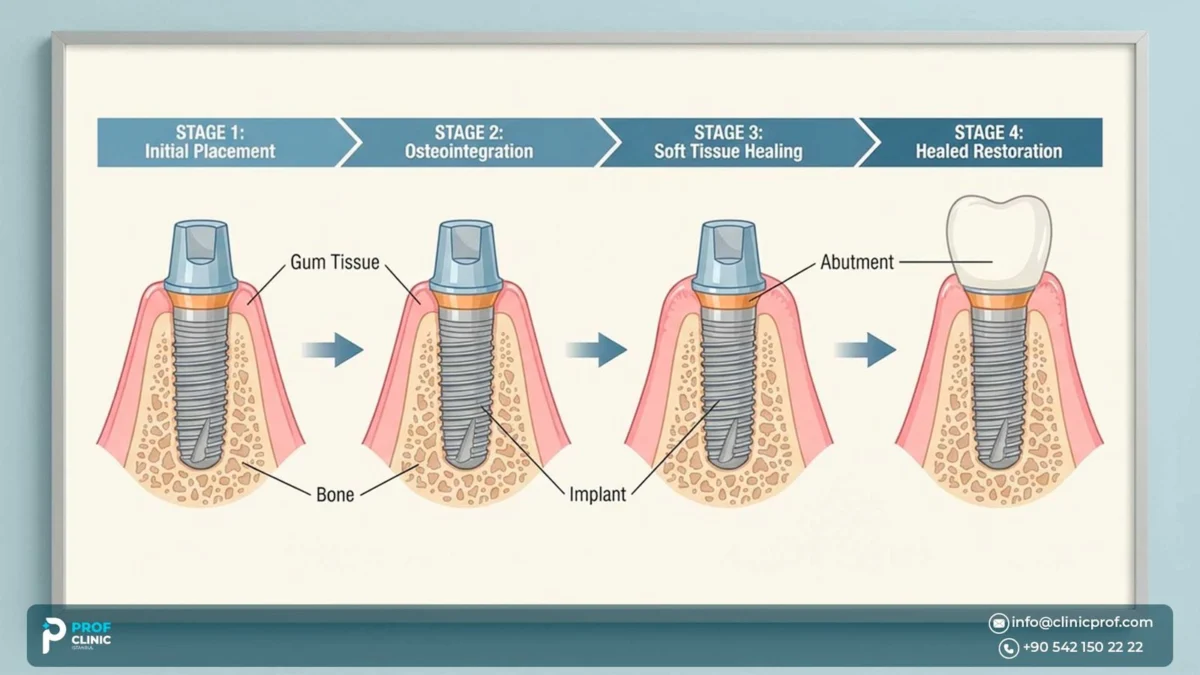
Gums also shrink and change shape after extractions. A final bridge made on day one would soon sit poorly against the healed gum. Waiting lets the dentist take fresh scans and refine the bite, length and shape of the teeth.
Temporary vs Final Teeth: What You Leave With
The temporary bridge is fixed and looks like teeth, though it is built only to protect the implants through the months they need to heal. The table compares the two stages.
| Feature | Temporary fixed bridge | Final bridge |
|---|---|---|
| When it is fitted | Day of surgery or within a few days, if the implants are stable | After about 3–6 months of healing, from new scans |
| Main job | Protect the implants and give you a usable smile | Long-term chewing, appearance and comfort |
| Usual material | Acrylic (resin), light and easy to adjust | Stronger materials chosen with your dentist |
| Diet | Soft foods, no hard biting | Wider diet once your dentist clears it |
| Adjustments | Frequent bite checks and small repairs | Fine-tuned fit, then routine maintenance |
Also read: All-on-4 Temporary vs Final Bridge: What Changes and When
How Does Teeth in a Day Work? Step by Step
Teeth in a day follows a fixed order: records and a 3D scan, a digital plan, surgery, then the temporary bridge if the implants pass the stability check. Most of the planning happens before you sit in the chair.
- Records review: you share photos, a panoramic X-ray or CBCT if you have one, and your medical history, so the team can judge whether full-arch treatment looks realistic.
- Examination and CBCT scan: a 3D scan shows bone height and width and the position of nerves and sinuses.
- Digital plan: the dentist decides between four and six implants and maps where each one goes, including the angle of the back implants.
- Surgery: in one session, teeth that cannot be saved come out and the implants go in, under local anaesthesia with sedation if needed.
- Stability check and temporary bridge: if each implant is firm enough, a fixed temporary bridge is attached; if not, the implants heal first under another temporary solution.
- Healing and final bridge: after about three to six months, new scans are taken and the final bridge is screwed onto the implants.
If you are comparing clinics, check that any plan for All-on-4 dental implants in Turkey spells out each of these steps, from the first scan to the final bridge.
What the Treatment Days Look Like
A same-day pathway usually fills a long day, sometimes two. A typical sequence for one arch runs like this, though your own schedule depends on extractions, bone and lab work:
- Morning: a final check of the plan, a medical review and anaesthesia.
- Late morning to early afternoon: extractions if needed, implant placement and stability measurement.
- Afternoon: impressions or scans of the new implant positions while the lab prepares the temporary bridge.
- Later that day or over the next few days: fitting the bridge, adjusting the bite and going through aftercare.
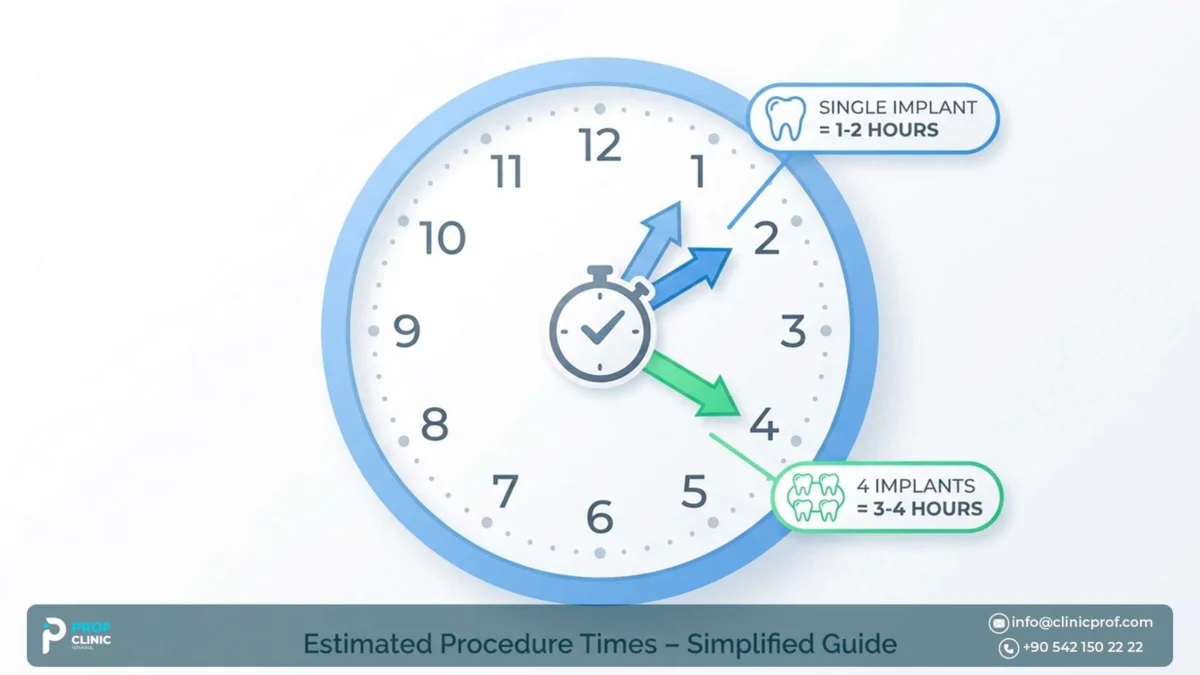
Surgery time itself varies with the number of extractions and implants. Prof Clinic plans the length of your stay with you, shorter or longer to suit your wishes, within what each step needs, and leaves room for a follow-up check before you travel.
If you would like that schedule drafted around your own X-rays, you can book a free consultation and send your records in advance.
Who Qualifies for Same-Day All-on-4?
You may qualify if most teeth in one jaw are missing or failing, your health is stable and the CBCT scan shows enough bone to anchor the implants. The final decision is made during surgery, when the dentist measures how firm each implant is.
The Stability Threshold Your Surgeon Checks
Immediate loading depends on primary stability, meaning how tightly the implant grips the bone the moment it is placed. Surgeons usually measure it as insertion torque, the turning force needed to seat the implant.
In a systematic review in the International Journal of Oral & Maxillofacial Implants, most immediate-loading studies recommended at least 30 Ncm. A consensus report on All-on-4 in the Journal of Clinical and Experimental Dentistry set the bar above 35 Ncm, with a rigid temporary bridge and a balanced bite.
Who May Not Be Suited to Immediate Teeth
Some situations lower the chance of reaching that threshold or raise the risk afterwards. They do not always rule out All-on-4, but they may change the timing:
- Very soft or thin bone, which can leave the implants less firm on the day.
- Active gum disease or infection around the teeth to be removed, which is treated first.
- Uncontrolled diabetes or other conditions that slow healing.
- Heavy smoking, which raises the risk of implant failure and infection.
- Strong clenching or grinding, which can overload a temporary bridge.
What Happens If Stability Is Not Reached on the Day?
If one or more implants are not firm enough, the safer choice is to let them heal without load. You usually leave with a different temporary solution, such as an adapted removable denture, and the fixed bridge comes later.
This is why no responsible clinic can promise fixed teeth on day one before surgery. The scan shows what is likely; the measurement during surgery confirms it.
Quick Self-Check Before Your Consultation
These questions are a starting point for the conversation with your dentist, not a diagnosis:
- Can I send a recent panoramic X-ray or CBCT scan?
- Is any gum infection already treated, or am I ready to treat it first?
- Can I keep to a soft diet and avoid hard biting for several weeks?
- Can I plan a second trip for the final bridge?
If most of your answers are yes, send your X-ray on WhatsApp and ask whether immediate teeth look realistic for your bone.
Recovery and Eating After Teeth in a Day
Recovery after teeth in a day is usually easier than people expect, though the first week still calls for rest and care. Swelling, bruising and soreness are common for a few days, especially when several teeth were removed.
The First Week
Cleveland Clinic notes that most people feel normal within about a week of implant placement and return to routine activities in two to three days. Avoid strenuous exercise for at least 48 hours. Our guide on pain and anaesthesia during All-on-4 covers pain relief in more detail.
What Can You Eat With a Temporary Bridge?
With a temporary bridge you eat soft foods only, even though the teeth feel fixed. The implants are still fusing with the bone, and hard biting can overload them or crack the acrylic.
- Days 1–3: cool or lukewarm soups, yoghurt, smoothies and scrambled eggs.
- Weeks 1–2: soft fish, mashed vegetables, porridge and well-cooked pasta.
- Weeks 3–8: tender meat cut small, rice and cooked vegetables.
- Until your dentist clears you: no nuts, crusty bread, hard fruit or biting into food with the front teeth.
Your dentist adjusts this plan to your bite and healing. A fuller timeline, from the first days to the final bridge, is in our article on All-on-4 recovery time.
Speech and the New Feel
A slight lisp or a bulky feeling is common with a new full-arch bridge. The tongue usually adapts within days to a few weeks, and small adjustments to the bridge can help if certain sounds stay difficult.
Is Same-Day All-on-4 Safe? Risks and What If Something Goes Wrong
In carefully selected patients, immediate loading appears about as reliable as waiting before loading. The systematic review above found similar implant and bridge survival for immediate, early and conventional loading, and the Cochrane review found no convincing difference in failures during the first year.
That evidence comes from selected cases treated under careful protocols, and complications can still happen. They fall into two groups.
Biological Risks
According to the All-on-4 consensus report, the most common biological complication is losing at least one implant, followed by inflammation around implants. A meta-analysis in the Journal of Dentistry found that implants in smokers failed about twice as often as in non-smokers (6.35% vs 3.18%).
Mechanical Risks With the Temporary Bridge
The same consensus names fractures of the acrylic temporary bridge as the main prosthetic problem. A loose screw, a chipped tooth or a bite that feels high is usually fixed by tightening, repairing or relining the bridge and adjusting the bite.
What If One Implant Does Not Integrate?
If an implant fails to fuse, the dentist reviews your scans and chooses the next step based on timing and the support that remains. Common options include:
- Removing the implant, letting the site heal and placing a new one later.
- Adding an implant or changing the design to restore support.
- Adjusting the temporary bridge to reduce load on the other implants while the plan is revised.
Warning Signs to Report Straight Away
Contact your dental team promptly if you notice any of these:
- A bridge that feels loose, clicks or moves when you chew.
- Bleeding that will not stop, swelling that worsens after the third day, or a fever.
- Pain that increases instead of easing, pus or a persistent bad taste.
Before you travel, ask who to contact once you are home and how check-ups are arranged. Questions about aftercare can also go through our contact page.
Same-Day All-on-4 vs Staged Loading and Single Same-Day Implants
Same-day loading is one of several timings. With staged, or conventional, loading, the implants heal for some months under a removable denture before fixed teeth are attached. It is often preferred when bone is soft or stability is borderline.
A single same-day implant is a different treatment: one implant and a temporary crown replace one tooth. If that is what you need, our page on dental implants in Turkey covers that treatment.
The choice between four and six implants is a separate question. Six implants spread the load further and can also be loaded immediately when the bone allows; our guide on what All-on-4 is and who it suits explains the basics.
Planning Teeth in a Day with Prof Clinic in Istanbul
At Prof Clinic, same-day treatment starts with an assessment of your photos, X-rays or CBCT, and no plan is offered before that review. A 3D CBCT scan and a digital plan then decide whether four or six implants suit your jaw. Same-day All-on-4 here costs about €4,400–7,500 per jaw (roughly £3,650–6,300 or $4,850–8,300), with four implants and 12 crowns. Your final price depends on your case and is set in a written quote after assessment and X-rays. Our guide to All-on-4 cost factors abroad explains what a quote covers.
About these prices: These prices are approximate and meant for planning only. They are Prof Clinic’s indicative prices in euros; amounts in other currencies are converted at the exchange rate of 13 November 2026 and will change as exchange rates move. Your final price is set after your medical assessment and X-rays and confirmed in a written quote that lists what is included. Contact us to get the actual price for your case.
On surgery day, local anaesthesia numbs the area, and sedation is added if you need it. When the implants are stable enough, a temporary fixed bridge is often attached within a few days; when they are not, they heal first under another temporary solution. After about 3–6 months, new scans are taken for the final bridge, followed by regular check-ups and cleaning.
Before a same-day full-arch plan is proposed, Dt. Orçun Özaydın, who works on prosthetic planning for All-on-4 and All-on-6, reviews your bite and restorative space. You can see full-arch cases in our before and after gallery, bearing in mind that results vary, and read more about full-arch treatment in Istanbul.
Frequently Asked Questions
Are teeth extracted and implants placed on the same day?
Yes, in most same-day All-on-4 cases the failing teeth are removed and the implants placed during the same surgery. This is confirmed only after the examination and CBCT scan. Active infection around the teeth or very weak bone may mean extractions come first and implants follow later.
How long does the teeth in a day procedure take?
Surgery for one arch usually takes a few hours, and the temporary bridge is fitted the same day or within a few days. The clinic plans your stay with you, shorter or longer to suit your wishes, around the scans, surgery and checks; a second visit for the final bridge follows after about 3–6 months.
Is the temporary bridge after All-on-4 fixed or removable?
It is fixed: the temporary bridge is screwed onto the implants and only your dentist takes it off. It is lighter than the final bridge and usually made of acrylic, so it is meant for soft foods and careful use while the implants fuse with the bone.
How long do teeth in a day last?
The temporary bridge is designed only for the healing months. A final bridge on well-integrated implants can last many years with daily cleaning and regular check-ups, although bridges wear and may need repair or replacement over time. Smoking and poor cleaning shorten that lifespan.
What are the pros and cons of teeth in a day?
The main advantage is that you avoid weeks without fixed teeth and may need fewer separate surgeries. The drawbacks: the implants must be firm enough on the day, you keep to a soft diet for weeks, and the temporary bridge may need repairs before the final teeth.
The Bottom Line
Same-day All-on-4 can give you fixed teeth within a day or a few days, provided the implants are firm enough when they are placed. What you leave with is a temporary bridge; the final teeth follow once the implants have healed.
A careful scan, clear stability criteria and a written plan for both stages matter more than speed. If you are weighing this option, share your X-rays and ask what is realistic for your jaw.
Sources
- PubMed (Int J Oral Maxillofac Implants) — Implant loading protocols for edentulous patients with fixed prostheses: a systematic review and meta-analysis
- PMC (J Clin Exp Dent) — Consensus statements and clinical recommendations on All-On-4 standard treatment
- PMC (Cochrane Database Syst Rev) — Interventions for replacing missing teeth: different times for loading dental implants
- PubMed (Clin Implant Dent Relat Res) — “All-on-Four” immediate-function concept for completely edentulous mandibles: a retrospective clinical study
- PubMed (Journal of Dentistry) — Smoking and dental implants: a systematic review and meta-analysis
- Cleveland Clinic — Implant-Supported Dentures