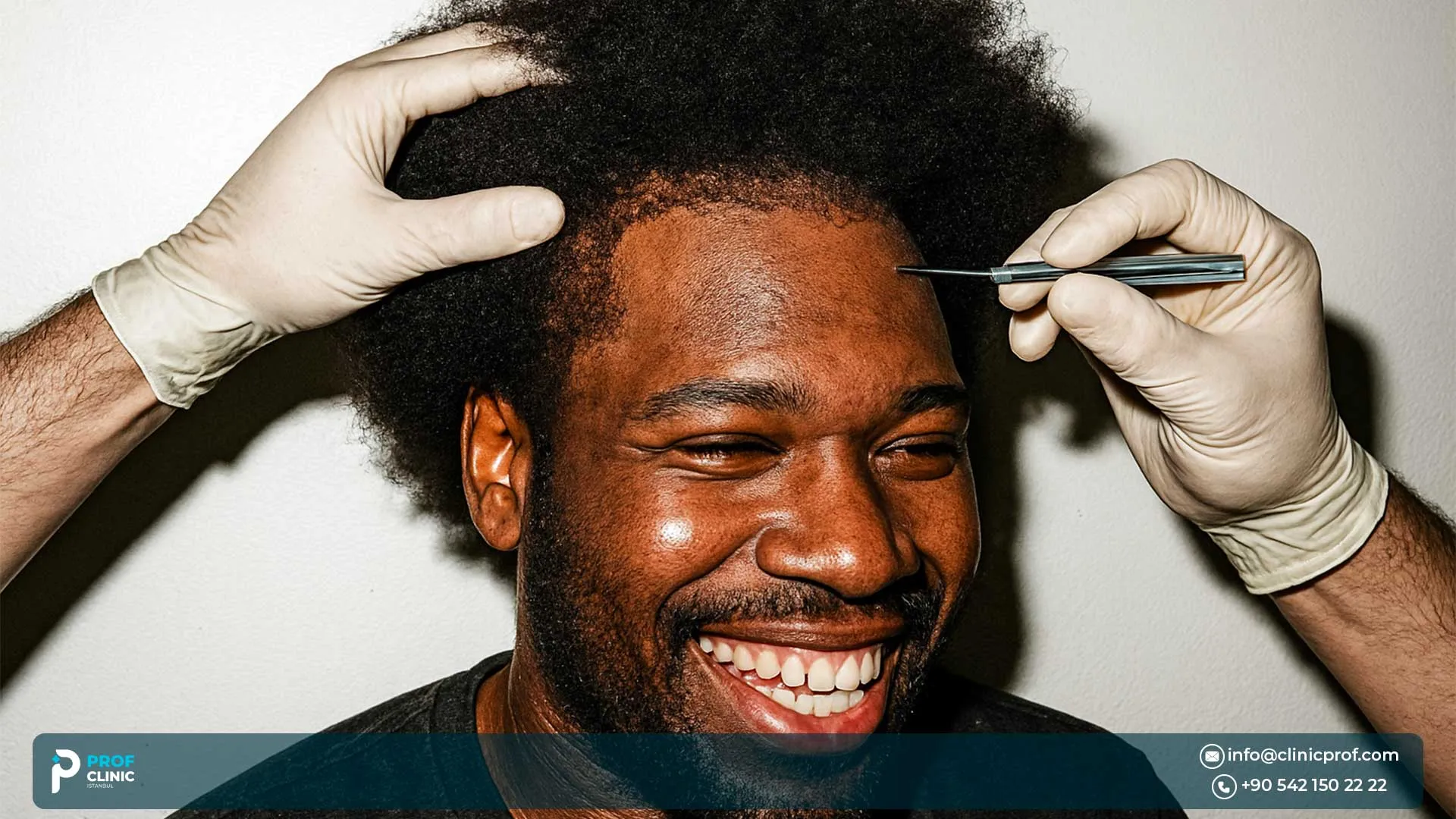
A curly hair transplant is usually possible. The practical question is whether your follicles can be harvested and placed safely, and whether the plan will preserve a natural curl flow once you heal.
This guide by Prof Clinic is written for patients traveling from anywhere in the world. It focuses on what changes with curly/coily follicles and how to choose a clinic that understands that difference.
Can You Get a Curly Hair Transplant With Curly Hair
In most cases, yes. A hair transplant with curly hair uses your own follicles—typically from the back and sides of your scalp and moves them into thinning areas.
What determines whether you are a good candidate:
- Diagnosis: Pattern hair loss is often transplant-appropriate. Active scarring alopecia must be stabilized first.
- Donor supply: Density, curl type, and safe donor limits determine what is realistic.
- Team experience: Curly follicles can curve under the skin, so extraction technique matters.
- Scalp health: Inflammation, itching, or patchy loss should be evaluated before surgery.
If your scalp burns, itches, or shows patchy thinning/scarring, prioritize a dermatologist-led diagnosis (and dermoscopy or biopsy when indicated) before booking surgery.
Is Curly Hair Better for a Hair Transplant
Curly and coily hair can create a cosmetic advantage: it tends to layer, bend, and overlap. That often means you can achieve strong visual coverage without chasing extreme graft numbers.
Why texture can help:
- More visual coverage: Curls occupy more space and can make a result look fuller.
- Better blending: Texture can soften the transition between native and transplanted hair.
- Camouflage: Curl pattern can hide minor density variation better than straight hair.
Why a Hair Transplant With Curly Hair Can Be More Challenging
The main technical issue is the follicle’s path under the skin. In tighter curl patterns, the root often curves. During FUE-style harvesting, the punch must follow that curve to avoid transection (cutting the follicle).
Common challenges clinics must plan for:
- Curved follicles under the skin: Higher injury risk if the team uses a straight-hair approach.
- Angle and rotation sensitivity: Small errors can translate into graft damage.
- Scalp variables: Thicker or firmer scalp can make harvesting more demanding.
What experienced teams do differently:
- They slow down: Careful pacing reduces unnecessary graft trauma.
- They tailor the approach: Punch selection, depth control, and angle discipline are adapted to your curl type.
- They prove it with cases: You should see curly/coily results similar to your curl pattern.
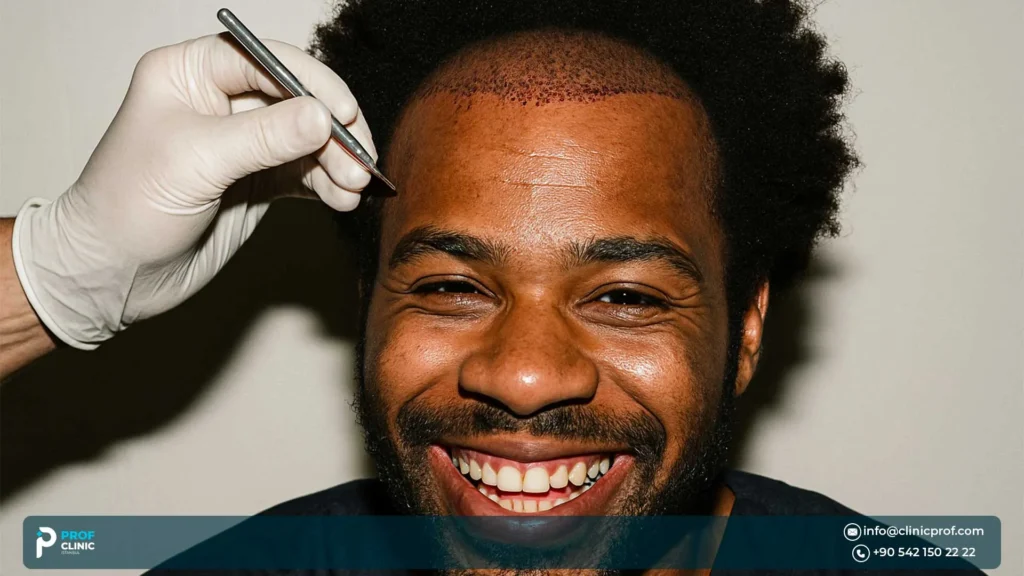
Black Curly Hair Transplant and African Curly Hair Transplant Considerations
If you have tightly coiled hair (often Type 4) or you are seeking a black curly hair transplant, two items are non-negotiable: a correct diagnosis and curl-aware hairline planning.
1) Confirm the type of hair loss
Not every hair loss pattern is transplant-ready. Scarring alopecias and inflammatory conditions must be controlled and stable before surgery.
Ask the clinic whether they screen for scarring alopecia and when they recommend a dermatologist evaluation.
2) Plan the hairline for your curl pattern
Natural-looking results depend on direction. The hairline must be designed for your face and age, and implantation angles must respect how your curls turn as they grow.
Practical consult checklist:
- Do you have a portfolio of curly/coily cases similar to my curl pattern?
- How do you minimize transection in curved follicles during extraction?
- How do you plan implantation angles so the front does not look pluggy or misdirected?
- Do you advise on traction-friendly styling during recovery?
If you suspect traction alopecia, scalp itching/burning, or patchy scarring, book a dermatologist-led diagnosis before committing to surgery—this can save your donor hair and your outcome.
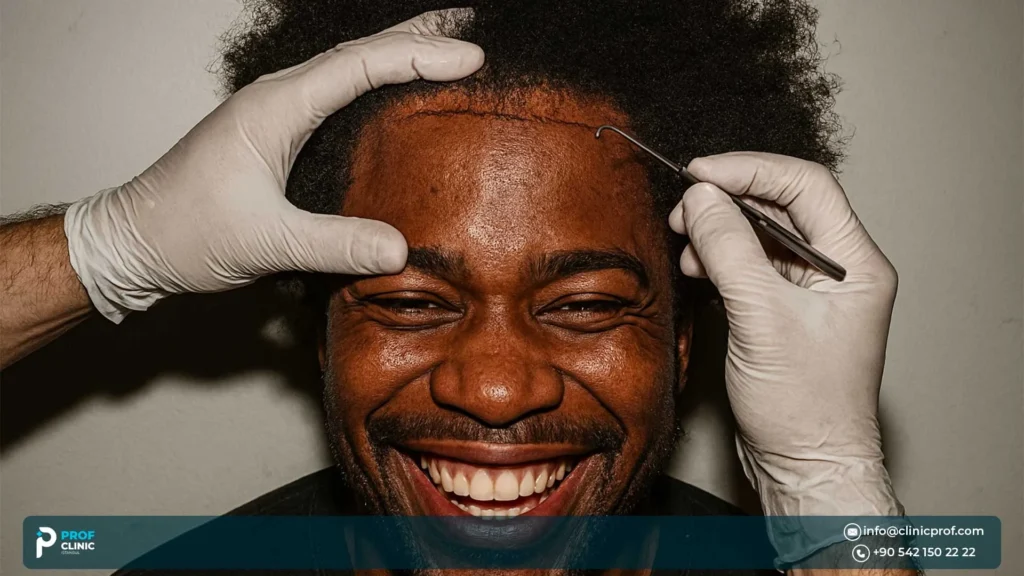
How to Choose FUE DHI or FUT for a Curly Hair Transplant
Technique labels matter less than team capability. The goal is to protect curved follicles during harvesting and to place grafts at angles that match your natural curl flow.
A simple way to understand the options:
- FUE: Follicles are extracted individually using a small punch.
- DHI: Usually FUE extraction plus an implanter-pen placement workflow.
- FUT (strip): A thin strip is removed from the donor area and dissected into grafts under magnification.
Quick comparison for curly/coily hair:
| Technique | Curly-follicle note | Potential upside | Key trade-off |
| FUE | Curved roots increase transection risk if the approach is not adapted. | No linear strip scar; flexible donor harvesting. | Technique discipline is critical in tight curls. |
| DHI (FUE + direct implantation workflow) | Angle control can help curl direction at the hairline. | Precise placement can support natural curl flow. | More technique-dependent; quality varies by team. |
| FUT (Strip) | Microscopic dissection can protect curved follicles. | Strong graft integrity; efficient harvesting. | Linear scar; less flexibility for very short haircuts. |
Decision rules that work in real life:
- Choose FUE/DHI: if avoiding a linear scar matters and the clinic has proven curly extraction experience.
- Consider FUT: if donor management and graft integrity are top priorities and you accept a linear scar.
- Avoid one-size packages: and ask for a plan based on your safe donor zone, curl tightness, and scalp characteristics.
What to Expect During a Hair Transplant for Curly Hair on Procedure Day
Most clinics of hair transplant for curly hair follow a predictable flow. Knowing it helps you plan travel and reduce anxiety.
- Pre-op review and hairline confirmation (photos, consent, final design).
- Trimming or shaving (depends on technique and clinic policy).
- Local anesthesia for donor and recipient areas.
- Donor harvesting (FUE extraction or FUT strip removal).
- Graft preparation and sorting under magnification.
- Recipient-site creation and implantation (or direct implantation workflow).
- Post-op instructions (washing, sleep position, activity limits).

Recovery and Aftercare for a Hair Transplant Curly Hair Patients
Aftercare protects your grafts, avoiding dislodging grafts early, controlling inflammation, and avoiding traction.
Do this:
- Follow the clinic’s washing instructions exactly (timing and technique).
- Sleep with your head elevated if advised.
- Avoid scratching, rubbing, and friction from hats or helmets early on.
- Protect the scalp from strong sun exposure during early healing.
Avoid this (especially with coily hair):
- Tight braids, ponytails, loc retwists, or any style that pulls (traction can compromise donor and recipient areas).
- Heavy sweating and intense training until cleared.
- Relaxers, bleach, or harsh chemical processes until your surgeon approves.
- Aggressive detangling or high-tension styling in the early weeks.
Tip: Ask for a written, day-by-day routine. Consistency matters more than extra products.
If you want your curls to look natural, treat aftercare like part of the procedure—get a written, day-by-day routine from Prof Clinic and follow it closely.
Will Your Transplanted Hair Stay Curly After a Curly Hair Transplant
Usually, yes. Transplanted follicles generally keep the characteristics of the donor hair, including curl pattern.
Two important nuances:
- Early growth can look different: New hairs may appear frizzy or irregular while the scalp settles.
- Angle planning matters: Even healthy curly follicles can look unnatural if graft angles are incorrect.

FAQs
Can I get a transplant if I have curly hair?
Yes, in many cases. Eligibility depends on your diagnosis (type of hair loss), donor capacity, and whether there’s any active scalp inflammation or scarring that must be treated first.
Is it possible to transplant curly hair?
Yes. Transplanting curly follicles is possible, but it requires careful extraction and placement because follicles can curve under the skin.
Is curly hair harder to transplant?
Often, yes—especially tightly coiled hair—because the curved follicle path can raise the risk of follicle transection during extraction if technique isn’t adapted.
Does hair transplant work for curly hair?
It can work well when the hair-loss type is appropriate for surgery (commonly pattern hair loss), the donor area is strong, and the surgeon has experience with curly/coily follicles and natural angle design.
Will my transplanted hair stay curly?
Usually yes. Transplanted hair typically keeps donor-hair characteristics like texture and curl pattern, though early growth can temporarily look different while healing