If you’re searching for Afro hair transplant before and after examples, you’re probably trying to answer two questions: Will it look natural on curls/coils? and When will I actually see results?
This guide by Prof Clinic explains how to read photos correctly, what realistic progress looks like month by month, and how to verify cases, especially for Turkey Afro hair transplant before and after research.
Why can Afro-textured and African American hair look different in photos?
Afro-textured hair often creates different visual coverage than straight hair at the same graft count. That’s why African hair transplant photos can look dramatic in one image and subtle in another.
Key reasons photos can be misleading
- Curl shrinkage vs stretch: Coils look shorter when dry and can look longer when stretched or blow-dried, changing how dense the result appears.
- Lighting & scalp contrast: Strong overhead lighting can show more scalp in “after” photos; softer lighting can hide it. This is especially noticeable on hairlines and the crown.
- Wet vs dry hair: Wet curls clump and reveal scalp—great for honesty, bad for marketing. Dry curls can hide scalp—great for appearance, bad for comparison.
- Length differences: A 12-month photo with longer curls will naturally look fuller than a 6-month photo with a shorter trim.
- Angle and styling: A slight change in camera angle, a sharp lineup, or fiber/concealer products can change the after dramatically.
Because of this, the best before-and-after afro hair transplant sets show multiple angles, consistent lighting, and comparable hair length.
Also read: Hair Implant vs Hair Transplant (Full Guide)

Afro hair transplant timeline from day 1 to 12 months
Most people can return to many normal routines within about 7–10 days, but visible growth takes months, and final maturation commonly takes up to 12 months. Sometimes longer depending on individual factors.
Here’s a practical Afro hair transplant before and after timeline you can use when comparing cases:
| Timepoint | What you may see (normal) | What to check |
| Day 1–3 | Swelling, redness, tiny graft sites; donor soreness | Clear baseline angles (front, temples, top, crown) |
| Day 4–10 | Scabs/crusts, mild redness; donor tightness | Same angles, same distance; close-up hairline |
| Week 2–4 | Shedding “shock loss”) of transplanted hairs is common | Don’t panic—focus on scalp healing |
| Month 2 | Quiet phase: looks similar to pre-op or thinner | Track redness, bumps, irritation |
| Month 3–4 | Early sprouts begin for many patients | Compare hairline shape + direction, not density |
| Month 5–6 | Noticeable improvement; curls start to frame the hairline | Density distribution (front vs midscalp vs crown) |
| Month 9–12 | Major cosmetic result; texture and thickness keep improving | Final-style photos & wet-hair honesty shots |
Shedding commonly begins a few weeks after surgery and regrowth often becomes noticeable around 3–4 months.
Want an honest timeline for your exact curl pattern and hair-loss stage? Ask Prof Clinic for a case-matched photo set.
Recovery and aftercare timeline for Afro hair transplants
Afro-textured hair and scalp may be more prone to dryness and breakage, so aftercare matters not only for graft survival but also for how good your after looks in real life.
Typical recovery checkpoints, but always follow your surgeon’s instructions first:
- First 48–72 hours: Protect grafts, sleep with head elevated if advised, avoid rubbing/pressure.
- First 7–10 days: Gentle washing as instructed; scabs should come off naturally (don’t pick).
- Weeks 2–4: Expect shedding; avoid aggressive brushing, tight hats, and heavy sweating if your clinic advises restrictions.
- Weeks 4+: Gradual return to exercise is often allowed based on healing; confirm with your surgical team.
And here is Afro-hair friendly aftercare tips
- Use gentle, fragrance-light cleansing if your skin is reactive.
- Avoid tight hairstyles (waves caps too tight, braids, durags with friction) until fully cleared.
- Keep the scalp moisturized only with products approved by your clinic during early healing.
- Protect from strong sun exposure early on.
Also read: Is it necessary to take PRP after a hair transplant?
What natural results look like with curls and coils
Natural-looking Afro hair transplant results aren’t just about more hair. They’re about:
- Correct direction and angle: Curls magnify mistakes. If implantation angles are off, the coil can point unnaturally.
- A hairline that matches your natural hairline pattern and age: Overly sharp, low, or straight hairlines often look unnatural in hair transplant before and after African American comparisons.
- Density that’s believable: Afro hair can create great coverage, but the crown often needs realistic expectations because it’s a swirl pattern.
- Consistency with your styling: A natural result should still look natural when you pick it out, sponge-curl it, twist it, or keep it short.
Be aware that a 12-month image with longer curls can look extremely dense. That doesn’t automatically mean the graft work was denser. It may mean the curl pattern is doing a lot of coverage work
What affects Afro hair transplant results
If you’re comparing African American hair transplant before and after cases, these are the biggest factors that explain why two people with similar hair can end up with different outcomes:
- Curved follicles under the skin: Afro-textured follicles often curve beneath the scalp, which can increase the risk of follicle damage during extraction unless the team is experienced and uses appropriate tools/technique.
- Team experience with curly grafts: Handling, hydration, and placement technique matter.
- Donor supply and hair caliber: Thicker shafts and tighter curls can create more coverage per graft.
- Hair-loss stability: A transplant restores hair where it’s placed, but ongoing loss around it can change the look over time.
- Scalp characteristics: Skin thickness, tendency for keloid or raised scarring (varies by person), inflammation risk, and healing response.
- Aftercare & lifestyle: Smoking, uncontrolled scalp conditions, and poor adherence to protection instructions can reduce quality of outcome.
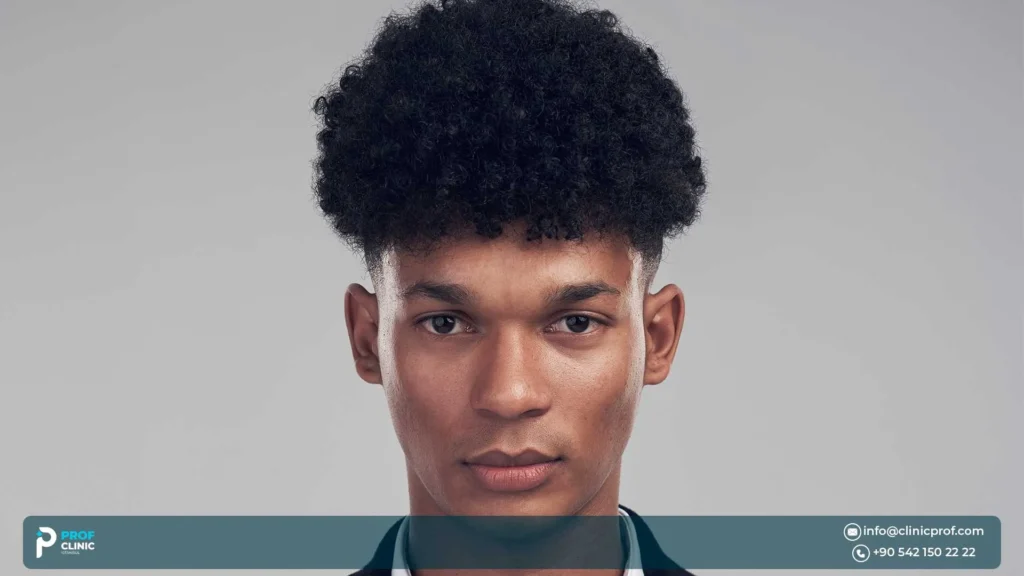
How to judge before-and-after Afro hair transplant photos
When you look at before and after hair transplant curly hair photos, you’re not just judging density. You’re judging truthfulness.
Use this quick table when reviewing African American hair transplant before and after galleries:
| Trustworthy sign | Red flag |
| Same lighting, same camera distance, same angles | Different lighting/angles that favor the “after” |
| Multiple timepoints (3, 6, 9, 12 months) | Only one impressive “after” photo |
| Both dry-hair and wet-hair shots | Only styled, picked-out, or fiber-enhanced shots |
| Close-ups of hairline direction and temple points | Cropped images that avoid the hairline/crown |
| Clear donor-area healing photos | No donor photos at all |
| High-resolution images (you can zoom) | Blurry images that hide detail |
Also ask yourself:
- Is the before taken with harsh light and the after with soft light?
- Is hair length the same?
- Is there a lineup or edge enhancement that wasn’t present before?
- Does the crown show honest angles?
Also read: How to Choose Hair Transplant Clinic in Turkey
How to verify before-and-after results before booking in Turkey?
If you’re researching Afro hair transplant before and after in Turkey, verification is where smart patients separate real clinics from marketing.
Before booking, request:
- Case-matched examples: Ask for photos/videos of patients with a similar curl pattern, similar Norwood stage, and similar goals (hairline-only vs hairline+crown).
- Proof of timeline: Request at least: immediate post-op, day 10, month 3–4, month 6, and month 12 images—same angles.
- Who does what (surgeon vs team): Confirm who performs extraction and who performs implantation.
- A written plan: Hairline design, target zones, approximate graft distribution by zone (front/mid/crown), and donor management approach.
- Follow-up structure: How you’ll get post-op support once you’re home: scheduled check-ins, what to do if you get folliculitis/irritation, and how they handle concerns during shedding.
Prof Clinic can help you compare clinics by requesting standardized photo sets and a written plan before you travel, so you’re not deciding based on one perfect after photo.

How Prof Clinic shares real Afro hair transplant before and after results
At Prof Clinic in Istanbul, we share African hair transplant before and after examples to set realistic expectations not hype. When you request before-and-after hair transplant , we provide consented, privacy-protected sets with standard angles, consistent lighting, and clear time milestones (3, 6, 12 months).
We also include before-and-after hair transplant curly hair results in normal everyday styling, and video when possible because it shows direction and coverage better than a single photo.
If you’re comparing African American hair transplant before and after options, share your hairline goal and styling routine, and we’ll send Afro-textured hair transplant examples and photo sets that match your plan, then book your free Prof Clinic consultation to review your case.
FAQs about ِfro hair transplant before and after
What does Afro hair transplant look like after 3 months?
Around 3 months, many patients are just starting to see early sprouts. Density is usually incomplete, and the hairline can look uneven as different follicles enter growth at different times.
How long until you see full results from Afro hair transplant?
A major cosmetic result often appears between 9–12 months, while full maturation can take up to a year (and sometimes longer depending on the individual and the area treated).
Will transplanted Afro hair look natural?
It can look very natural when the team plans an ethnicity-appropriate hairline and matches implantation angles to your curl direction. Because Afro follicles curve under the skin, experience and technique are especially important.
What is the timeline for Afro hair transplant recovery?
Visible healing of scabs and surface irritation often improves within the first 1–2 weeks, while the growth journey takes months (shedding in weeks 2–8 is common, early growth around months 3–4, stronger change by months 6–12).
Can you see before-and-after photos of Afro hair transplant?
Yes, but prioritize verified sets: same angles, multiple timepoints, including month 6 and month 12, and ideally at least one wet-hair or video check. If you’re comparing African American hair transplant before and after results, ask for cases matched to your curl type and hair-loss pattern.
References
- International Society of Hair Restoration Surgery (ISHRS) — Patient education on surgical hair restoration. (ISHRS)
- Umar S. et al., 2016 (PubMed Central) — FUE challenges in tightly curled Afro-textured hair and tool/technique considerations. (PMC)
- Umar S. et al., 2023 (PubMed Central) — Follicular Unit Excision in patients of African descent. (PMC)
- Hims (patient guide) — General recovery timeline and “back to routine” range. (hims)