When people search for dental implants in Turkey vs other countries, they are rarely looking for a textbook definition of implants. They are trying to answer a practical question: where should I actually have my treatment done?
The most honest answer is that there is no universal best country for every patient. The better comparison is between treatment planning, implant-system traceability, total cost, travel burden, and how easy it will be to manage follow-up if the case becomes more complex than expected.
That is why the most useful way to compare Turkey with the UK, Germany, the USA, or local private treatment is not to ask which country is ‘best’ in the abstract, but which option gives you the safest and clearest pathway for your own case.
What does matter most when comparing Turkey with other countries?
The comparison becomes much clearer when you ignore marketing language and focus on five decision points instead:
- The quality of assessment and treatment planning
- The implant brand, model, and restorative traceability
- The true total cost rather than the advertised starting price
- The treatment timeline, including healing and number of visits
- The aftercare route once you return home
Official guidance supports this way of thinking. FDA patient information emphasizes keeping the implant brand and model for your records, while NHS guidance stresses staged treatment, healing time, and maintenance rather than destination labels. CDC dental infection-control guidance also underlines the importance of documented sterilization processes and monitoring. Turkey’s USHAŞ framework may help patients identify health-tourism structures, but it does not replace clinic-level verification.
Already know you want procedure details rather than destination comparison, the natural next step is our Dental Implants in Turkey page.
| Destination | Typical headline cost | What to verify first | Main trade-off | Best fit |
|---|---|---|---|---|
| Turkey | Often lower | Brand/model, imaging, written plan, exclusions, aftercare pathway | Travel and follow-up can be harder if records are weak | Patients comfortable traveling who want a well-documented plan |
| UK | Often higher | The same checks still apply | Less price advantage, but easier local continuity | Patients prioritizing home-country follow-up |
| Germany | Often higher | The same checks still apply | Less price advantage, but easier language and review continuity for local residents | Patients prioritizing local access and continuity |
| USA | Often higher | The same checks still apply | Less price advantage, but easier access to reviews for US residents | Patients prioritizing local access and simpler logistics |
Are dental implants in Turkey as safe as those in other countries?
They can be. Turkey can be as safe as treatment elsewhere when the clinic uses sound case assessment, clear imaging, traceable implant systems, realistic staging, and a well-defined aftercare pathway.
At the same time, Turkey is not automatically the right choice for every patient. Patients who expect frequent reviews, have higher medical complexity, or want the simplest possible continuity may still prefer treatment closer to home.
So the safest conclusion is not ‘Turkey is best’ or ‘local is best.’ It is that the right choice depends on case complexity, travel tolerance, documentation quality, and how credible the written treatment pathway looks before you commit.
What should you compare before booking anywhere?
- The named clinician who will treat you and their role in the case
- The imaging used for planning and whether grafting has been discussed honestly
- The implant brand, model, and restorative components
- What is included in the quote and what is case-dependent
- How many visits are expected and what the medically realistic timeline is
- What happens if you need help after you return home
Also read: Is it safe to have dental implants in Turkey?
How do quality and safety really compare between Turkey and other countries?
Quality and safety are not guaranteed by country alone. Reputable clinics in Turkey and reputable clinics in other countries can both follow high standards. Equally, weak planning and poor documentation can happen anywhere.
A more useful comparison is how easy it is for the patient to verify quality before treatment begins. The strongest signs include proper case assessment, appropriate imaging, staged planning, traceable implant systems, documented sterilization procedures, and a realistic plan for follow-up.
For that reason, a practical pre-booking checklist is usually more reliable than a country-level reputation. Ask who will place the implant, what imaging is used, which implant brand and model will be used, what records you will receive, how sterilization is monitored, and what happens if you have pain, looseness, or a prosthetic problem after you return home.
Are dentists in Turkey qualified and internationally trained?
Many dentists in Turkey are highly qualified, and some have international training, congress participation, or extensive experience with cross-border patients. But that fact alone should not decide the case. Patients should verify the treating clinician, the planning process, and the clinic’s documentation standards directly.
The best comparison is not ‘Turkish dentist versus German or American dentist’ as a general stereotype. It is whether the named clinician who will treat you has the right role, the right planning process, and a clearly explained restorative pathway.
Local treatment can make face-to-face verification easier. Turkish clinics that focus on international patients may be stronger in multilingual coordination and pre-travel communication. Both can be valid advantages depending on what the patient values most.
Do Turkish dental clinics use internationally recognized implant brands?
Many do, but patients should not rely on general claims such as ‘premium implant’ or ‘European quality.’ The key issue is traceability. A strong clinic should be comfortable confirming the exact brand, model, and restorative components before treatment, and should provide written records afterward.
This matters in every country, not only Turkey. If two clinics use recognized systems but one documents them clearly and the other does not, the documented clinic is usually the safer option to compare.
Are dental implant materials in Turkey the same as in the USA?
They can be. Reputable clinics in Turkey may use the same broad implant-material categories used in the USA and other major markets, such as titanium-based systems, as long as the clinic is sourcing recognized systems and documenting them properly.
So the more practical question is not whether the country label is the same, but whether the clinic will confirm the system in writing and whether the restorative pathway is transparent from the start.
How should you compare dental implant costs in Turkey vs other countries?
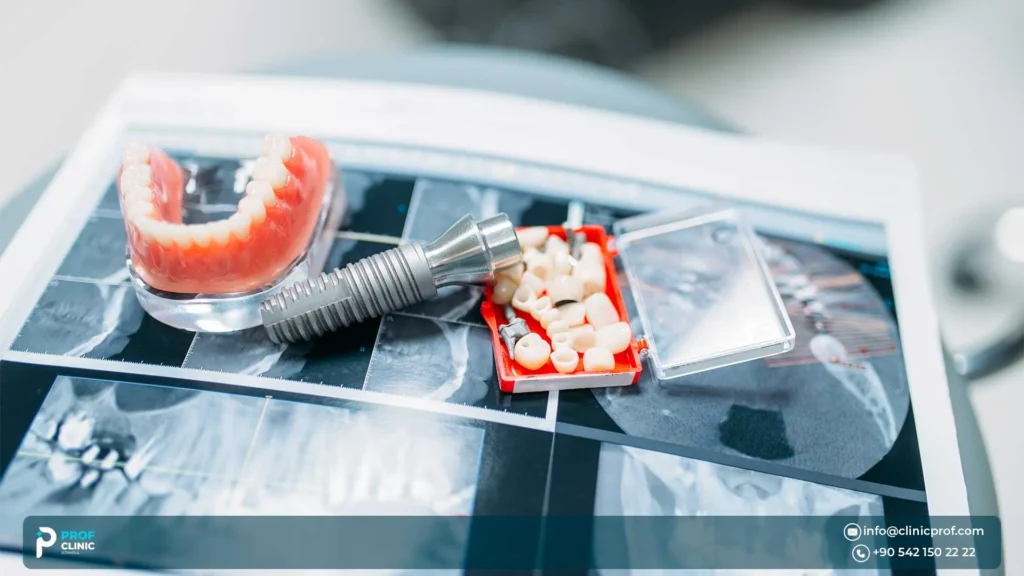
The safest way to compare price is to compare the full treatment package, not a single number in an advertisement. Implant quotes can change significantly depending on imaging, extractions, grafting, sinus lifting, temporary restorations, prosthetic materials, and the number of visits required before final teeth are delivered.
That is why a single-tooth promotional price in one country is often a poor comparison against a more complete quote elsewhere. For a real decision, the question is not ‘Which country advertises the lowest implant price?’ but ‘Which clinic has shown me the clearest written pathway from assessment to final restoration?’
| Cost item to verify | Sometimes bundled in dental-tourism packages | Often extra or case-dependent | Why it changes the real comparison |
|---|---|---|---|
| Examination and panoramic imaging | Often yes | Sometimes | A low price without imaging is not a true treatment quote |
| Hotel or transfers | Sometimes | Often | Helpful for logistics, but not a substitute for clinical transparency |
| Bone grafting or sinus lift | Rarely included by default | Often | These can change both price and treatment timeline materially |
| Temporary and final prosthetics | Sometimes | Often depends on case and material | The restoration phase is part of the true total cost |
| Extra nights, extra scans, or added visits | Sometimes | Often | Changes in healing or planning can affect travel cost as well as clinical cost |
Our website is a good example of why itemization matters: the homepage highlights hotel options and VIP transfers as part of the broader patient journey, while the implant cost guide clearly states that hotel accommodation, sinus lifting, and bone grafting may be excluded from certain implant packages. That is exactly why you should ask for the inclusions and exclusions in writing.
Why are dental implants often cheaper in Turkey than in Europe or the USA?
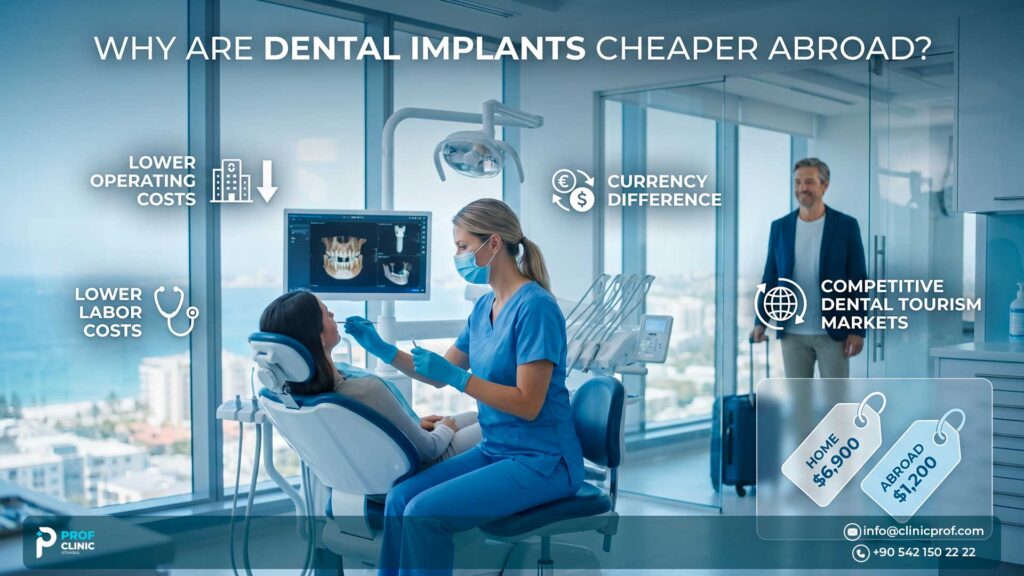
In many cases, the lower cost reflects differences in operating costs, local pricing structures, and the competitive medical-tourism market rather than a fundamentally different implant concept. Turkish clinics that treat international patients also tend to build more coordination into the patient journey, which can make the process feel more streamlined.
That said, lower price alone does not prove better value. A cheaper quote only becomes a strong option when the clinic also discloses the implant system, the restorative plan, what is included, what is excluded, and what happens if treatment takes longer than expected.
The most useful comparison is therefore not ‘Turkey is cheaper’ versus ‘home treatment is expensive.’ It is whether the lower headline price still remains attractive after you account for staging, travel, possible grafting, and aftercare.
Are cheaper dental implants in Turkey lower in quality?
Not automatically. Lower price does not, by itself, prove lower quality. The more reliable signal of quality is whether the clinic is transparent about planning, implant-system traceability, imaging, restorative details, and the likely number of visits.
High-quality care can exist in Turkey, Germany, the UK, the USA, and elsewhere. The patient’s job is to distinguish between a clinic that explains the case clearly and one that relies on vague promises. If a provider cannot state the implant brand, model, restorative plan, and aftercare route in writing, the lower price becomes much harder to trust.
A good comparison therefore looks beyond cost and asks whether the cheaper option is still properly documented, staged, and supported.
Are there hidden costs when getting dental implants in Turkey?
While dental implants in Turkey often present a cost-effective solution, potential hidden costs can arise if patients do not receive a comprehensive and itemized quote upfront. The most common pricing oversights typically stem from procedures not initially included, such as grafting, sinus lifts, or temporary restorations, or from logistical expenses like extra imaging, hotel nights, repeat flights, and local follow-up care upon returning home. This common tension in dental tourism underscores the importance of a thorough decision-making process.
To avoid unexpected expenses, it is crucial to request a detailed, itemized written plan before booking. As advised by the U.S. Food and Drug Administration, this plan should clearly state the implant system, the number of implants, the restorative type, what is included in each visit, what may become extra after initial imaging, and the protocol if the case takes longer than expected.
At Prof Clinic in Istanbul, we prioritize complete transparency to ensure our patients experience no hidden costs. Our pricing content, for instance, clearly outlines inclusions and exclusions, such as specific details on sinus lifting, bone grafting, and accommodation support in various packages. We believe in providing a meticulously itemized plan that covers every aspect of your dental implant journey, allowing you to make an informed decision with full confidence and peace of mind.
Also read: Cost of Dental Implants in Turkey: Everything you want to know
Treatment timeline and travel burden: Turkey vs local treatment
How Long Do I Need to Stay in Istanbul, Turkey for Dental Implant Treatment?
The answer depends on the case. One of the biggest misunderstandings in dental tourism is the difference between procedure time and full treatment time. Implant placement may happen during a short stay, but healing, osseointegration, and final restoration usually take longer than the first trip itself.
NHS patient information explains that patients commonly wait at least three months before an implant is ready to support replacement teeth, and grafting can extend treatment further. That makes timing one of the biggest practical differences between treatment abroad and treatment closer to home.
For many patients, Turkey means two planned visits separated by a healing period. Local treatment may not always be faster biologically, but it is often easier logistically because reviews and adjustments do not require flights.
Why Does Travel Burden to Istanbul Matter in This Comparison?
Travel burden matters because treatment abroad is not judged only on surgery day. It also affects how easily you can attend reviews, how you manage unexpected delays, and how much flexibility you have if the timeline changes after imaging or healing.
Turkey can still be an excellent option when the timetable is clear and the patient is comfortable with staged travel. Local treatment may be the better fit when the patient wants simpler logistics, expects frequent review visits, or may struggle with re-travel if the plan changes.

Aftercare, warranties, and what happens after you go home
Is Aftercare Easier at Home or After Treatment in Istanbul, Turkey?
For many patients, this is the real comparison. Home-country treatment is usually stronger for continuity, because routine reviews, urgent appointments, and minor adjustments are easier to arrange when the clinic is nearby.
Turkey can still compare well if the clinic provides full documentation, a realistic shared-care pathway, and a clear contact route for urgent questions after you return home. The key is that the aftercare route must be explained before treatment, not invented afterward.
Do dental clinics in Turkey provide implant warranties?
Some do, but a warranty should never be treated as the same thing as guaranteed success. The useful questions are what exactly is covered, for how long, under what conditions, and what happens if a problem appears after you fly home.
Patients should ask separately about implant-component coverage, prosthetic coverage, exclusions, maintenance requirements, and whether remake or adjustment scenarios are included. A short written explanation is much more useful than a broad marketing claim.
Is follow-up care more difficult after dental treatment in Turkey?
It can be more difficult if the records are incomplete or the aftercare route is vague. The difficulty is not that implant problems are unique to Turkey; it is that any problem can feel more complicated when the treating clinic is in another country and the documentation is weak.
That is why the clinic should provide the implant brand and model, restorative details, relevant imaging, and a clear explanation of what can be handled remotely versus what requires local or return treatment.
What problems can be harder to manage after getting dental implants abroad?
The complications themselves are not necessarily unique to treatment abroad. Pain, looseness, healing issues, prosthetic adjustments, or the need for additional care can happen anywhere. What becomes harder abroad is coordination if the treatment plan was vague from the beginning.
For that reason, choosing the right clinic matters more than choosing Turkey alone. Patients with uncontrolled diabetes, heavy smoking habits, a complex medical history, significant treatment anxiety, or cases likely to need repeated follow-up may still be better treated closer to home, where continuity of care is easier.

Who is a better fit for Turkey, and who may be better treated locally?
| Patient profile | Turkey may fit better when… | Local treatment may fit better when… |
|---|---|---|
| Price-sensitive patient | The case is straightforward and the written plan is clear | Headline savings are less important than easy follow-up |
| Patient comfortable with travel | Staged visits and travel are acceptable | Travel uncertainty would add stress or delay |
| Case complexity | Single or moderate-complexity cases with well-defined planning | Advanced grafting, repeated review needs, or significant medical complexity |
| Need for continuity | Remote coordination is acceptable and records are complete | The patient wants the simplest possible route for reviews and adjustments |
| Decision style | The patient is willing to compare documents carefully before booking | the patient prefers face-to-face local access throughout the process |
Is Turkey better than other countries for dental implants?
Turkey is not automatically better than other countries for dental implants. It is often shortlisted because it combines lower headline pricing with a medical-tourism model built around international patients, online pre-assessment, travel coordination, and package-style communication.
That can make Turkey a strong option when a patient is cost-conscious, comfortable traveling, and able to compare clinics carefully before booking. It can also be attractive when the patient values bundled coordination and is happy to complete treatment in planned stages.
Local treatment may still be the better option when the patient has a more complex medical history, may need repeated reviews, wants the simplest possible follow-up route, or prefers the continuity of being treated close to home.
So the right question is not whether Turkey is universally better. The right question is whether Turkey gives you a better balance of price, documentation, planning, and follow-up than your local alternatives for your specific case.
To determine the best course of action, it is recommended to request a case review with our experts. This allows for a discussion of a personalized treatment plan and provides an opportunity to compare it against any local quotes you may already have.
FAQs about dental implants Turkey vs other countries
Is Turkey better than other countries for dental implants?
Not for every patient. Turkey can be a strong choice when the clinic provides clear planning, documented implant systems, transparent inclusions, and a practical aftercare route. Local treatment may still be the better option when continuity matters more than travel-based savings.
Why are dental implants cheaper in Turkey compared with Europe or the USA?
Usually because of differences in operating costs and the way dental-tourism clinics bundle coordination, not automatically because the implant concept is inferior. The real total can still change if grafting, extra visits, or travel-related costs are not included in the quote.
How long do I need to stay in Turkey for dental implant treatment?
It depends on the case. Many implant cases involve two visits with a healing period in between, and overall treatment may take months even if the first stay is short.
What happens if a dental implant fails after I return home?
You should already have a written aftercare pathway before traveling. Keep the implant brand and model, restorative details, and treatment records, know who to contact if the implant feels loose or painful, and clarify what the clinic will handle remotely versus what may require local care.
Sources
- U.S. Food and Drug Administration (FDA) – Dental Implants: What You Should Know
- Guy’s and St Thomas’ NHS Foundation Trust – Dental implants overview, having a dental implant, and after having a dental implant
- CDC – Best Practices for Sterilization in Dental Settings and Sterilization Monitoring in Dental Settings
- USHAŞ – Health tourism portal and related health-tourism information