When you start researching tooth replacement, you will constantly encounter the term “Endosteal.” While it sounds highly technical, it is simply the medical way of saying “in the bone.” In 2026, this method remains the undisputed gold standard for patients seeking a permanent, natural-feeling smile.
At Prof Clinic Istanbul, we specialize in Endosteal restorations because they offer the highest success rates and the most biological benefits for our patients. For patients considering endosteal dental implants in Istanbul, this guide explains why this is still the most common and predictable implant type in 2026.
What is the meaning of endosteal implants?
The word Endosteal is derived from the Greek “endo” (inside) and “osteon” (bone).
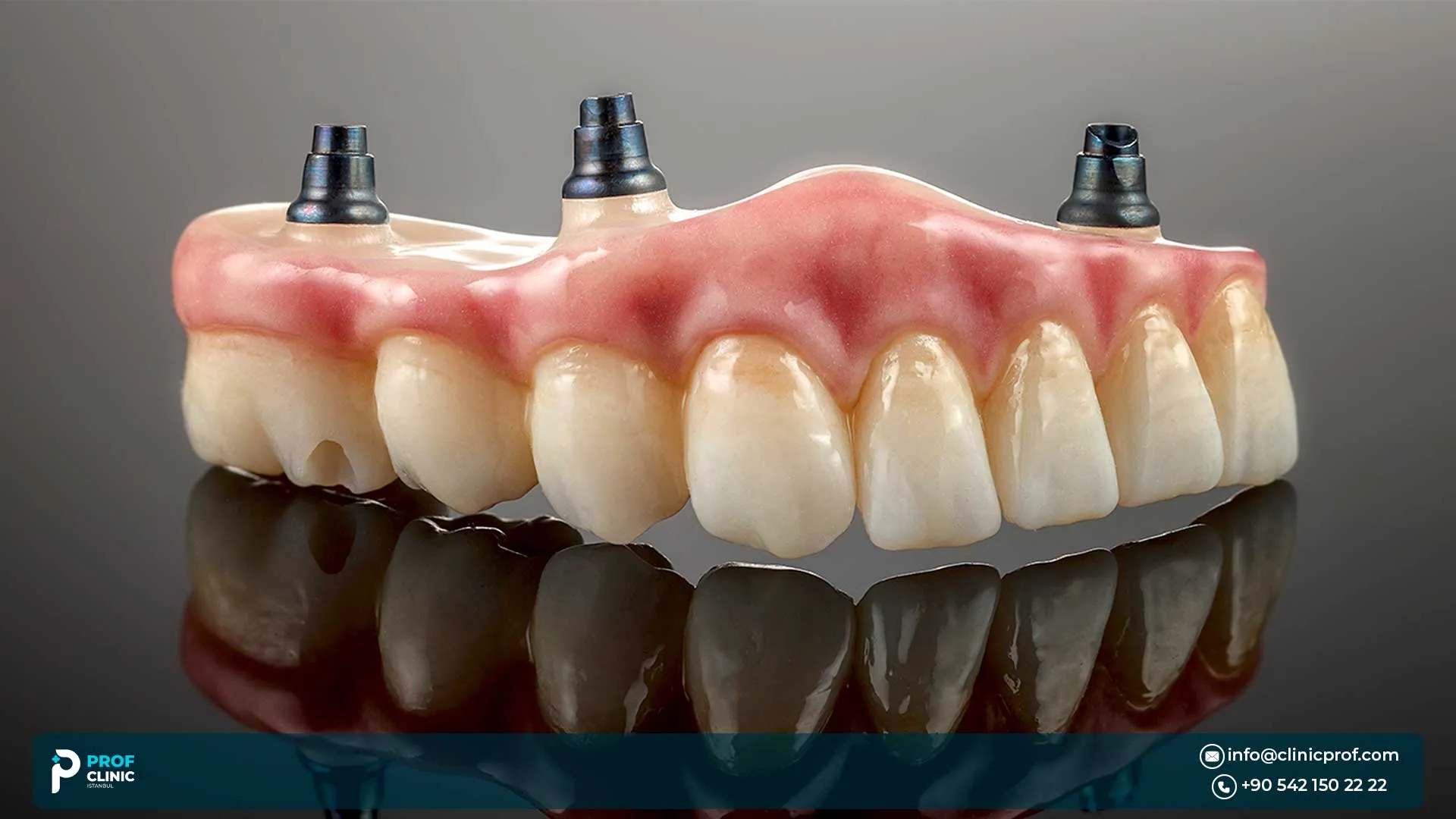
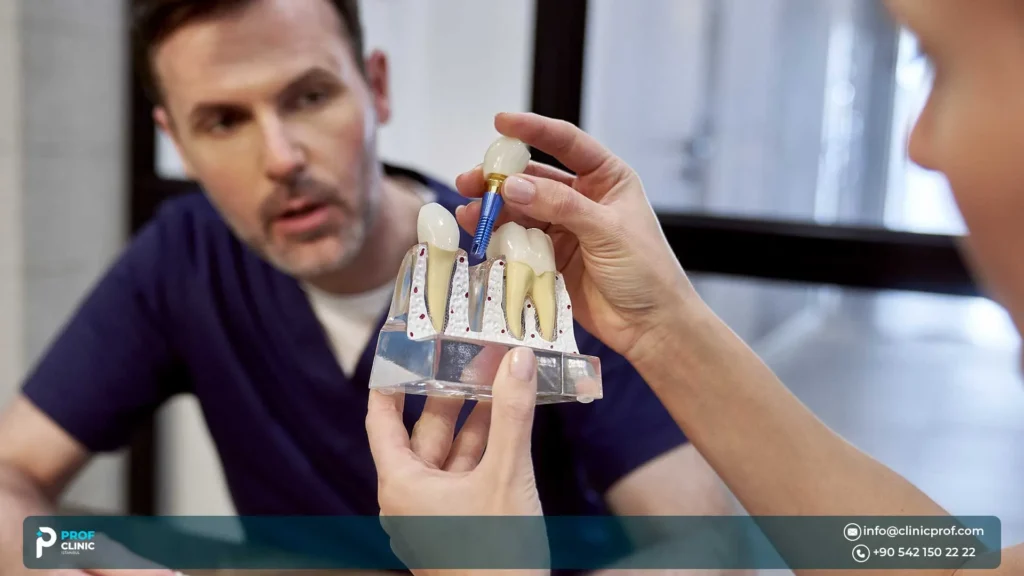
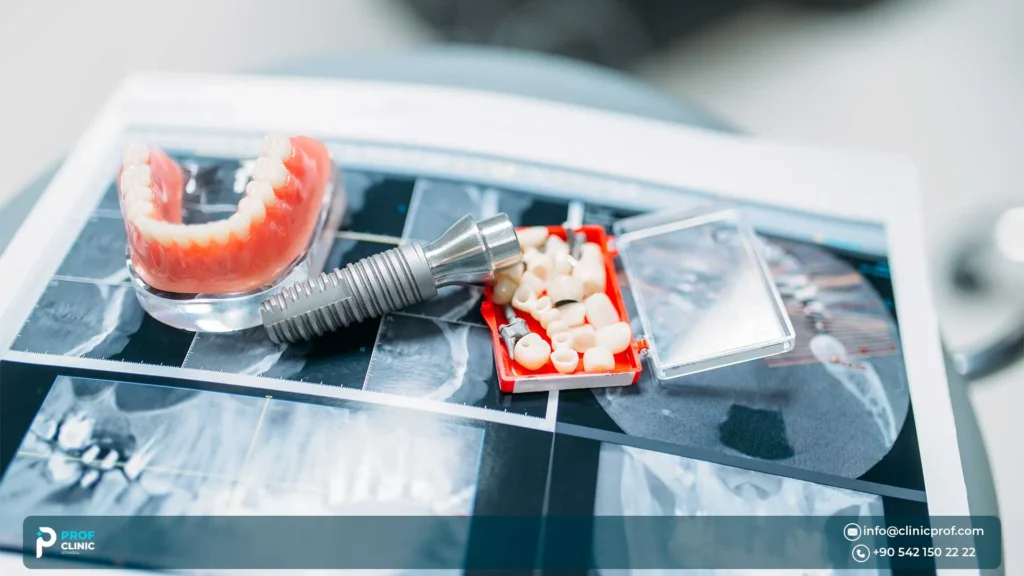
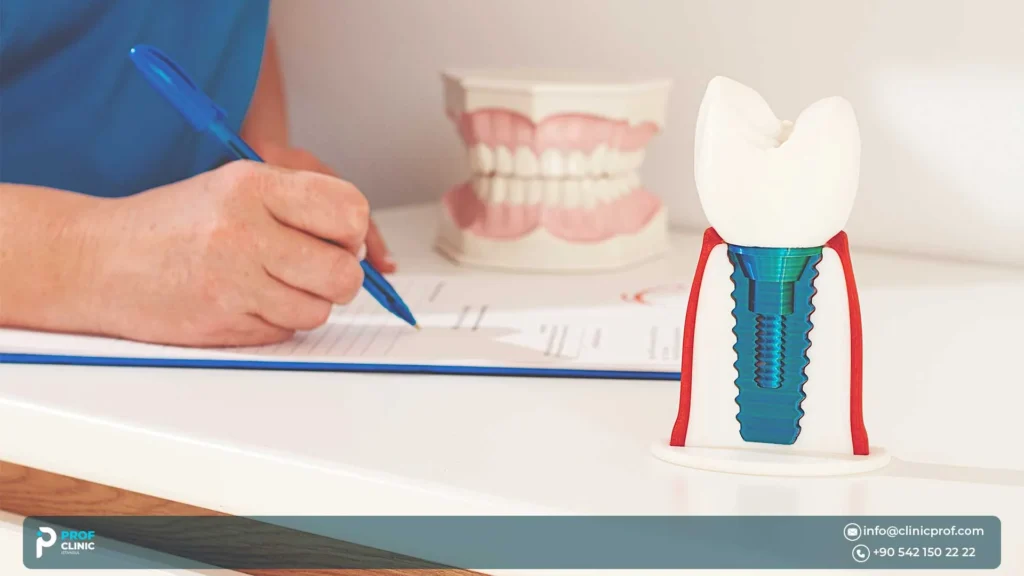
An endosteal implant is a small, screw-like post—usually made of biocompatible titanium or high-grade zirconia—that is surgically embedded directly into your jawbone. Unlike dentures that sit on your gums or bridges that “hang” on neighboring teeth, the endosteal implant becomes a functional part of your skeletal system through a process called osseointegration.
If you are receiving a dental implant today, there is a 90-95% chance it is an endosteal type. Why is it the “standard”?
- Unrivaled Stability: Because it is anchored in the bone, it provides a foundation that mimics the strength of a natural tooth root.
- Predictability: With decades of clinical data and 2026 AI-driven placement technology, the success rate for endosteal implants at Prof Clinic exceeds 98%.
- Versatility: Whether you need a single crown, a multi-unit bridge, or an All-on-4 full-mouth restoration, the endosteal post is the universal building block.
Why do Patients choose Endosteal Implants
Losing a tooth triggers a hidden biological chain reaction. Without a root to stimulate the jawbone, the bone begins to “resorb” or shrink.
This leads to two major “Pain Points” for patients:
- The “Sunken Face” Look: As the jawbone thins, the facial muscles lose their support. This causes the lips to thin, the cheeks to hollow, and the chin to appear more prominent, significantly aging your appearance.
- Weakened Adjacent Teeth: When bone is lost in one area, the teeth next to the gap lose their support and begin to tilt or loosen.
How Endosteal Implants Fix This: By placing the implant inside the bone, it mimics the natural pressure of chewing. This signals your body to keep the jawbone dense and strong. At Prof Clinic, we don’t just restore your teeth; we preserve your facial structure and your youth.
| Feature | Endosteal Implants | Traditional Dentures |
| Bone Health | Actively prevents bone loss | Can accelerate bone loss |
| Facial Aesthetics | Maintains natural contours | Leads to “Sunken Face” over time |
| Bite Power | 100% (Eat anything) | 20-30% (Avoids hard foods) |
| Comfort | Feels like a natural part of you | Can slip, click, or cause sores |
You don’t have to live with the discomfort or the aging effects of tooth loss. Using the most advanced 2026 endosteal protocols, our team at Prof Clinic can help you reclaim your smile’s health and beauty.
Book Your Free 3D Mapping Consultation at Prof Clinic
Endosteal Implants vs. The Alternatives
In the world of dental terminology, confusion is common. Patients often hear different terms used interchangeably, leading to the question: “Am I getting a ‘regular’ implant, a ‘titanium’ implant, or an ‘endosteal’ one?” At Prof Clinic Istanbul, we believe clarity is the first step to a stress-free procedure. Let’s break down these comparisons to see where endosteal implants sit in the 2026 dental landscape.
What is the difference between endosteal implants and regular implants?
The short answer: There is no difference. When people speak about “regular” or “standard” dental implants, they are almost always referring to Endosteal Implants.
- Endosteal is the clinical classification based on where the implant is placed (in the bone).
- “Regular” is simply the layman’s term because this is the type used in the vast majority of cases globally.
At Prof Clinic, when we plan a “standard” restoration for a patient with healthy jawbone density, we are using the endosteal method.
Endosteal vs. Subperiosteal Implants
When do you go “on the bone” instead of “in the bone”? The real choice in placement usually comes down to these two types. The decision is dictated entirely by your bone volume.
| Feature | Endosteal Implants | Subperiosteal Implants |
| Placement | In the jawbone (like a screw). | On the jawbone, under the gum. |
| Ideal Candidate | Patients with sufficient bone height/width. | Patients with severe bone loss. |
| Surgical Goal | To mimic a natural tooth root. | To provide a base when bone is too thin for screws. |
| 2026 Trend | The most common and stable choice. | Less common due to advanced bone grafting. |
In 2026, thanks to advanced Bone Augmentation techniques at our clinic, many patients who were once only candidates for subperiosteal implants can now safely receive more stable endosteal implants.
Endosteal vs. Titanium: Is endosteal the same as titanium?
This is one of the most frequent points of confusion. Comparing “Endosteal” to “Titanium” is like comparing the location of a house to the bricks used to build it.
- Endosteal refers to the LOCATION: It tells us the implant is placed inside the bone.
- Titanium refers to the MATERIAL: It tells us what the implant is made of.
Can an implant be both? Yes! In fact, most endosteal implants we use at Prof Clinic are made of high-grade medical Titanium because of its incredible ability to fuse with bone. However, you can also have an endosteal implant made of Zirconia (Ceramic) if you prefer a metal-free option.
| Term | Category | What it describes |
| Endosteal | Placement | Where it goes (In-the-bone). |
| Titanium | Material | What it’s made of (Metal). |
| Subperiosteal | Placement | Where it goes (On-the-bone). |
| Zirconia | Material | What it’s made of (Ceramic/Non-metal). |
Understanding these terms helps you advocate for your health, but the final decision depends on your unique anatomy. At Prof Clinic, we use 3D digital scans to determine if an endosteal placement is the safest and most durable path for you.
Consult with our experts at Prof Clinic to see which type fits your bone structure

How Endosteal Implants Work
In 2026, the success of a dental restoration isn’t just about the skill of the surgeon—it’s about the biological harmony between the technology and your body. At Prof Clinic, we leverage the latest scientific advancements to ensure your endosteal implant works exactly like a natural tooth.
Root Form Implants: How they mimic the natural tooth root anatomy.
Most endosteal implants are classified as “Root Form” implants. As the name suggests, they are engineered to replicate the shape, size, and function of a natural tooth root.
Unlike older dental technologies that simply bridged a gap, root form implants are tapered or cylindrical screws that act as a direct replacement for the missing root. This design allows for:
- Even Pressure Distribution: When you bite down, the force is transferred directly into the bone, just like a real tooth.
- Stability: The screw threads provide “primary stability” immediately after placement, which is the foundation for long-term success.
The Materials used in Endosteal Implants
While “Endosteal” describes the placement, the material choice at Prof Clinic is tailored to your health profile and aesthetic preferences.
1. Titanium
Titanium remains the most widely used material in 2026 for a reason: Biocompatibility. * The Advantage: It is incredibly strong yet lightweight. Your body does not recognize it as a “foreign object,” allowing the bone to grow tightly around it.
- 2026 Tech: We use specialized surface-etched titanium that speeds up healing by providing a “rough” surface for bone cells to cling to more effectively.
2. Zirconia
For patients seeking a metal-free alternative, Zirconia is the 2026 standard.
- The Advantage: It is naturally white and opaque, meaning there is zero risk of a “grayish shadow” appearing at the gum line.
- The Benefit: It is highly resistant to plaque buildup and is ideal for patients with metal sensitivities or very thin gum tissue.
How do Endosteal Implants Work?
The reason endosteal implants are a permanent solution lies in a biological miracle called Osseointegration (from the Latin osseus “bony” and integrare “to make whole”).
How it works at Prof Clinic:
- Placement: The implant is placed into the jawbone.
- The Healing Phase: Over 3 to 6 months, your bone cells (osteoblasts) begin to grow into the microscopic pores of the implant surface.
- The Fusion: Eventually, the bone and the implant become one solid unit. In 2026, we often use Platelet-Rich Fibrin (PRF) therapy at our clinic to accelerate this fusion, reducing your waiting time significantly.
Did You Know? Once osseointegrated, an endosteal implant is so secure that it actually becomes more difficult to remove than a natural tooth.
Also read: Dental Implants Without Surgery: Is It Possible?
Who is a good candidate for endosteal implants?
The ideal candidate is someone in good general health with a focus on two specific areas:
- Bone Density & Volume: Since the implant is a screw that sits inside the jaw, you need enough “real estate” (bone width and height) to surround it. If you have been missing a tooth for years, the bone may have thinned, but 2026 bone-grafting techniques at Prof Clinic can often restore this.
- Healthy Gum Tissue: Your gums act as the “seal” that protects the implant from bacteria. Patients with active periodontal (gum) disease must be treated before the procedure begins.
Do You Qualify for an Endosteal Dental Implant?
- Age: There is no upper age limit. We successfully treat patients in their 80s and 90s. However, we do not place implants in children or teenagers whose jawbones are still growing.
- Health Factors: Conditions like controlled diabetes or heart disease are no longer automatic “nos.” We use specialized protocols to manage healing for patients with chronic conditions.
- Lifestyle: Good oral hygiene is the most important lifestyle factor. If you commit to brushing and flossing your implants like natural teeth, you qualify!
Check Your Candidacy—Schedule Your Digital Scan at Prof Clinic
The 3/2 Rule for Dental Implants
Why spacing is the secret to a lifetime smile.
One of the most critical technical standards we follow at Prof Clinic is the 3/2 Rule. Most patients never hear about this, but it is the difference between an implant that lasts 5 years and one that lasts 50.
- 3mm of Space: There must be at least 3mm of bone between two adjacent implants.
- 2mm of Space: There must be at least 2mm of bone between an implant and a natural tooth.
This spacing ensures that the bone between the implants receives enough blood flow to stay alive and healthy. Ignoring this rule often leads to bone loss and “black triangles” (gaps) in the gum line.
The Endosteal Implant Journey in Istanbul: Procedure & Recovery
In 2026, the journey to a new smile at Prof Clinic Istanbul is defined by speed, precision, and a total focus on patient comfort. We’ve replaced the “fear of the unknown” with a transparent, tech-driven process that ensures you know exactly what to expect at every stage of your endosteal implant procedure.
The Implant Process: A step-by-step breakdown
At Prof Clinic, we divide the endosteal journey into four key phases:
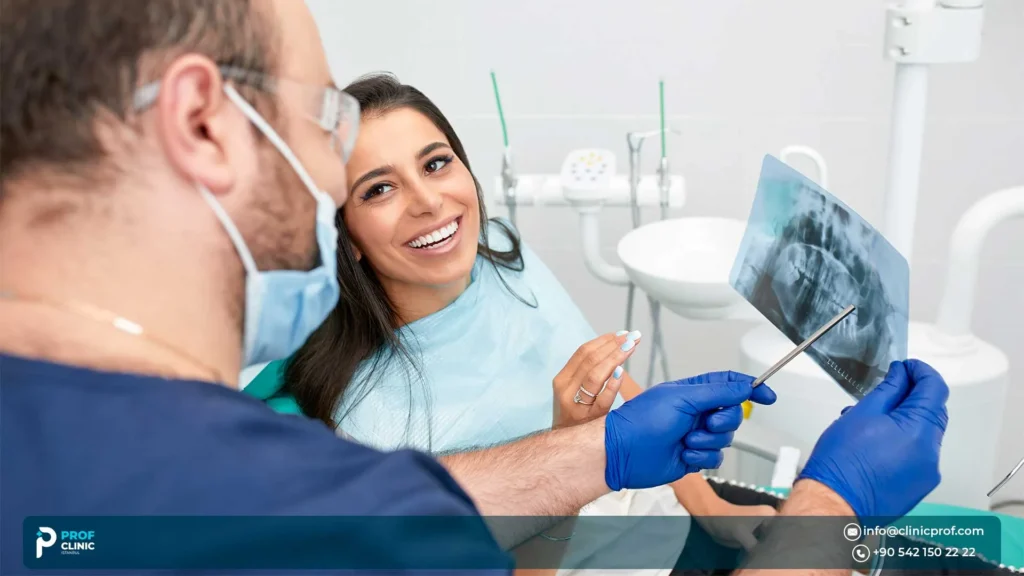
- Digital Consultation & AI Mapping: We start with a 3D CBCT scan. Our AI software creates a virtual model of your jaw, allowing our surgeons to “place” the implant digitally before the actual procedure begins.
- Minimally Invasive Placement: Using a 3D-printed surgical guide, the endosteal post is placed into the jawbone. This guide ensures the exact angle and depth, often requiring no large incisions or traditional sutures.
- The Healing (Osseointegration): This is the biological phase where your bone fuses with the implant. While this happens, we provide a high-quality temporary tooth so you never leave our clinic with a gap.
- The Final Crown Attachment: Once healed, we attach your custom-designed Zirconia or Porcelain crown. Your new tooth is color-matched to your natural teeth for a seamless finish.
How long does endosteal implant treatment take in Istanbul?
Time is a major “pain point” for our international patients. Here is the 2026 reality:
- The Surgery: A single endosteal implant placement typically takes only 15 to 30 minutes.
- The Total Timeline: While the surgery is fast, the bone needs 3 to 4 months to fully bond with the implant. However, with our “Smile in a Day” protocols for eligible candidates, you can get a functional temporary tooth in just 24 hours.
Endosteal Implant Recovery: What to expect in the first 72 hours vs. the first 3 months.
Recovery in 2026 is significantly faster thanks to minimally invasive techniques.
- The First 72 Hours: You may experience minor swelling or a “tight” sensation. Most patients manage this with standard over-the-counter relievers. At Prof Clinic, we provide a specialized post-op kit to accelerate tissue cooling.
- Weeks 1–2: The gum tissue closes over the implant. You can return to your normal diet, though we recommend avoiding extremely hard or sharp foods on the surgical site.
- Months 1–3: You won’t “feel” the implant working, but this is the most active phase for bone growth. You’ll have a follow-up (digital or in-person) to ensure everything is progressing perfectly.
Are endosteal dental implants painful?
How we use “Minimally Invasive” tech to reduce discomfort.
This is the #1 question we receive. The answer is no. In fact, most patients describe the sensation as less intense than a simple filling or a tooth extraction.
How we eliminate discomfort at Prof Clinic:
- Advanced Local Anesthesia: We use targeted numbing that takes effect instantly.
- Minimally Invasive Tech: By using 3D guides, we avoid large flaps in the gum, which means less trauma to the tissue and almost zero bleeding.
- Sedation Options: For patients with dental anxiety, we offer conscious sedation to ensure you are completely relaxed throughout the 20-minute procedure.
You don’t have to fear the dentist’s chair anymore. With 2026 technology, the endosteal implant procedure at Prof Clinic is as routine and comfortable as any other modern wellness treatment.
Experience a Pain-Free Smile Transformation at Prof Clinic
Also read: Dental Implant Pain: Causes, Period, & Solutions
Benefits & Advantages of an Endosteal Dental Implant
The reason 90% of dental implants are endosteal is due to their unparalleled biological integration.
- Superior Stability: Because they are anchored inside the jawbone, they offer a “bite force” that is nearly identical to natural teeth. You can return to eating steak, apples, and nuts without fear.
- Structural Bone Preservation: Endosteal implants are the only solution that stops the “melting” of the jawbone. By stimulating the bone, they preserve your natural facial contours and prevent the premature aging associated with tooth loss.
- High Success Rate: With Prof Clinic’s 2026 AI-guided protocols, the success rate for endosteal placement is over 98%.
What are the disadvantages of endosteal implants?
No medical procedure is without its trade-offs. It is important to consider:
- Surgical Nature: Unlike bridges or dentures, this requires a minor surgical procedure. While we make it painless at Prof Clinic, it still involves a healing period.
- Bone Requirements: If you have been missing teeth for many years, you might not have enough bone height for an endosteal screw. This may require a bone graft before the implant can be placed.
- Upfront Cost: The initial investment is higher than traditional alternatives. However, when viewed over a 20-year period, they are often the most cost-effective choice because they don’t need frequent replacement.
What does no one tell you about dental implants?
Most clinics focus only on the surgery, but at Prof Clinic, we prepare you for the lifestyle shift. Here is what you need to know:
- The “Non-Feeling” Tooth: Natural teeth have a ligament that acts as a shock absorber and sends “pressure signals” to your brain. Implants are fused directly to the bone. They are incredibly strong, but they don’t “feel” cold or heat, which takes a few days to get used to.
- Maintenance is Non-Negotiable: You can’t get a cavity in a titanium implant, but you can get Peri-implantitis (gum disease around the implant). If you don’t brush and floss, the bone supporting the implant can recede, leading to failure.
- The Cleaning Learning Curve: Cleaning under an implant bridge requires different tools, such as interdental brushes or a water flosser. We provide a full “Oral Hygiene Masterclass” at Prof Clinic after your final fitting.
How long do endosteal dental implants last?
In 2026, we view endosteal implants as a permanent medical device.
- The Implant Post: Designed to last 25 years to a lifetime. Once it is fused with your bone, it rarely needs to be touched again.
- The Crown (The Visible Part): Just like natural teeth, the crown is subject to daily wear and tear. You can expect to replace the porcelain or zirconia crown every 15 to 20 years.
| Component | Expected Lifespan | Maintenance Level |
| Endosteal Post | Lifetime | Low (Internal) |
| Abutment | 20+ Years | Low |
| Zirconia Crown | 15 – 20 Years | High (Brushing/Flossing) |
At Prof Clinic Istanbul, we don’t just give you a new tooth; we give you a long-term health plan. Our use of premium materials ensures that your “2026 smile” remains just as bright and functional in 2050.
Start your long-term smile journey with Prof Clinic today
Also read: Best Mini Dental Implants (MDI): pros, cons, cost
Endosteal Implants Cost in Turkey
Traditional solutions like dentures or bridges often seem cheaper upfront, but they frequently require replacement or adjustment every 5–10 years.
The Endosteal Advantage:
- Lifetime Durability: An endosteal implant is designed to last 25+ years.
- Health Savings: By preventing jawbone loss and protecting neighboring teeth, you avoid the future costs of more complex bone grafting or additional tooth extractions.
- Quality of Life: The value of being able to eat, speak, and smile without worry is a “return on investment” that pays off every single day.
Factors influencing Endosteal implants cost
Not all implants are created equal. At Prof Clinic, the cost of your treatment is determined by three main pillars of quality:
- Brand & Warranty: We use premium global brands like Straumann and Nobel Biocare. These brands invest heavily in research and offer lifetime warranties that are honored by dentists worldwide.
- Material Excellence: High-grade medical Titanium or aesthetic Zirconia (Ceramic) are more expensive than generic alloys but offer superior biocompatibility and success rates.
- Clinic Technology: The use of AI-Guided Placement and 3D CBCT Imaging increases precision. While this involves advanced equipment, it significantly reduces the risk of complications and “hidden” future costs.
Note: Turkey’s lower costs are driven by lower operational overhead and government support for medical tourism, not a reduction in material quality.
Also read: Cost of Dental Implants in Turkey: Everything you want to know
Endosteal Implant Alternatives
If our 3D mapping shows that your jawbone density is insufficient for a standard endosteal screw, you still have excellent 2026 options at Prof Clinic:
- Bone Grafting: We can “build” the bone back up using specialized grafts. This adds a few months to the timeline but allows for a standard endosteal implant.
- Zygomatic Implants: For severe upper jaw bone loss, these longer implants anchor into the dense cheekbone, bypassing the need for bone grafts.
- All-on-4 / All-on-6: These techniques use angled placement to maximize the use of your existing bone, often eliminating the need for grafting even in cases of moderate bone loss.
- Mini Dental Implants: Thinner screws that require less bone volume, often used to stabilize removable dentures.
At Prof Clinic, we provide all-inclusive packages that cover your treatment, VIP transfers, and luxury accommodation. This ensures you know your total investment before you even board your flight.
Why Prof Clinic Istanbul for Endosteal Implants?
Choosing a clinic for a permanent medical procedure is a decision that impacts your health, budget, and quality of life. In 2026, Prof Clinic Istanbul has become a global leader in endosteal restorations by replacing guesswork with digital certainty.
AI-Guided Placement & 3D Digital Mapping
The biggest risk in traditional implantology is “human error” in positioning. At Prof Clinic, we eliminate this risk using Real-Time AI Guidance.
- Precision Mapping: We use ultra-high-definition CBCT scans to create a 3D digital twin of your jawbone, nerves, and sinus cavities.
- The AI Advantage: Our software simulates millions of chewing cycles to determine the exact nanometer where the endosteal post will be most stable.
- Guided Surgery: We use 3D-printed templates that lock our surgical tools into the perfect position, ensuring the procedure is faster and minimally invasive.
High Success Rates & Global Standards
While the global average success rate for implants is around 95%, Prof Clinic consistently achieves over 98%. We reach this through:
- Premium Materials: We only use internationally recognized, lifetime-warranty brands such as Straumann, Nobel Biocare, and Bego.
- Sterilization Protocols: Our 2026 facility meets the strictest EU medical hygiene standards, virtually eliminating the risk of post-operative infection.
International Patient Support in Istanbul
We understand that traveling to Istanbul for dental work is a big step. Our “Concierge Medical Team” handles everything so you can focus on healing:
- VIP Airport Transfers: A private driver meets you at Istanbul Airport (IST) or Sabiha Gökçen (SAW).
- Luxury Recovery: We partner with elite 5-star hotels located minutes from the clinic.
- 24/7 Personal Assistant: You will have a dedicated coordinator who speaks your language and is available around the clock for any questions.
| Service Feature | Traditional Clinics | Prof Clinic Istanbul (2026) |
| Placement Method | Manual / Visual | AI-Driven & 3D Guided |
| Materials | Varies / Generic | Top-Tier Global Brands Only |
| Warranty | Limited | Lifetime Global Warranty |
| Patient Logistics | Self-managed | Full VIP Concierge Service |
Your transformation begins with a conversation. Don’t leave your health to chance—choose the clinic that uses the world’s most advanced technology to protect your smile
Ready for a change? Send us via WhatsApp your X-ray or simply describe your case. Our specialists will provide a no-obligation treatment plan and a transparent price quote within 24 hours.
Get Your Personalized Treatment Plan at Prof Clinic Now
FAQs about endosteal dental implants
Which type of dental implants are best?
For the vast majority of patients, Endosteal (Root Form) implants are the best choice. They are the “Gold Standard” because they integrate directly with the bone, providing the highest level of stability and preventing jawbone loss. However, the “best” type for you depends on your specific bone density—something we determine using our 3D digital mapping.
What is the highest quality dental implant brand in 2026?
In 2026, the industry leaders remain Straumann (Switzerland) and Nobel Biocare (Sweden). At Prof Clinic, we primarily use these brands because they have the most extensive clinical research and offer Lifetime Global Warranties. Using high-quality brands ensures that if you ever need a replacement part 20 years from now, it will be available anywhere in the world.
What is the most comfortable denture to wear?
While traditional removable dentures are an option, the most comfortable “denture” is actually an Implant-Supported Bridge (or All-on-4/6).
- Traditional Dentures: Can slip, cause sores, and cover the roof of your mouth, affecting taste.
- Implant-Supported: These are fixed in place. They do not move, they don’t require messy adhesives, and they leave the roof of your mouth open, making them feel and function exactly like natural teeth.
Can endosteal dental implants be used to replace multiple missing teeth?
Absolutely. You do not always need one implant for every missing tooth.
- Bridges: Two endosteal implants can support a bridge of 3 or 4 teeth.
- Full Arch: As few as 4 to 6 implants can support an entire row of upper or lower teeth. This is a highly cost-effective way to restore a full smile.
What I wish I knew before dental implants?
Based on feedback from thousands of patients at Prof Clinic, here are the top 3 tips for 2026:
- Don’t wait too long: Bone loss begins the moment a tooth is lost. The sooner you get an implant, the easier (and cheaper) the procedure will be because you won’t need a bone graft.
- Hydration is key to recovery: In the first 72 hours, staying hydrated helps your soft tissues heal faster and reduces swelling.