Losing a tooth is more than just a gap in your smile; it’s a decline in your quality of life. From the frustration of avoiding your favorite crunchy foods to the self-consciousness of hiding your laugh, the problem of missing teeth is real and personal.
In 2026, Dental Implants have officially transcended traditional dentistry. They are no longer just replacements; they are high-tech dental restorations designed to function, feel, and look exactly like biological teeth.
At Prof Clinic, we combine this 2026 innovation with a patient-first approach to eliminate the fear of surgery and the long wait times of the past. For patients considering dental implants in Istanbul, understanding the different types of dental implants is the first step toward choosing the most suitable treatment approach.
What is a Dental implant?
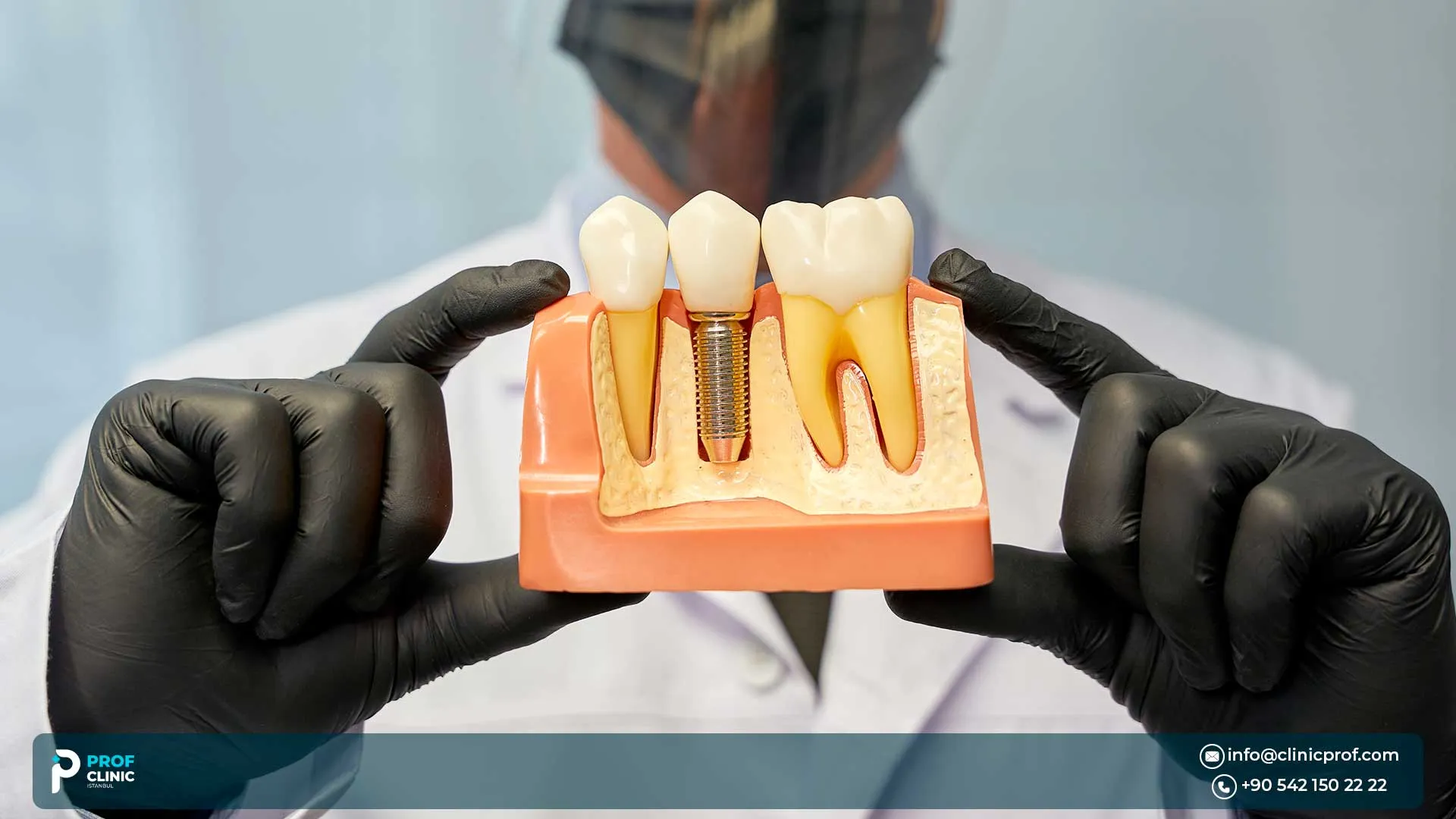
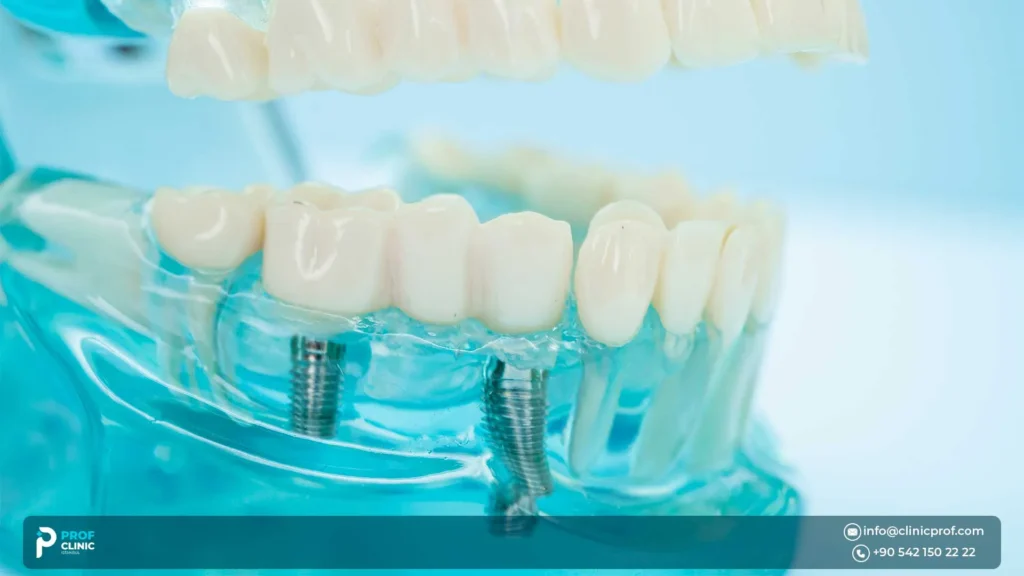
At its core, a dental implant is a sophisticated prosthetic root. While dentures sit on top of the gums and bridges rely on neighboring teeth for support, an implant integrates directly with your jawbone.
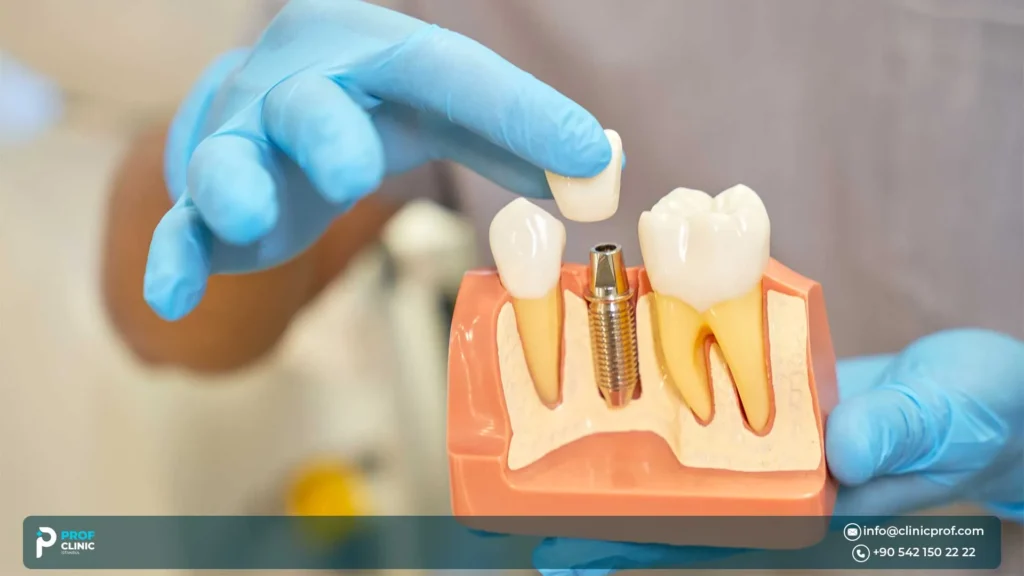
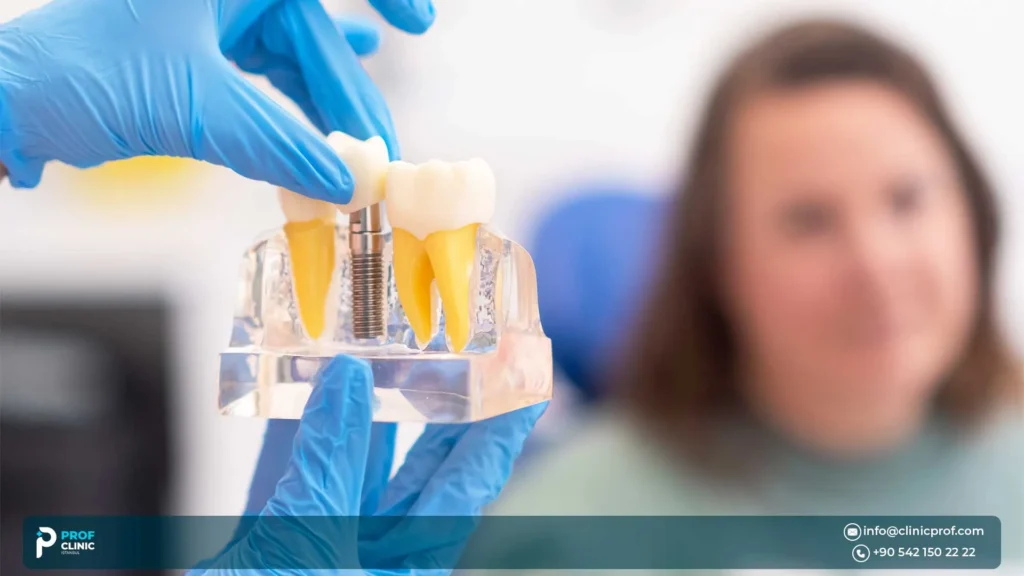
The three-part anatomy of a modern implant:
- The Root: A small post, typically made of biocompatible titanium or ceramic, placed into the jawbone.
- The Connector: A custom-made piece that sits on top of the fixture to hold the crown.
- The Tooth: The visible part of the tooth, crafted from high-grade porcelain or zirconia to match your natural shade.
Unlike other options, implants stimulate the bone, preventing the facial sunken look that often follows tooth loss.
Also read: Define Dental Implant: Comprehensive Guide
Modern Dental implants in Istanbul: How technology changed the procedure?
The biggest barrier for patients has always been the “Fear of the Unknown”—pain, recovery time, and success rates. In 2026, technology has turned these concerns into relics of the past. At Prof Clinic Istanbul, we utilize these advancements to ensure your procedure is as predictable as it is comfortable.
Traditional vs. 2026 modern implants
| Feature | Traditional Implants | 2026 Modern Implants |
| Diagnostic Tool | 2D X-rays (Lacks depth) | 3D CBCT Scanning |
| Surgical Planning | Manual “Eye-balled” placement | AI-Driven Guided Surgery |
| Time to Results | 3–6 months of waiting | Smile in a Day |
| Recovery | Significant swelling/sutures | Minimally Invasive |
The 2026 innovations you’ll find at Prof Clinic:
- AI-Enhanced Planning: We use artificial intelligence to analyze your bone density and nerve locations, ensuring the implant is placed in the safest, most stable position.
- 3D Printed Customization: Your crowns aren’t just “off the shelf.” We use 3D printing to create a tooth that fits your bite and facial symmetry with micrometer accuracy.
- Biomaterial Evolution: New coatings on implants now accelerate “Osseointegration” (bone healing), cutting recovery time by nearly 40% compared to a decade ago.
You deserve a solution that lasts a lifetime and a team that understands your concerns. At Prof Clinic, we turn dental anxiety into a confident new smile using the world’s most advanced 2026 protocols.
Book Your Free 2026 Digital Smile Consultation at Prof Clinic
Understanding the different types of dental implants
At Prof Clinic, we don’t believe in a one-size-fits-all approach. Your jawbone density and the number of teeth missing dictate the strategy. Here is the breakdown of how we classify modern implants today.
Classification by placement
| Type | Description | Placement location | Best for… |
| Endosteal | The most common type | Directly into the jawbone | Patients with healthy, dense bone |
| Subperiosteal | The alternative for thin jawbones | Under the gum, on top of the bone | Patients with thin jawbones who want to avoid bone grafts. |
| Zygomatic | For complex cases | In the cheekbone (Zygoma) | Complex cases with severe upper jaw bone loss. |
- Endosteal Implants: These are the “gold standard.” Shaped like small screws, they are the most stable option. If you have sufficient bone, this is likely what our specialists at Prof Clinic will recommend.
- Subperiosteal Implants: A lifesaver for those who have been told they “don’t have enough bone.” Instead of drilling into the bone, these implants use a metal frame that rests on the bone but under the gum tissue.
- Zygomatic Implants: These are highly specialized. By utilizing the dense bone of your cheeks, we can provide a full set of upper teeth even in the most challenging cases, often bypassing the need for extensive bone grafting.
Classification by Procedure/Timeline
The “pain point” for many patients is the wait time. 2026 technology has drastically shortened the journey from the dental chair to the dinner table.
1. Single and Multiple Implants
Whether you lost one tooth in a sports injury or several teeth due to age, we use individual implants or “Implant Bridges.” This prevents your remaining natural teeth from shifting and maintains your facial structure.
2. Smile in a Day
One of the most requested services at Prof Clinic. Using 3D-guided surgery, we can place the implant and a temporary, high-quality crown in a single appointment.
- The Benefit: You walk out with a smile, not a gap.
- Ideal for: Front teeth and patients with high-density bone.
3. Implant-Retained Denture
If you are tired of “slipping” dentures or messy adhesives, this is your solution. We place 2 to 4 implants that “snap” your dentures into place.
This is the most cost-effective way to get the stability of implants with the coverage of a full denture.
Mini implants vs. Traditional implants: When is “smaller” better?
Many patients ask if they can get “Mini Implants” to save money or avoid surgery. Here is the 2026 perspective:
- Traditional Implants: Usually 3mm to 6mm in diameter. They are designed for maximum bite force and long-term durability (25+ years).
- Mini Dental Implants (MDIs): About the size of a toothpick.
- When to use them: They are excellent for stabilizing lower dentures or for tight spaces where a regular implant won’t fit.
- The Trade-off: They may not be as durable for heavy chewing as traditional implants.
The best way to know which of these types fits your anatomy is through a 3D scan. At Prof Clinic, we use these scans to map out your surgery before we even touch a tool, ensuring 100% precision.
Consult with our Specialists to find your perfect match
Also read: Best Mini Dental Implants (MDI): pros, cons, cost
Dental Implant Materials: Titanium vs. Ceramic
In 2026, the choice of material is no longer just about strength—it’s about biocompatibility, aesthetics, and how your body integrates with the restoration. At Prof Clinic, we help you navigate the “Metal vs. Metal-Free” debate based on your health profile and aesthetic goals.
The material of your implant determines how it interacts with your jawbone and gum tissue. While both options are highly successful, they cater to different patient needs.
Titanium Implants
Titanium has been the industry leader for decades. In 2026, we use Grade 5 Medical Titanium, often alloyed with small amounts of aluminum or vanadium to maximize fracture resistance.
- Why it’s popular: It is incredibly “biocompatible,” meaning the bone grows around it through a process called osseointegration.
- The “Pain Point” Solution: For patients worried about the implant snapping or failing under pressure, titanium offers the highest track record of long-term survival.
- Ceramic (Zirconia) Implants: The metal-free, aesthetic alternative.
Zirconia is a high-performance ceramic that has revolutionized aesthetic dentistry. It is 100% metal-free, making it the top choice for holistic-minded patients or those with metal sensitivities.
- Why it’s popular: It is naturally white, mimicking the color of a tooth root.
- The Aesthetic Advantage: If you have thin or receding gums, a titanium implant might occasionally show a faint gray shadow at the gum line. Zirconia eliminates this risk entirely.
- Pros, Cons, and Expected Lifespan of each material.
| Feature | Titanium Implants | Ceramic (Zirconia) Implants |
| Material Composition | Biocompatible Metal Alloy | Non-metal Crystal (Ceramic) |
| Aesthetics | Grayish (May show through thin gums) | Tooth-colored (Highly aesthetic) |
| Durability | Extremely high (High fracture resistance) | High (But slightly more brittle than metal) |
| Allergy Risk | Rare (But possible nickel/metal sensitivity) | Zero (Hypoallergenic) |
| Holistic Rating | Standard | Superior (Metal-free) |
| Expected Lifespan | 25+ years to Lifetime | 20+ years (Long-term data is evolving) |
Pros, Cons, and Lifespan
Titanium Implants
- Pros: Lower cost than ceramic; versatile two-piece designs allow for easier adjustments; decades of proven clinical data.
- Cons: Potential (though rare) metal allergies; aesthetic limitations in patients with very thin gum biotypes.
- Lifespan: With proper oral hygiene at Prof Clinic, these are designed to be a permanent solution (25+ years).
Ceramic (Zirconia) Implants
- Pros: No corrosion; less plaque buildup around the implant; ideal for front-teeth restorations where aesthetics are critical.
- Cons: Generally more expensive; often comes as a “one-piece” design, which requires high surgical precision.
- Lifespan: Modern 2026 Zirconia is incredibly tough, with an expected lifespan of 20 years or more.
At Prof Clinic, we don’t guess—we test. If you have concerns about allergies or are looking for the most “natural” look for your front teeth, our specialists will guide you through the pros and cons of each during your 3D planning session.
Schedule your meeting now to discover the best material for your biology.
Also read: Different Types of Dental Implants: Which is Best?
Dental Implant Journey in Istanbul: Process and Suitability
Understanding the “how” and “who” is often where the most anxiety lies. In this section, we demystify the process at Prof Clinic and address the specific health factors that determine your success.
Are You a Good Candidate?
In 2026, advanced bone grafting and systemic health management mean that almost everyone is a candidate for dental implants. However, certain factors play a role:
- Bone Density: You need enough bone to support the “root.” (If you don’t, we offer bone augmentation).
- Gum Health: Active periodontal disease must be treated before implantation.
- Age Restrictions: There is no “too old” for implants! However, there is a “too young.” We typically wait until the jawbone has finished growing (usually ages 18–21).
- Health Factors: Controlled diabetes or heart disease are rarely barriers today, thanks to our specialized protocols at Prof Clinic.
The Procedure Steps: A breakdown of the journey from consultation to recovery.
At Prof Clinic Istanbul, we’ve streamlined the 2026 journey into four clear phases:
- Digital Consultation & 3D Mapping: We use CBCT scans to create a “digital twin” of your mouth. No messy molds—just pure digital precision.
- The Placement (The Procedure): Using AI-Guided Surgery, the implant is placed. Because it’s “Minimally Invasive,” most patients report feeling only slight pressure, not pain.
- Osseointegration (The Healing): Over 3–6 months (shorter with our 2026 bio-activators), your bone fuses with the implant. (Temporary teeth are provided so you’re never without a smile).
- The Final Restoration: Your custom-designed 3D-printed crown is attached. You can now eat, speak, and smile with 100% confidence.
Also read: Dental Implant Procedure Time
Dental Implants vs. Alternatives: Why implants win over bridges and traditional dentures.
Why choose an implant over a traditional bridge or removable dentures? The difference lies in the long-term health of your jaw.
Implants vs. Alternatives
| Feature | Dental Implants | Dental Bridges | Traditional Dentures |
| Lifespan | 25+ Years (Permanent) | 7–15 Years | 5–10 Years |
| Jawbone Health | Prevents bone loss | Bone under bridge thins | Accelerated bone loss |
| Natural Teeth | Leaves neighbors intact | Requires grinding neighbors | Can damage existing teeth |
| Chewing Power | 100% (Like natural teeth) | 70% | 20–30% (Can slip) |
| Maintenance | Brush/Floss normally | Requires special cleaning | Must be removed/soaked |
While bridges or dentures might have a lower upfront cost, the “Biological Cost” of losing bone and damaging healthy teeth makes Dental Implants the most cost-effective and healthiest choice for 2026.
Don’t settle for “removable” or “temporary.” Invest in a solution that protects your health and restores your youth.
Book your free consultation to check your suitability with a Digital Assessment at Prof Clinic
Dental Implant Planning in Istanbul: Costs and Decision Making
In 2026, the financial aspect of dental implants is often the final barrier for patients. At Prof Clinic, we believe transparency is the foundation of trust. Understanding the “why” behind the cost helps you move from uncertainty to a clear, actionable plan for your health.
What Determines the Type You Need?
The “best” implant isn’t always the most expensive one; it’s the one that aligns with your biology and lifestyle. During your consultation at Prof Clinic, we evaluate three main pillars:
- Bone Density & Volume: * If your jawbone is healthy, a Standard Endosteal Implant is the most cost-effective.
- If you have significant bone loss, you may require Zygomatic Implants or Bone Grafting, which increases the initial investment but ensures the implant doesn’t fail.
- Aesthetic Goals: * For back molars, Titanium is usually the choice for its strength and value.
- For the “Smile Zone” (front teeth), many patients choose Ceramic (Zirconia) to avoid any metallic shadows at the gum line.
- Procedure Complexity: * “Smile in a Day” procedures involve higher technology and laboratory costs upfront but save you money on multiple visits and temporary fixes.
Understanding financing options for your new smile
We understand that dental implants are a significant investment. In 2026, high-quality care should be accessible. At Prof Clinic Istanbul, we offer several ways to manage the cost:
- All-Inclusive Packages: For our international patients, we bundle the procedure, luxury accommodation, and VIP transfers into one transparent price. This typically saves patients 50% to 70% compared to UK or US prices.
- Flexible Payment Milestones: Unlike many clinics that require full payment upfront, we often split the cost between the surgical phase (placement) and the prosthetic phase (final crown).
- Medical Tourism Benefits: By choosing Istanbul, you aren’t just getting lower costs; you are benefiting from a hub where high volume allows us to offer premium brands like Straumann or Nobel Biocare at a fraction of Western prices.
How to choose the right dental implant clinic in Turkey?
The Turkish market is crowded, but your health shouldn’t be a bargain-hunting experiment. In 2026, look for these “Must-Have” markers when choosing a clinic:
| Quality Marker | Why It Matters | At Prof Clinic |
| Surgical Accreditation | Ensures the surgeon is specialized in implantology, not just general dentistry. | Certified Oral Surgeons |
| In-House Digital Lab | Allows for 3D-printed teeth to be adjusted instantly for a perfect fit. | Yes (CAD/CAM Tech) |
| Brand Transparency | Generic implants have higher failure rates and no global warranty. | Top-Tier Global Brands |
| Success Guarantee | A clinic that stands by its work offers long-term warranties. | Lifetime Guarantees |
Your smile is the first thing people notice and the last thing you should compromise on. At Prof Clinic, we combine 2026 technology with financial clarity so you can focus on what matters: your transformation.
Request an itemized 2026 Treatment Plan from Prof Clinic
Why choose Prof Clinic in Istanbul?
Choosing the right clinic for your dental transformation is a decision that affects your health for decades. In the competitive landscape of 2026, Prof Clinic Istanbul stands out by bridging the gap between high-end medical technology and deeply personalized patient care.
At Prof Clinic, we don’t just “fix teeth”; we restore the confidence that comes with a healthy, functional smile. Here is why patients from across the globe trust us with their dental implant journeys:
Unparalleled medical expertise
Our surgical team is composed of internationally trained specialists who focus exclusively on implantology and restorative dentistry. With over 16 years of experience and thousands of successful placements, we handle everything from single-tooth replacements to complex full-mouth reconstructions.
2026 cutting-edge technology
We invest in the future of your smile. Our clinic is equipped with the latest diagnostic and surgical tools to ensure your safety and precision:
- 3D CBCT Imaging: For millimeter-perfect surgical planning.
- Digital Smile Design (DSD): See your final result before the procedure even begins.
- Intraoral Scanners: Say goodbye to uncomfortable physical molds; our digital impressions are faster and more accurate.
The Patient-First experience
We understand that traveling for dental care can be daunting. That’s why we provide a “Door-to-Door” service that makes your journey stress-free:
- VIP Transfers: Seamless transport between the airport, your hotel, and the clinic.
- Luxury Accommodation: Rest and recover in some of Istanbul’s most prestigious 4 and 5-star hotels.
- Multilingual Support: Dedicated coordinators who speak your language and guide you through every step of the process.
Prof Clinic’s advantage
| Feature | The Prof Clinic Standard |
| Success Rate | Exceeding 98% due to AI-guided precision. |
| Material Quality | Only FDA & CE-approved premium brands (Straumann, Nobel, etc.). |
| Patient Care | 24/7 post-operative support and personal assistants. |
| Pricing | Up to 70% more affordable than US/UK/EU without quality compromises. |
Your journey to a perfect smile begins with a single conversation. Our medical consultants are ready to provide you with a personalized, itemized treatment plan tailored to your specific needs—with no hidden costs.
Join the thousands of satisfied patients who chose excellence.Submit an Enquiry & Get Your Free 2026 Quote Now
FAQs about types of dental implants
What is the best type of dental implant for me?
The “best” type depends on your jawbone health and the location of the missing tooth. If you have strong bone density, Endosteal Titanium implants are usually the top recommendation. If you have significant bone loss, Zygomatic or Subperiosteal implants may be better. A 3D CBCT scan at our clinic is the only way to determine your perfect match.
Titanium or Ceramic: Which is better?
Both are excellent, but they serve different needs:
- Titanium is better for molars because of its extreme durability and flexibility in multi-piece designs.
- Ceramic (Zirconia) is better for patients with metal allergies or those seeking the highest aesthetic result for front teeth.
What is the “3/2 Rule” in dental implants?
The “3/2 Rule” is a clinical guideline for spacing to ensure bone health and gum aesthetics:
- 3mm: The minimum distance required between two adjacent implants.
- 2mm: The minimum distance between an implant and a natural tooth.
Proper spacing ensures there is enough blood supply and bone volume to support the implants long-term.
What is the “New Type” of implant available in 2026?
The “New Type” refers to Bio-Active Surface Implants. These implants are coated with special materials (like hydroxyapatite or growth factors) that signal your bone to heal faster. In 2026, these have reduced the typical 6-month healing period to as little as 6–8 weeks in qualified candidates.
Is the procedure painful? What to expect during recovery.
Most patients are surprised to find that getting an implant is less painful than a tooth extraction.
- During: We use local anesthesia or sedation, so you feel no pain—only slight pressure.
- Recovery: You may experience minor swelling for 3–5 days. At Prof Clinic, we provide a recovery kit and detailed instructions to make this process nearly effortless.
How long do implants typically last?
Dental implants are designed to be a lifetime solution. While the crown (the visible tooth) may need replacement every 15–20 years due to normal wear, the titanium or ceramic “root” should last 25+ years if you maintain good oral hygiene and regular check-ups.
Can I resume normal activities immediately?
You can usually return to light work the very next day. However, we recommend avoiding strenuous exercise or heavy lifting for 3–5 days to prevent throbbing or increased swelling at the surgical site.