Is a hair implant the same as a hair transplant? Usually, yes: most clinics use “hair implant” as everyday shorthand for a transplant that moves your own follicles, but the term can also mean synthetic hair implants, where artificial fibres are knotted into the scalp. When people compare a hair implant vs hair transplant, it’s this second meaning that matters, because the two procedures differ in material, lifespan, upkeep and risk.
In this guide by Prof Clinic, you’ll learn what each procedure actually involves, why synthetic fibres don’t grow, what medical bodies say about their safety, how a natural transplant compares, and how terms such as hair grafting and hair plugs fit in. By the end, you’ll know which questions settle the choice for your own hair loss.
Hair Implant vs Hair Transplant: The Short Answer
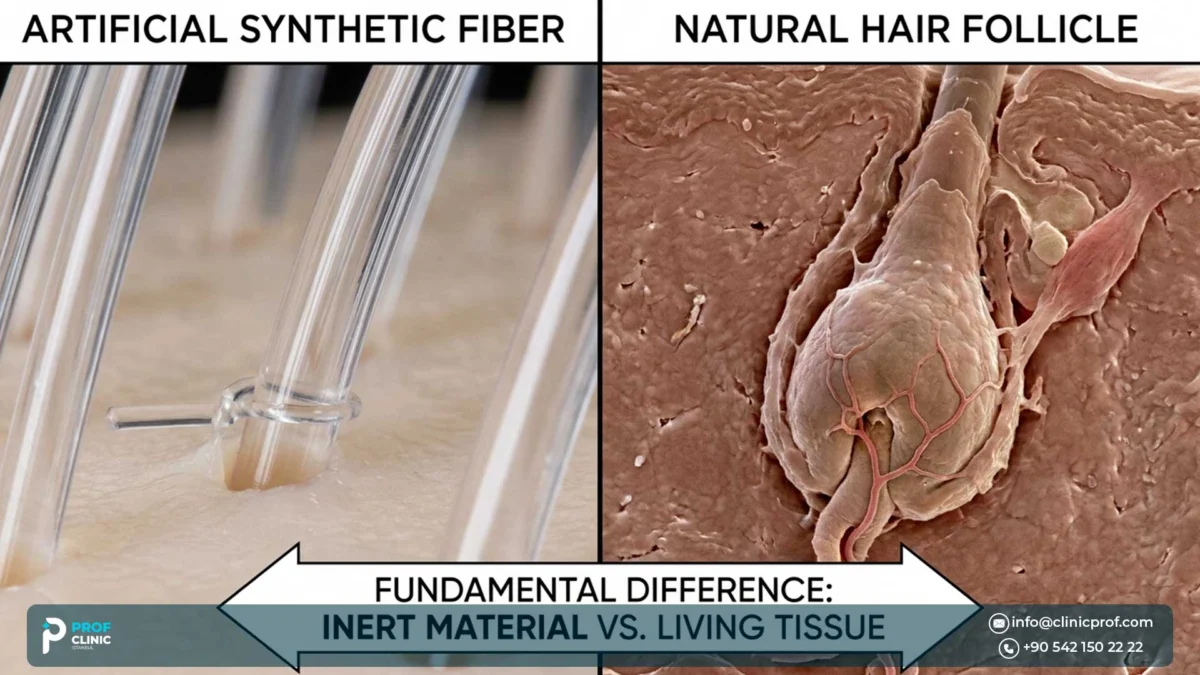
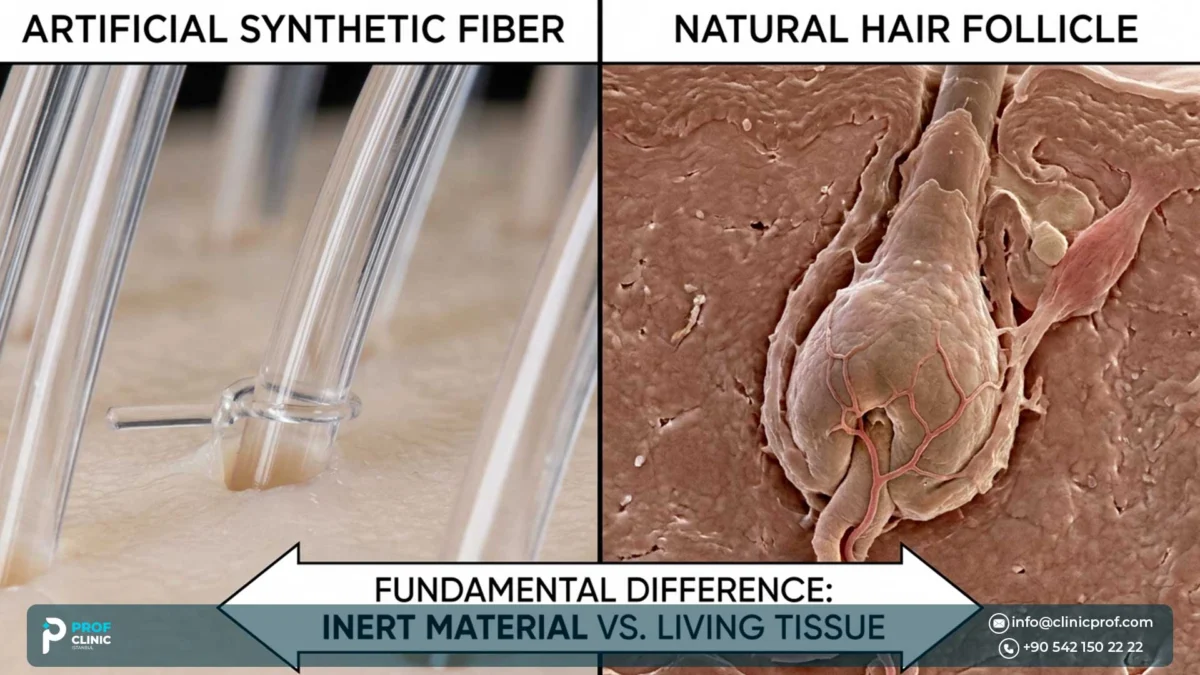
The core difference is living tissue versus inert material. A hair transplant moves your own follicles from a dense donor area to a thinning one, where they keep growing for years. A synthetic hair implant places manufactured fibres, usually made of polyamide, into the scalp; they look like hair on the day but never grow, and some fall out every year.
Part of the confusion is linguistic. Many people search “hair implant” when they mean a transplant, and techniques such as DHI use a pen-shaped “implanter” to place your own grafts. So when a clinic says hair implants, ask one question: whose hair is it? If the answer is “yours”, you’re talking about a transplant.
The table compares the two on the points that usually decide the matter:
| Criterion | Synthetic hair implant | Natural hair transplant |
|---|---|---|
| What goes into the scalp | Manufactured fibres (polyamide in current products) | Your own follicles, moved from the back and sides of the head |
| Growth | None; length stays as implanted | Grows, can be cut and styled like the rest of your hair |
| When it shows | Immediately after the session | New hair from about 4 months; full result after 10–18 months |
| Lifespan | Fibres are lost gradually, often up to about 10% a year | Long-lasting, because donor-area follicles keep their character |
| Upkeep | Strict hygiene, regular check-ups and yearly top-up sessions | Normal hair care once healed; medication may be advised for ongoing loss |
| Main risks | Infection, inflammation, foreign-body reactions, scarring | Bleeding, infection, poor graft growth, scarring (all uncommon) |
| Regulatory status | Banned in the US since 1983; CE-marked fibres exist in Europe | A standard surgical procedure worldwide |
| Usually suits | A small group with no usable donor hair, after a tolerance test | Most people with stable pattern hair loss and enough donor hair |
Figures in the table come from the NHS, the AAD and published studies on artificial hair, which are covered in the sections below.
Not sure which group you belong to? Book a free online consultation and send photos of your hairline, crown and donor area for an initial opinion.
What Are Synthetic Hair Implants?
Synthetic hair implants, also called artificial hair or prosthetic hair fibres, are strands of man-made material inserted one by one into the scalp. According to a case review in the International Journal of Trichology, early fibres were acrylic or polyester, while current products are polyamide fibres that manufacturers describe as inert. The appeal is speed: you leave with visible “hair” the same day, after a minor procedure under local anaesthetic.
How the Fibres Are Implanted
Each fibre ends in a small knot that a hand-held implanter pushes into the deep layer of the scalp, where it anchors. The same review describes about 1,000 fibres per session, spaced roughly 2 mm apart at a 45° angle. A report in JAAD Case Reports adds that standard protocols start with a small tolerance test, then build up over several sessions about a month apart, with an average of around 2,300 fibres per patient in total.
Why Synthetic Fibres Don’t Grow or Last
A fibre has no root, no blood supply and no growth cycle, so it can’t lengthen, thicken or replace itself. In one study quoted by the International Journal of Trichology, fibre loss stayed at or below 10% a year in 91.4% of patients, but some lost 15–20%. The review also notes that the method needs good hygiene, periodic check-ups and yearly retouching sessions to keep the look.
What it means in real life: a synthetic implant is closer to a subscription than a one-off procedure. The result starts thinning from the first year, and keeping it means planning, and paying for, regular top-ups.
Safety, Risks and Regulation
Synthetic fibres carry real medical risks, which is why regulators treat them cautiously. The US Food and Drug Administration banned prosthetic hair fibres in 1983, finding no public health benefit and a risk of serious infection, illness and injury. In 2021 the International Society of Hair Restoration Surgery (ISHRS) stated that it aligns with the FDA position. In Europe, some fibres carry CE certification, so availability differs from country to country.
Modern studies report lower complication rates than the early years, but problems remain common enough to take seriously:
- Inflammation and infection: case series reviewed in the International Journal of Trichology found temporary superficial inflammation or infection in 7.4–30% of patients, usually settling within about 15 days of treatment.
- Serious reactions: 1–2% of patients had inflammation or infection severe enough to need the fibres removed.
- Foreign-body reactions: the body can wall off fibres in granulomas, and bacteria can form biofilms on the fibre surface that resist antibiotics.
- Rare severe events: JAAD Case Reports notes reports of bone infection (osteomyelitis) and heart-valve infection (infective endocarditis).
The authors of the JAAD report add that tolerance tests, fibre limits and aftercare are not always followed in practice, so the real complication rate is probably higher than published figures. Both of their patients developed abscesses after sessions done without a tolerance test, and one needed every fibre removed before the inflammation cleared.
Who Might Still Be Offered Synthetic Fibres?
Published reviews present synthetic fibres as a niche option, not an alternative to transplantation for most people. They may be considered for patients who have tried medical treatment, have no adequate donor hair and won’t accept a hairpiece. The same review lists clear exclusions: diabetes, autoimmune disease, scalp disease, hair loss that hasn’t stabilised, poor hygiene, and work in dusty or dirty environments. The fibres are also unsuitable for the temples, a low front hairline and other thin-skinned areas.
What Is a Natural Hair Transplant?
A natural hair transplant moves your own hair from an area that resists balding to one that has thinned. The NHS describes it as “a procedure to move hair to an area that’s thin or bald”, usually done under local anaesthetic and sedation, so you stay awake but should not feel pain. It is the standard surgical treatment for pattern hair loss, and the method behind any hair transplant in Turkey that uses FUE, DHI or Sapphire FUE.
Where the Transplanted Hair Comes From
The donor hair comes from the back and sides of the scalp, which in pattern hair loss usually keeps growing. Follicles taken from this zone keep their resistance after they are moved, a principle known as donor dominance, first described by Orentreich in 1959. There are two main ways to harvest them, plus two common variations:
- FUE (follicular unit extraction): individual follicular units are removed one at a time, leaving many tiny dot scars that are not very noticeable.
- FUT (strip method): a strip of scalp is removed and divided into grafts, leaving a single linear scar that hair usually covers.
- DHI and Sapphire FUE: variations of FUE that change how the recipient sites are opened or how the grafts are placed, not where the hair comes from.
For a side-by-side look at the three techniques, read FUE vs DHI vs Sapphire FUE: Which Technique Fits You?
When Does Transplanted Hair Grow?
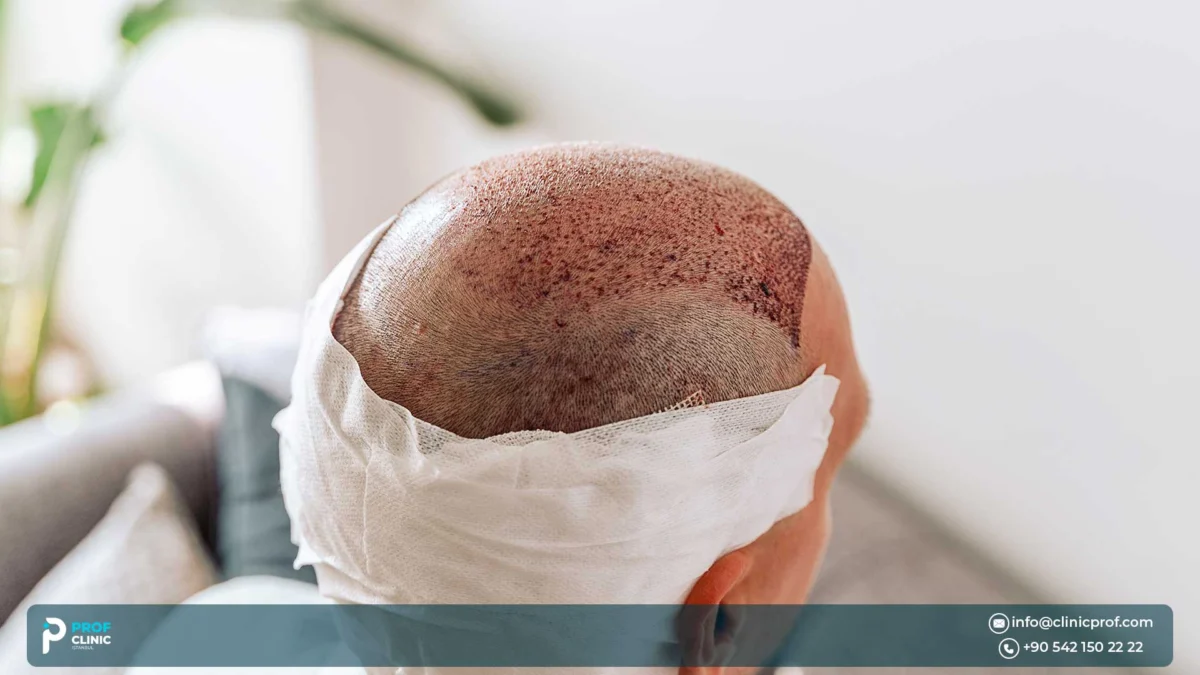
Transplanted hair follows a predictable but slow timeline. The AAD notes that the transplanted hairs often shed within two to eight weeks, which is normal. The NHS says new hair usually starts to appear at around 4 months, and that the full result should be visible after 10 to 18 months. Unlike a synthetic implant, the early result looks thinner than the final one. If the shedding worries you, our article on shock loss after a hair transplant covers what usually happens and when the hair comes back.
Want to see what the months in between look like? Browse real cases at different stages in the Prof Clinic before-and-after gallery.
Is a Hair Transplant Permanent?
The transplanted follicles are long-lasting, but your other hair is not protected. The AAD says a transplant can be a permanent solution with results so natural that a barber or stylist may not notice, yet hair loss and thinning can continue around the grafts. That’s why a dermatologist may recommend hair loss medication alongside surgery, and why a hairline is planned with future loss in mind.
The donor area is also finite: every graft you use now is one you can’t use later. For a closer look at how results hold up over time, see our guide to how permanent a hair transplant really is.
Also read: PRP After a Hair Transplant: Is It Necessary? Timing and Sessions
Risks of a Natural Hair Transplant
The NHS describes hair transplant surgery as generally safe, with a small risk of bleeding, infection and an allergic reaction to the anaesthetic. It also lists the chance that the transplant won’t take, a noticeable scar, and continued thinning around the transplanted area. The key difference from synthetic fibres is that your body doesn’t treat its own follicles as a foreign object, so there is no ongoing reaction to the material itself.
Hair Grafting, Hair Plugs and Hair Replacement: Clearing Up the Terms
Most of these terms describe the same idea, moving your own hair, at different points in its history. Here’s how they fit together:
- Hair graft: a single follicular unit of one to four hairs moved during a transplant. Hair grafting and hair transplant mean the same procedure.
- Hair plugs: an older transplant method that moved larger round sections of scalp. The AAD links it to the “doll-like” look patients saw in the 1970s and 1980s, which modern follicular-unit methods avoid.
- Hair implant: either a transplant (your own grafts, sometimes placed with an implanter pen) or synthetic fibres. Always ask which.
- Hair replacement or hair system: usually a non-surgical hairpiece or wig attached with tape, adhesive or clips. Nothing is placed into the skin, but it needs regular refitting. It can suit people without enough donor hair who want a reversible option.
- Hair fibres (sometimes sold as “micro hair”): cosmetic fibre powder that clings to your existing hairs to hide thinning for a day. It is not implanted and washes out, so it has nothing to do with synthetic implants.
- Hair restoration: the umbrella term for all of the above, plus medical treatments.
Also read: What Is a Hair Transplant? Pros, Cons, Hairline & Who It Suits
Hair Implant or Transplant: Which Should You Choose?
For most people with pattern hair loss and a usable donor area, a natural transplant is the option medical bodies support, because it uses living hair that grows. Synthetic fibres make sense only in a narrow set of cases, and only under medical supervision. Before you decide, ask yourself:
- Do I have enough donor hair? If yes, a transplant is usually the first option to assess. If not, the conversation shifts to medication, a hair system, or, rarely, fibres.
- Is my hair loss stable? Synthetic fibres aren’t indicated for loss that hasn’t stabilised, and a transplant done during rapid loss can leave gaps later, so medical treatment often comes first.
- What is the cause? The NHS notes that transplants are usually not suitable for alopecia areata, and scarring alopecia needs a specialist diagnosis before any procedure.
- Can I commit to upkeep? Synthetic fibres need lifelong hygiene, check-ups and top-ups; a transplant needs patience for the first year.
- What will it cost over ten years? Compare the total, including retouching sessions, not just the first invoice.
Women with thinning hair are among those drawn to synthetic fibres, and both patients in the JAAD report were women. Many women with pattern thinning are still candidates for a female hair transplant, so it’s worth an assessment before choosing artificial hair.
Nothing here replaces a diagnosis; treat it as general information. Whether either procedure suits you depends on a medical assessment of your scalp, donor area and the cause of your hair loss.
Still weighing your options? Send your photos to our team on WhatsApp and ask whether your donor area is likely to be enough.

Your Own Hair, Assessed First: Hair Transplant at Prof Clinic in Istanbul
Prof Clinic’s hair services in Istanbul use your own follicles: FUE, DHI, Sapphire FUE and Micro FUE for the scalp, as well as afro and curly hair, women, eyebrows, beard and moustache. Synthetic fibre implants are not among the services listed on the site. Whether your donor hair is enough is judged by Spc. Dr. Lütfi Öztürk, an internal-medicine specialist and the clinic’s hair restoration lead, who also plans your treatment and coordinates follow-up.
Unlike a fibre implant marketed on its instant look, a transplant with living follicles comes with checks you can confirm before you fly:
- A written quote: the team looks at your photos first and then sends a price in writing, for a package that covers the procedure, your accommodation, airport and hotel transfers, and post-op care.
- Pre-op tests: before any grafts are taken you have a blood count and an ECG, plus checks of kidney and liver function, electrolytes and blood sugar, and screening for hepatitis and HIV.
- Honest expectations: because living hair varies from person to person, the density you can expect is discussed for your case and never promised beforehand.
- Follow-up at home: once you have left Istanbul, the coordination team keeps in touch and answers your questions over WhatsApp.
As a general guide, a scalp hair transplant package in Istanbul costs about €1,800–€3,500, and a female hair transplant about €2,000–€3,800. These are approximate ranges as of this update, not final prices; yours depends on your case after assessment and is confirmed in the written quote.
Comparing quotes or clinics right now? Contact Prof Clinic and ask for a written plan that states the technique, graft estimate and what the package includes.
FAQs About Hair Implants and Hair Transplants
Is a hair implant the same as a hair transplant?
Often, yes. Many clinics and patients say “hair implant” when they mean a transplant of your own follicles. Strictly, though, an artificial hair implant uses synthetic fibres that don’t grow. Ask the clinic directly whether the hair comes from your own scalp or from a manufactured fibre.
Which is better, a hair implant or a transplant?
For most people, a natural transplant. It uses living hair that grows and usually needs no special upkeep once healed. Synthetic implants give an instant look but lose fibres every year, need regular top-ups and carry a higher risk of inflammation. They are generally reserved for people without usable donor hair.
Are synthetic hair implants safe?
They carry more risk than a transplant. The US FDA banned prosthetic hair fibres in 1983, and the ISHRS supports that position. Published series report temporary inflammation or infection in roughly 7–30% of patients and serious reactions needing fibre removal in 1–2%. Where they are offered, a doctor should perform them after a tolerance test.
Does implanted synthetic hair grow?
No. A synthetic fibre has no root, so it keeps the length it had on the day of the procedure and can only be trimmed. Fibres also fall out over time, often up to about 10% a year, which is why patients usually need yearly top-up sessions to keep the density.
What is the difference between hair grafting and a hair transplant?
There’s no real difference. A graft is the follicular unit that’s moved, and grafting is the act of moving it, so “hair grafting” is another name for a hair transplant. Hair plugs, by contrast, were an older form of grafting using larger pieces of scalp, which modern FUE and FUT have replaced.
How does a hair transplant look after 10 years?
The transplanted hair usually keeps growing, because donor-area follicles resist pattern balding. What can change is the hair around it: native hair may keep thinning, which can leave gaps behind a transplanted hairline. Medical treatment and careful long-term planning help the result age naturally.
Final Thoughts
The hair implant vs hair transplant question comes down to one thing: whether the hair placed in your scalp is alive. Your own transplanted follicles grow and age with you, while synthetic fibres give an instant look that thins every year and brings a higher risk of reactions. If you have a usable donor area, start by assessing a natural transplant, and treat synthetic fibres as a last resort only under a doctor’s care.
Before you choose between fibres and follicles, get your donor area assessed rather than booking straight away. Talk to our team about your donor area and ask for a written plan for your hair transplant in Istanbul.
Sources
- ISHRS — ISHRS Aligns with U.S. FDA: Exploring the Role of Prosthetic Hair Fibers
- International Journal of Trichology — Staphylococcus lugdunensis and Trichophyton tonsurans Infection in Synthetic Hair Implants (Colli et al., 2017)
- JAAD Case Reports — Side Effects After Artificial Hair Implants: 2 Case Reports (Näslund-Koch et al., 2020)
- American Academy of Dermatology — A hair transplant can give you permanent, natural-looking results
- NHS — Hair transplant