Is a DHI hair transplant in Turkey worth considering, and how is it different from the FUE you keep reading about? DHI is a way of placing grafts with a Choi implanter pen, which opens a tiny channel and sets the graft in one movement, while the grafts themselves are still harvested by FUE. It gives fine control over angle and depth, especially along the hairline, but it is not automatically the better choice: that depends on your donor area, the size of the thinning zone and the team doing the work.
In this guide by Prof Clinic, you’ll learn what a Choi pen is, how DHI compares with standard FUE and Sapphire FUE, who it suits, what recovery looks like month by month, and what a DHI package in Istanbul usually costs. By the end, you’ll know which questions to ask before you accept a quote.
What Is a DHI Hair Transplant?
DHI (Direct Hair Implantation) is an implantation technique, not a separate type of hair transplant. The International Society of Hair Restoration Surgery (ISHRS) describes DHI as another name for implanting grafts with sharp implanters, and points out that the grafts are still taken by follicular unit excision (FUE).
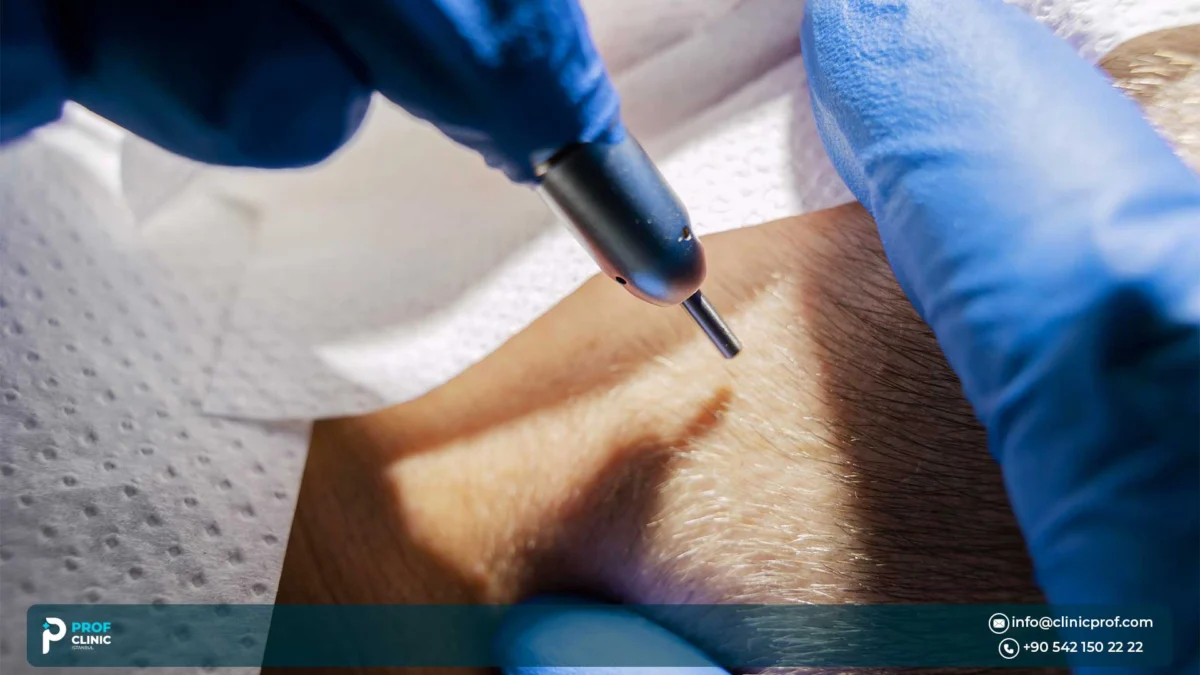
The easiest way to understand it is what we call the two halves of every transplant. The first half is extraction: taking individual follicular units from the back and sides of the scalp. The second half is implantation: placing them where the hair has thinned. DHI changes only the second half. In standard FUE, the team first opens all the recipient channels with a fine blade or needle and then places each graft with forceps. In DHI, each graft is loaded into the hollow needle of an implanter pen, and the pen creates the channel and delivers the graft at the same moment.
Why this matters to you: when one clinic quotes “FUE” and another quotes “DHI”, you are comparing two ways of implanting, not two different operations. Harvesting, donor limits and donor-area healing are largely the same. DHI is one of several techniques used for hair transplant in Turkey, and the right one is chosen after your scalp has been examined.
What Is a Choi Pen?
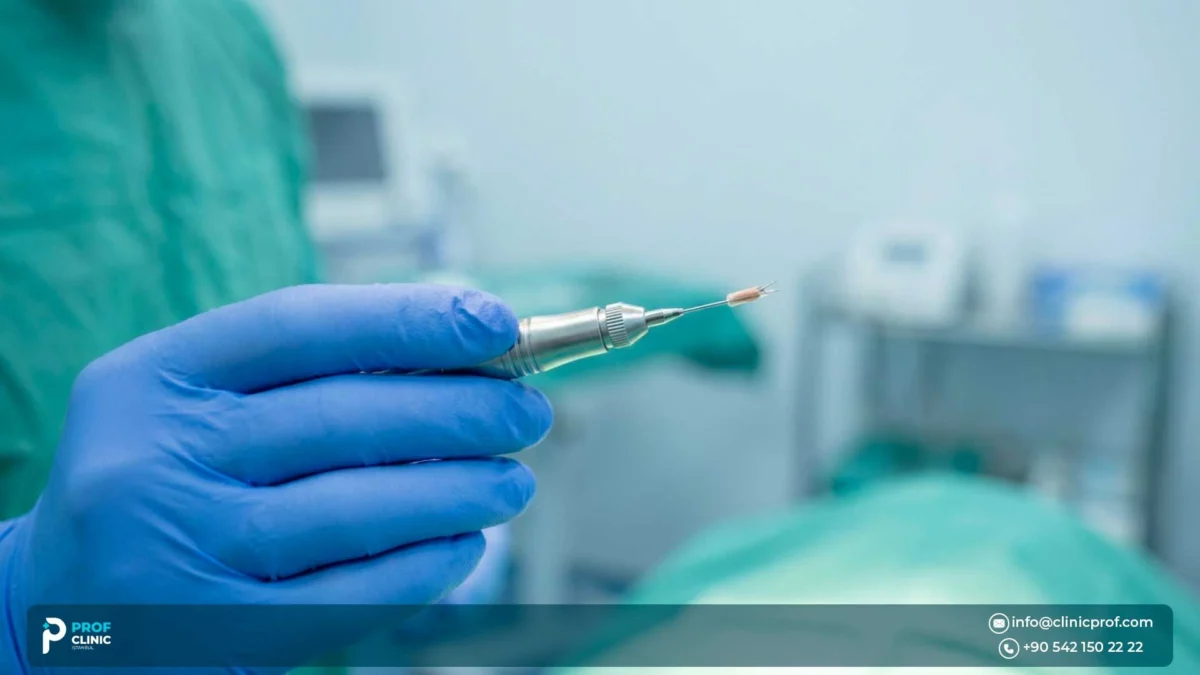
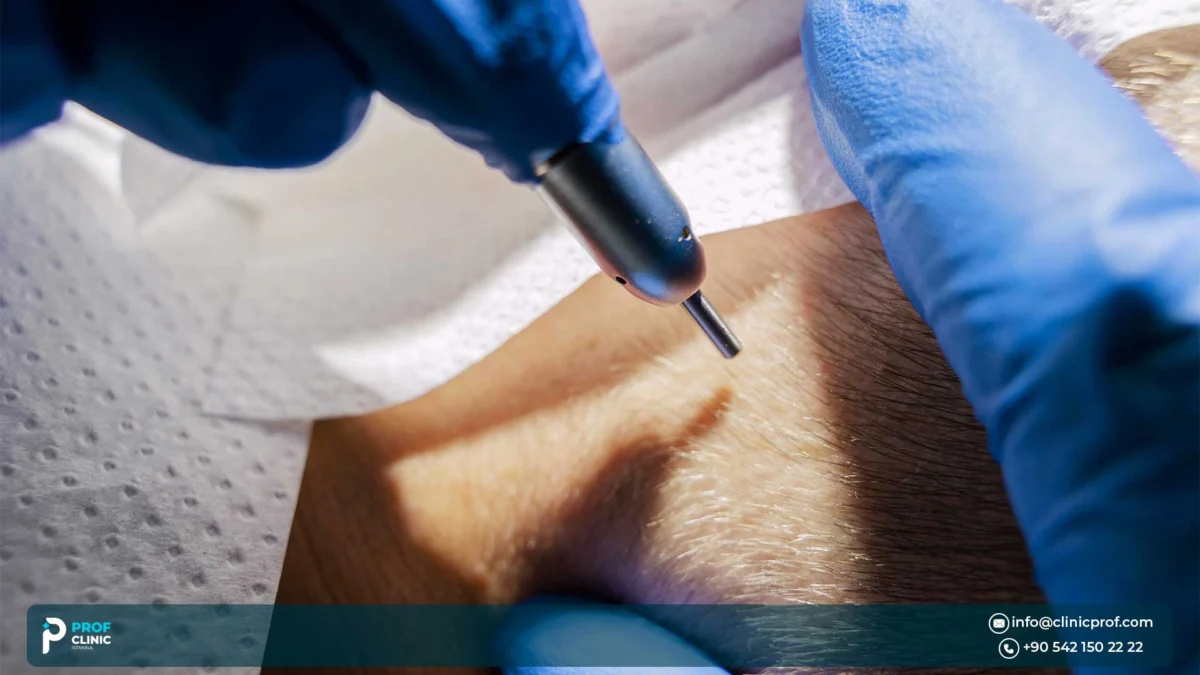
A Choi pen, or Choi implanter, is a pen-shaped instrument with a hollow, sharp needle at the tip and a plunger that pushes the graft into the skin. According to a 2024 review in Facial Plastic Surgery, Dr Choi introduced the implanter in 1992. It first became popular in East Asia, where hair is typically straight and thick and most grafts carry one or two hairs, and spread in the West once FUE became common, because FUE grafts are uniform in size but more fragile.
The needles come in different diameters, so the team can match the tip to the size of each graft. A practical guide to the sharp implanter method, published in 2023, links good graft survival to details such as choosing the right tip size, controlling depth and training the staff. The ISHRS adds that with implanters the graft bulb is not gripped directly, which may mean less trauma than forceps handling.
How the DHI Procedure Works, Step by Step
A typical DHI day follows the same order, though the timing changes with the number of grafts:
- Assessment and hairline design: the doctor checks donor density, the pattern of loss and your medical history, then marks the hairline and the areas to treat.
- Local anaesthetic: the NHS notes that hair transplants are usually done under local anaesthetic and sedation, so you stay awake but the scalp is numb.
- Extraction: grafts are removed one by one from the donor area with a small circular punch, exactly as in FUE.
- Loading: trained assistants load each graft into an implanter needle, and several pens are used in rotation.
- Implantation: each pen is inserted at the planned angle, direction and depth, and the plunger releases the graft into the skin.
- Dressing and instructions: you leave the same day with written aftercare advice. According to the NHS, a hair transplant usually takes a day and does not need an overnight stay.
DHI vs FUE and Sapphire FUE: How the Placement Differs
The three techniques differ mainly in how the recipient channels are opened and how the grafts are placed; the extraction is FUE in all three. Standard FUE uses steel blades or needles to open the channels before forceps placement. Sapphire FUE uses sapphire-tipped blades for those channels. DHI uses the implanter needle itself, so there is no separate incision stage.
Here is how they usually compare in practice:
| Criterion | Standard FUE | Sapphire FUE | DHI (Choi pen) |
|---|---|---|---|
| Recipient channels | Opened in advance with a steel blade or needle | Opened in advance with a sapphire-tipped blade | Opened by the implanter needle at the moment of placement |
| Graft placement | Fine forceps | Fine forceps (sometimes blunt implanters) | Implanter plunger |
| Angle and depth control | Set when the channels are made | Set when the channels are made | Set graft by graft |
| Shaving | Usually a full shave | Usually a full shave | Partial shave sometimes possible |
| Usually suits | Large areas and high graft numbers | Same cases as FUE, where the team prefers sapphire blades | Hairlines, temples and dense packing in selected areas |
Also read: FUE Hair Transplant in Turkey: Procedure, Pros and Cons, and Cost
In practice, clinics mix and match these steps. The ISHRS notes that blunt implanters can also be used to place grafts into pre-made incisions, so the lines between the methods are often blurred in real clinics. For a side-by-side decision guide, see FUE vs DHI vs Sapphire FUE: Which Technique Fits You?.
Does the instrument change the result? The evidence doesn’t point to a clear winner. The 2024 Facial Plastic Surgery review concludes that forceps are safe in the hands of well-trained teams, and that the choice of implantation technique depends on the surgeon’s experience and the pros and cons of each instrument. In short, neither option is universally better. What changes the outcome most is how carefully the grafts are handled, how the hairline is designed and how well your donor area is managed.
Also read: Sapphire FUE Hair Transplant in Turkey: Benefits, Evidence and Cost
Not sure which technique fits your hair loss? Send photos of your front, top, crown and donor area on WhatsApp and ask which method the doctor would suggest, and why.
Advantages and Limitations of DHI
DHI’s main strengths are control and gentle graft handling; its main costs are time, staffing and, at many clinics, price. Knowing both sides helps you judge whether the extra precision is worth it in your case.
Advantages of DHI
- Graft-by-graft control: the angle, direction and depth are set for every graft, which is useful at the hairline and temples, where small errors are most visible.
- Less direct handling: the graft sits inside the needle rather than being gripped by forceps, which the ISHRS says may mean less trauma.
- Dense packing: the 2023 implanter guide reports that dense, natural-looking results can be achieved when the method’s principles are followed, including careful depth control and avoiding graft “popping”.
- Working among existing hair: because no field of incisions is made in advance, DHI can be used to add density between hairs that are still present, in suitable cases.
- Shaving options: in smaller cases, a partial or limited shave is sometimes possible.
Limitations of DHI
- More staff time: every graft has to be loaded into a pen, so large sessions need an experienced, well-coordinated team.
- Often a higher price: some clinics charge more for DHI because of the implanters and the extra working time.
- Technique-sensitive: a sharp implanter cuts the skin, which is a surgical step. The ISHRS states that doctors should be the primary people responsible for the surgical part of any hair transplant.
- Donor limits still apply: DHI does not create extra grafts. If the bald area is large and the donor area is limited, coverage will be limited too, and the NHS notes that large areas may need two or more sessions.
- Healing is not dramatically faster: the recipient channels are small, but the donor area heals as it would after any FUE, and comparative data on recovery speed are limited.
Does DHI Require Shaving?
Usually, at least part of the donor area is shaved, because the punch needs short hair to follow each follicle’s direction. The recipient area may not need shaving in a smaller DHI case, such as a hairline or temple refinement. If you only want a partial transplant, for example the front third, a partial-shave plan is more realistic than it would be for a full-crown case. For large sessions, a full shave is often still the safest choice, because it lets the team see every graft and every existing hair. Ask in your consultation which shaving option fits your graft count.
A partial shave is not automatically cheaper or better, so ask whether it changes your graft count or your quote. Our guide to unshaven hair transplants explains who that approach suits and what it costs.
Who Is a Good Candidate for DHI?
A good candidate for DHI is someone with stable, patterned hair loss and enough healthy donor hair to cover the area they want to treat. The American Academy of Dermatology (AAD) notes that men and women of all races can be good candidates, provided they have enough healthy hair to transplant and the scalp can grow hair in the thinning area.
DHI is often worth discussing if you:
- want a soft, natural hairline or need the temples rebuilt
- have thinning areas where native hair is still present
- need a moderate number of grafts and would like to avoid a full shave
- are correcting or refining an earlier transplant
It may be less suitable, or need to wait, if your hair loss is still progressing fast, your donor area is weak, you have diffuse thinning without a clear pattern, or you have active scalp disease or an uncontrolled medical condition. For men, our page on male hair transplant in Turkey explains how pattern baldness is staged and planned. Women’s hair loss usually needs a diagnosis first, because many causes are not treated with surgery; the female hair transplant page covers how those cases are assessed.
DHI Recovery and Results: A Month-by-Month Timeline
After DHI, your skin usually heals in one to two weeks, but the hair takes about a year to show its final result. This is the same biology as any follicular-unit transplant, so the timeline below applies whichever implantation method was used.
The ranges come from the NHS and the AAD:
| Period | What usually happens | What it means for you |
|---|---|---|
| First few days | A tight, achy and swollen scalp; tiny crusts around the grafts | Normal healing. Keep pressure and friction off the grafts. |
| Days 2–14 | Dressings come off within the first days; washing follows your written instructions; crusts clear | Most people return to work within 1–2 weeks. Treat the grafts with extra care throughout this period. |
| Weeks 2–8 | Most transplanted hairs shed | Expected. The follicle stays in the skin and rests. |
| Months 3–4 | The area can look thinner; new hairs start to appear around month 4 | Too early to judge. The new hair is fine at first. |
| Months 6–9 | Most patients see a clear change | Hair thickens and gains length. |
| Months 10–18 | Full result | The right time to assess density and discuss any touch-up. |
DHI does not change these stages much, and they vary from person to person. Your aftercare instructions, the number of grafts and your hair type can shift them. As general aftercare from the NHS, be very careful with the grafts for the first two weeks and expect to cut down on exercise during the first month. For a fuller picture of each stage, see our hair transplant timeline.
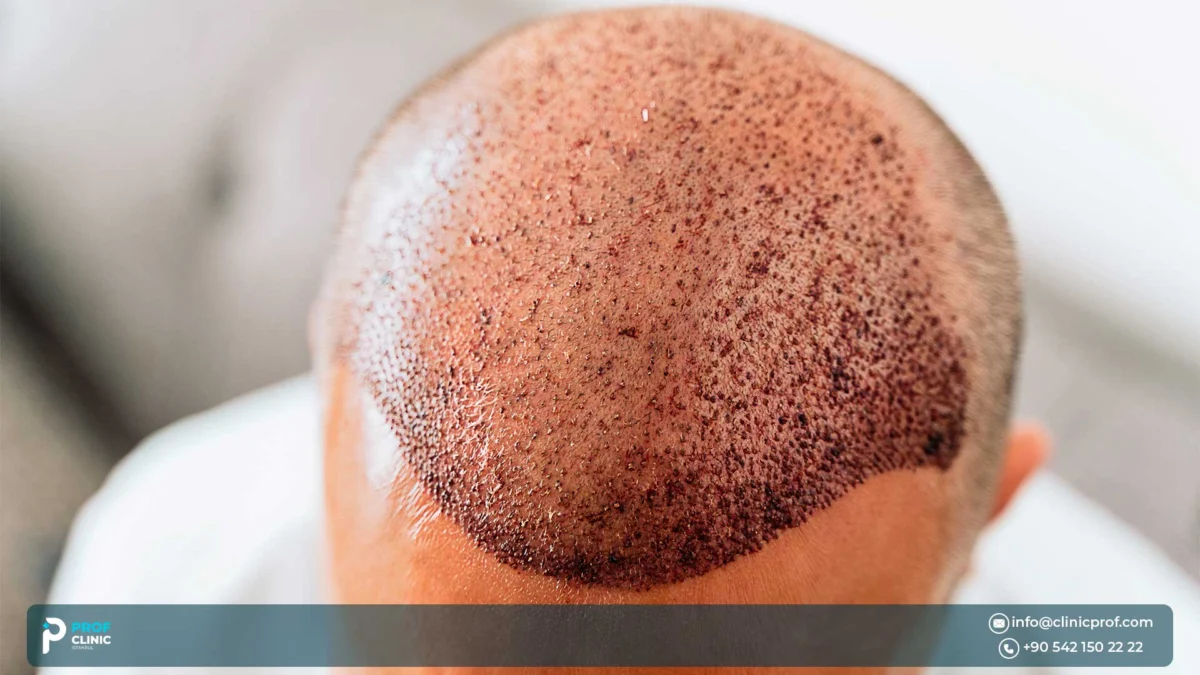
Many advertisements say DHI heals faster than FUE. The recipient channels are small with either method, and the donor area heals the same way, so it’s safer to plan for the usual one to two weeks.
How to Read DHI Before-and-After Photos
Before-and-after photos help, but only when the comparison is fair. For a DHI case, check that both photos share the same angle, light and hair length, that the month after surgery is stated, and that the hairline is shown up close, not just the crown. Photos from the first weeks show scabs and redness, not results, and a fair judgement of density usually waits until about month 10. Be wary of filtered images or a result shown after a few days. A single striking case also says little about yours, because density depends on your own donor area. Our guide on how to judge real hair transplant results lists the red flags in full.
Want to see how results build over the months? Browse our before-and-after gallery to compare different hair types at different stages.
DHI Hair Transplant Cost in Turkey
In Istanbul, a scalp hair transplant package with FUE, DHI or Sapphire FUE usually costs about €1,800–€3,500. Treat it as a rough 2026 guide, not a fixed price: your own price depends on your case and comes in a written quote after your photos have been assessed.
For comparison, the NHS says a hair transplant in the UK can cost anywhere between £1,000 and £30,000, depending on the extent of hair loss, the type of procedure and the clinic. That gap is one reason many UK and European patients look at Istanbul.
A typical package in Istanbul includes:
- the procedure itself
- pre-operative blood tests
- medication and an aftercare kit
- hotel accommodation
- VIP airport and hotel transfers
What Changes the Price of DHI?
The main factors are the number of grafts you need, how large the area is, whether you choose a partial-shave plan, and whether the work is split into two sessions. Some clinics charge more for DHI than for standard FUE because of the implanters and the extra staff time; others use one package price for all techniques. A low headline price is only useful if the quote names who performs the implantation and how many grafts are planned.
For a wider breakdown of prices by technique, see our guide to hair transplant cost in Turkey.
What to Compare in DHI Packages
A DHI package is usually quoted as one figure that bundles the operation with the hotel and transfers, so two quotes with the same total can contain very different things. Line them up on these points:
- Technique and team: DHI named in writing, and who loads the pens and who implants.
- Grafts and sessions: an estimated graft count and whether the work is planned in one session or two.
- Shaving plan: full or partial, and whether it changes the graft count or the price.
- Logistics: hotel nights, VIP airport and hotel transfers, medication and the aftercare kit.
- Extras: ask whether PRP or additional check-ups are included or billed separately.
Our guide on what is included in a hair transplant package in Turkey goes through the standard inclusions line by line.
Comparing DHI packages right now? Ask for a written quote that lists your estimated grafts, the technique and everything the package includes.
Why Turkey, and How to Choose a DHI Clinic There
Many patients choose Turkey for DHI because the total cost is usually lower than in the UK, Europe or the Gulf, and because hair restoration is a large, specialised field in Istanbul. The country alone does not decide your result, though. Two clinics in the same street can work very differently, so the questions you ask matter more than the city on the ticket.
What “Best DHI Hair Transplant in Turkey” Should Mean for You
Search results promise the best DHI clinic, but there is no official ranking. A better approach is to check how each clinic works. Before you choose, check these points:
- Who does the surgical steps: ask who makes the incisions and who uses the implanter pens. The ISHRS says doctors should lead the surgical part.
- A donor assessment in writing: an estimate of your available grafts and the number planned for this session.
- Honest density talk: a clinic should explain what density is realistic for your donor area rather than promising a number.
- Consented before-and-after photos: with the month after surgery stated, and cases similar to yours.
- A clear package: what is included, what is not, and what happens if you need help after you fly home.
- Medical screening: pre-operative blood tests and a review of your medication and health history.
- Language and follow-up: a coordinator who speaks your language and stays in contact during the months of regrowth.
Our guide on how to choose a hair transplant clinic in Turkey goes through these questions in more detail, including the credentials worth checking.
Planning a DHI Trip: What UK and European Patients Should Check
If you are flying in from the UK or elsewhere in Europe, ask for a written plan that covers the whole trip, not just the day of surgery. Four checks help:
- Length of stay: as general guidance, about 2–4 days is typical, but ask how many nights your own plan needs.
- What the quote covers: hotel, airport and hotel transfers and the aftercare kit, in writing.
- Follow-up from home: who answers your photos and questions during the months of regrowth, and in which language.
- Licensing and responsibility: ask the clinic to show its Turkish Ministry of Health licence and to name the doctor responsible for your case.
Also ask what is advised about flying home and normal activity in the first two weeks. That is general guidance, and your own doctor sets the rules for your case.
DHI Hair Transplant in Istanbul at Prof Clinic
At Prof Clinic, the technique is chosen after the medical assessment, not before it. The clinic offers FUE, DHI, Sapphire FUE and Micro FUE for hair transplant in Istanbul, and the plan depends on your donor area, the pattern of loss and your goals.
- Medical lead: hair restoration is led by Spc. Dr. Lütfi Öztürk, an internal-medicine specialist who graduated from Istanbul University Cerrahpaşa Faculty of Medicine in 1992 and specialised at Şişli Etfal Hospital in 1997. He carries out the medical assessment and treatment planning and coordinates follow-up.
- Pre-operative tests: before the Choi pen is used, you have an ECG and blood work covering blood count, kidney and liver function, electrolytes, blood sugar, and hepatitis and HIV screening.
- A written quote: the clinic sends a written price offer after evaluating your photos, with the package contents listed.
- All-inclusive packages: the procedure, accommodation, airport and hotel transfers and post-operative care.
- Realistic density: expected density is discussed with you individually, and it is never promised in advance.
- Follow-up after you fly home: the coordination team stays in touch and gives advice over WhatsApp on +90 542 150 2222.
FAQs About DHI Hair Transplant in Turkey
Is DHI really better than FUE?
Not for everyone. DHI gives graft-by-graft control of angle and depth, which can help along the hairline, while forceps placement into pre-made incisions is often efficient for large sessions. A 2024 review of placement techniques found forceps safe in well-trained hands, so the team’s skill usually matters more than the instrument.
What is the success rate of DHI?
There is no single verified success rate for DHI. In one small 2001 study of 11 patients using a Korean implanter, about 92% of transplanted hairs were present at six months. Results in your case depend on donor quality, graft handling, your health and aftercare, so treat any clinic’s percentage with caution.
Can a DHI hair transplant fail?
Complete failure is uncommon, but poor growth is possible. The NHS notes a small risk that the transplant will not take, alongside bleeding and infection. Rough graft handling, too-dense placement, smoking, ongoing hair loss and skipped aftercare all lower the yield, so judge growth only after 10–18 months.
Is a DHI hair transplant painful?
The procedure is usually done under local anaesthetic, often with sedation, so most people feel pressure rather than pain once the area is numb. The injections sting briefly. Afterwards, the NHS describes a tight, achy and swollen scalp for a few days, which simple painkillers usually control.
How many grafts can be implanted with DHI in one session?
There is no fixed number. It depends on the density of your donor area, the size of the thinning zone and how many trained staff are loading and implanting. Very large areas may be split into two sessions, which the NHS also mentions. Ask for your estimated graft count in writing after assessment.
Is a DHI hair transplant permanent?
The transplanted hair usually is, because it comes from the back and sides of the scalp, which are less affected by pattern hair loss. The AAD describes results as permanent and natural-looking. Your original hair can keep thinning, though, so some people need medical treatment or a later session.
Final Thoughts on DHI in Turkey
A DHI hair transplant in Turkey makes most sense when precise placement matters, such as a new hairline, temple work or adding density among existing hair, and when the clinic can show who will do the implanting. The pen is a tool; your donor area and the team’s skill decide the result. The safe first step is an assessment that tells you whether DHI, FUE or Sapphire FUE fits your case. Book a free online consultation and ask for a written plan with your graft estimate.
Sources
- ISHRS — Why FUE Is So Confusing
- NHS — Hair transplant
- American Academy of Dermatology (AAD) — A hair transplant can give you permanent, natural-looking results
- Facial Plastic Surgery — Advancements in Graft Placement Techniques (Speranzini & Souza, 2024)
- Clinical, Cosmetic and Investigational Dermatology — A Practical Guide to Hair Graft Placement Using the Sharp Implanter Method (Park et al., 2023)
- Dermatologic Surgery — Evaluation of Survival Rate After Follicular Unit Transplantation Using the KNU Implanter (Lee et al., 2001)